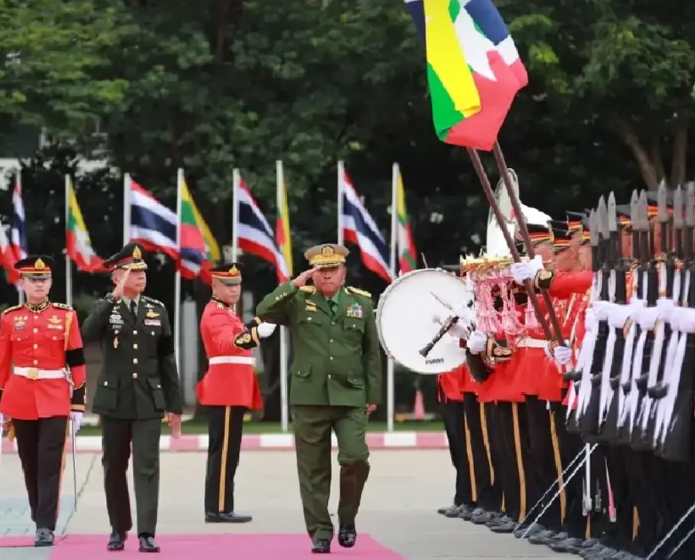
Thailand's military establishment rolled out formal state-level hospitality for Myanmar's military chief Ye Win Oo on Thursday, underscoring a decisive regional pivot toward engagement with Naypyidaw's post-coup leadership. The visit represents Ye Win Oo's maiden foreign trip since assuming his position and signals that Myanmar's junta, isolated internationally for five years following the 2021 overthrow of civilian government, is beginning to rebuild its standing through coordinated diplomacy with sympathetic neighbours.
Myanmar's military seized power in February 2021, removing an elected administration from office and detaining its most prominent figure, democracy icon Aung San Suu Kyi. The takeover unleashed a cascading humanitarian catastrophe. Armed resistance to military rule sparked a generalised civil war that humanitarian analysts estimate has claimed approximately 100,000 lives, while documented accusations against the military include systematic rights violations, extrajudicial killings, and displacement of vast civilian populations.
The junta attempted to restore its international legitimacy through elections conducted in early 2026, elections that the military designed with severely restrictive parameters explicitly excluding Suu Kyi's party and opposition figures. Following the ballot, the coup's original architect, General Min Aung Hlaing, transitioned from military chief to the ceremonial post of civilian president, a manoeuvre designed to present military rule wearing democratic clothing. He transferred military command to Ye Win Oo, a former intelligence officer and ardent loyalist with longstanding ties to the junta's security apparatus.
Thailand's welcoming of Ye Win Oo reflects a broader strategic calculation among Myanmar's immediate neighbours. The two nations share a 2,400-kilometre frontier that has become a flashpoint as civil war violence bleeds across boundaries, creating refugee flows, armed incursions, and security complications for Thai border communities. Thai military chief Ukris Boontanondha's hosting of Ye Win Oo, occurring barely weeks after Prime Minister Anutin Charnvirakul accorded Min Aung Hlaing a ceremonial state visit, demonstrates that Bangkok has consciously chosen pragmatism over principles.
Thai Foreign Minister Sihasak Phuangketkeow crystallised this calculation in stark terms, telling journalists that the decision to engage reflected "reality" rather than "legitimacy." The formulation is revealing. Thailand faces genuine border management challenges requiring coordinated action with Myanmar's military authorities, regardless of those authorities' international standing or domestic conduct. From Bangkok's perspective, diplomatic engagement serves tangible security interests—managing refugee populations, controlling arms trafficking, preventing militant group sanctuaries along the frontier—that outweigh reputational costs of association with a widely discredited military regime.
This regional realignment exposes fractures within international responses to Myanmar. Western democracies and human rights organisations have largely maintained critical stances, with the United States and others imposing sanctions on junta figures, including Ye Win Oo himself. The United Nations's Independent Investigative Mechanism released findings this month documenting that Myanmar's military continues escalating aerial bombardment of civilian areas, maintains patterns of arbitrary detention, and employs torture and sexual violence as instruments of control.
Yet Myanmar's neighbouring states—particularly those sharing land borders and facing direct consequences of the ongoing conflict—have adopted a competing logic. Thailand, along with Cambodia and Laos, have signalled willingness to normalise relations conditional on the junta's demonstrated restraint at borders and management of refugee populations. This calculus reflects developing nations' prioritisation of immediate security and stability concerns over compliance with international human rights frameworks or Western foreign policy preferences.
Myanmar's military dismisses international criticism as ideologically motivated misrepresentation. Government statements characterise UN findings as "one-sided allegations" grounded in "unverifiable and inaccurate information," a rhetorical posture designed to delegitimise investigative bodies while appealing to nationalist sentiments within Myanmar and sympathetic governments in the region. The strategy appears partially effective—Thailand's decision to host Ye Win Oo proceeded without meaningful domestic political backlash.
Human rights advocacy organisations have responded sharply to Thailand's diplomatic recalibration. The Special Advisory Council for Myanmar declared that Bangkok's embrace of Myanmar's military leadership represented a fundamental surrender of ethical consistency, suggesting that Thailand had "torched its credibility" and compounded its "ignominy" through successive diplomatic courtesies. These critiques highlight the tension between realist foreign policy calculations and principles-based international governance—a tension rarely resolved to satisfaction across both frameworks simultaneously.
The talks between Ye Win Oo and Ukris Boontanondha almost certainly focused on border security mechanisms, refugee management protocols, and coordination against armed groups operating across the frontier. For Myanmar's military, such agreements provide tangible legitimacy by demonstrating that neighbouring states treat it as a responsible governmental actor. For Thailand, similar arrangements offer practical tools for managing transnational security challenges without necessarily endorsing junta governance.
This diplomatic opening carries significant implications for Southeast Asian regional dynamics. If Thailand's example encourages other border states to normalise relations, Myanmar's military obtains breathing room to consolidate power without confronting unified regional isolation. Conversely, such engagement may create diplomatic incentives for the junta to moderate its conduct—though recent UN findings suggest military violence is instead intensifying rather than declining.
For Malaysian observers, Thailand's pragmatic realignment demonstrates how immediate security pressures can override commitment to regional human rights standards and democratic principles. Malaysia faces analogous border management challenges with Thailand itself and indirect complications from Myanmar's instability. Thailand's choice to privilege bilateral stability over international solidarity concerning Myanmar's junta suggests that regional governments increasingly view such alignment choices as separable from broader governance commitments—a calculation that shapes future regional cooperation frameworks and the weight assigned to humanitarian considerations within Southeast Asian foreign policy calculations.

