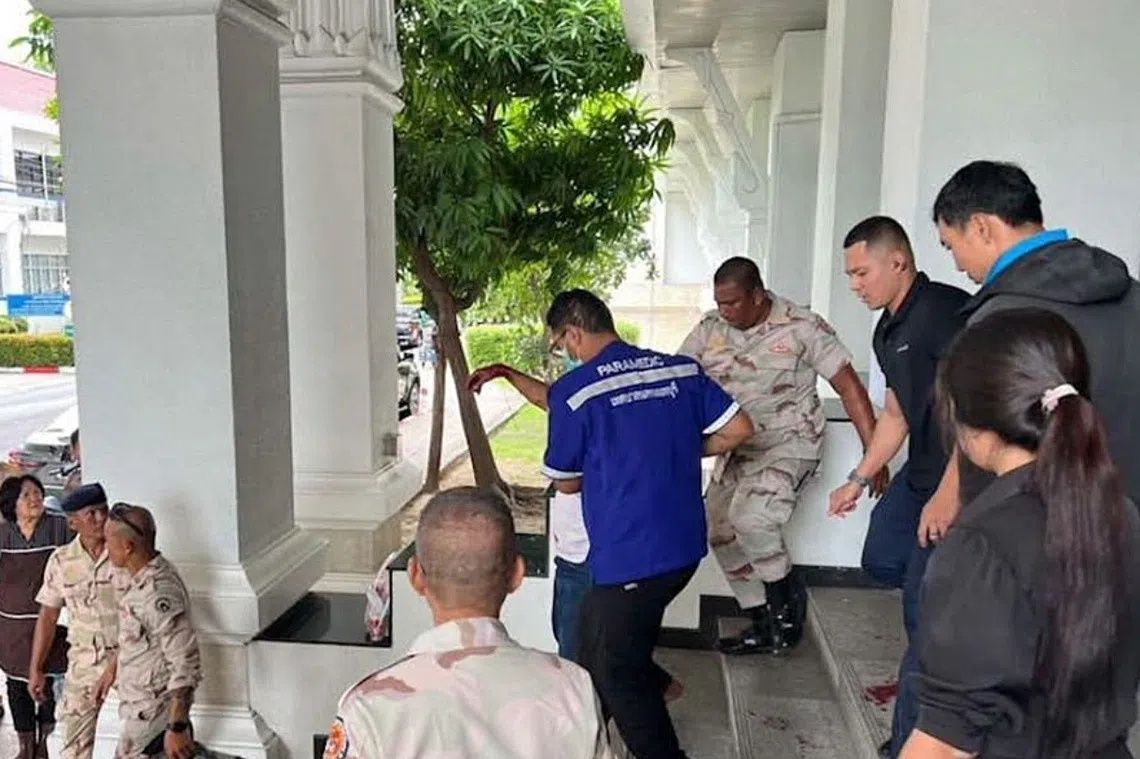
Thailand's fragile sense of security was shaken anew on Monday when a gunman opened fire at a government office on the outskirts of Bangkok, leaving two officials wounded and forcing the country to confront its escalating gun violence crisis. The shooting came barely three days after one of the nation's deadliest mass casualty incidents in nearly four years, when a teenager executed a calculated killing spree at a school in the same province. The back-to-back attacks have pushed firearms regulation to the forefront of national discourse and exposed serious vulnerabilities in how Thailand manages access to weapons.
According to provincial police commander Major General Dejrapee Kongdee, the suspect in the Monday incident is a former lawmaker who fired on a senior provincial official and the official's driver. Both victims were transported to hospital for emergency treatment. Security forces moved swiftly to apprehend the shooter, preventing what could have evolved into a prolonged hostage situation or larger loss of life. The arrest suggests law enforcement capabilities remain intact, though critics question why such an individual retained access to firearms given his political background.
The Monday attack occurred in the shadow of Friday's catastrophic shooting at Debsirin Nonthaburi School, where a 14-year-old boy killed nine people and wounded more than twenty others. The teenager's rampage began within his own household when he shot his grandparents, then proceeded to the school where he continued his violent spree before taking his own life. The incident represents Thailand's deadliest shooting in approximately four years and has exposed the psychological vulnerabilities of young people within Thai society, while simultaneously highlighting the terrifying ease with which firearms can be obtained and used.
The psychological toll on Thailand's population cannot be understated. Schools across the nation have implemented emergency security protocols, with some facilities installing metal detectors and conducting additional security screenings as students returned to classrooms on Monday. Parents who dropped their children at school gates faced the grim reality that educational institutions, traditionally perceived as sanctuaries, now require fortress-like defences. The normalisation of such security measures represents a profound shift in how Thais perceive public safety and institutional protection.
Prime Minister Anutin Charnvirakul has responded to the twin crises by reasserting his government's commitment to stricter gun control legislation. His public statements indicate recognition that the status quo is untenable and that meaningful regulatory reform must proceed urgently. However, translating political promises into concrete legislative action in Thailand's complex political environment remains uncertain. The country has experienced multiple constitutional transitions and shifts in governance structures, which have historically complicated policy implementation timelines.
The incident exposes troubling patterns within Thai society regarding firearm accessibility and ownership. That a former lawmaker retained the ability to carry and use a weapon raises fundamental questions about background checks, psychological evaluations, and ongoing compliance monitoring. Unlike many developed nations with rigorous permitting systems, Thailand's regulatory framework appears insufficient to prevent individuals with questionable judgment from accessing lethal instruments. The fact that both perpetrators in these sequential attacks were able to obtain firearms suggests systemic failures at multiple governmental levels.
Regional implications extend beyond Thailand's borders. Southeast Asian nations have generally struggled with managing proliferation of illegal and semi-legal firearms, particularly in areas with porous borders and weak enforcement mechanisms. Thailand's visible struggles with gun violence may influence policy discussions across the region, particularly in neighbouring countries that import or manufacture weapons. Malaysian and Indonesian policymakers monitoring the situation may find lessons applicable to their own contexts, where firearms-related crime, though less frequent, remains a persistent concern.
The economic and social disruption caused by these incidents ripples through communities far beyond immediate shooting sites. Tourism, a critical pillar of Thailand's economy, faces potential headwinds if international visitors perceive the country as increasingly dangerous. Educational institutions must invest in security infrastructure, diverting resources from academic programmes. Healthcare systems absorb costs associated with treating gunshot wounds and providing psychological counselling to trauma survivors and witnesses.
International observers note that Thailand's approach to this crisis will establish precedent for how other developing democracies respond to mass casualty events. The nation's handling of gun regulation reform, victim compensation, and psychological support systems will be studied by policymakers across Asia. Successful implementation of coherent gun control measures could position Thailand as a regional leader in addressing this preventable category of violence, while failure to act decisively would signal that even traumatic incidents cannot overcome entrenched interests opposing regulation.
The coming weeks will determine whether the government translates urgent rhetoric into legislative reality. Effective reform would necessitate comprehensive registration of existing firearms, stringent background check procedures, mandatory psychological evaluations for potential owners, and strict licensing requirements with regular renewal protocols. International best practices from jurisdictions that have successfully reduced gun violence offer blueprints, though Thai political and cultural contexts may require adapted approaches.
For Malaysia and other Southeast Asian nations observing Thailand's response, the situation underscores the importance of proactive rather than reactive policymaking. Thailand's tragedy illustrates how inadequate preventive measures ultimately prove far more costly than the political capital required to implement sensible restrictions before crises occur. The international community watches to see whether Thursday's shooting prompts genuine systemic change or merely temporary alarm followed by gradual return to insufficient oversight.

