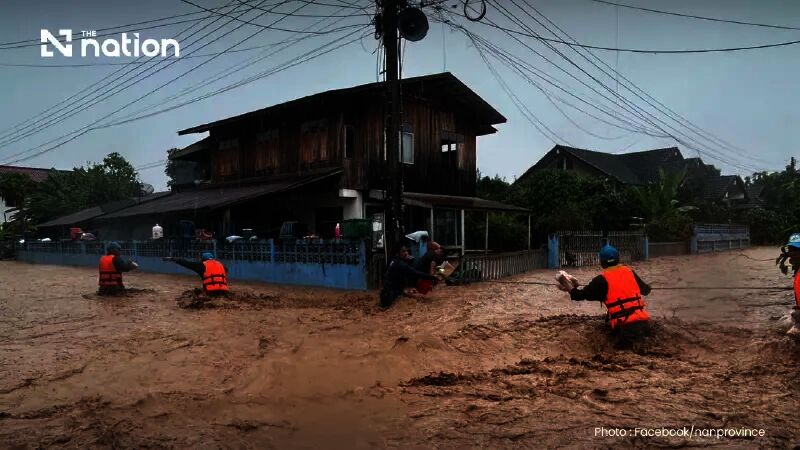
Thailand's government has activated emergency protocols across its northern region after declaring Nan province a formal disaster zone on Wednesday, responding to heavy rainfall and flash flooding that has disrupted transportation networks and displaced residents. Two neighbouring provinces, Phayao and Lamphun, have simultaneously been placed on heightened alert status as meteorological forecasts predict continued wet weather through the end of the week. The cascade of weather events reflects the intensity of the southwest monsoon season currently affecting mainland Southeast Asia, bringing the kind of extreme precipitation that has become increasingly familiar to Thai communities in recent years.
Prime Minister Anutin Charnvirakul is overseeing the national response despite being in Australia on official business, maintaining close contact with his cabinet and issuing direct instructions to mobilise all available resources. Government spokesperson Rachada Dhnadirek outlined the prime minister's comprehensive directive, which requires coordination across military units, civilian agencies, and local administration to mount an effective disaster response. This distributed command structure reflects Bangkok's recognition that flood management in Thailand now requires sustained, multi-agency engagement rather than ad-hoc crisis management.
The operational priorities established by Charnvirakul emphasise preventative deployment of response teams and heavy machinery to zones most vulnerable to flooding, aiming to address water accumulation before communities experience severe disruption. The approach signals a shift toward anticipatory rather than purely reactive disaster management, with pre-positioned equipment and personnel ready to intervene rapidly when rainfall intensifies. This strategy has become increasingly common in Thai flood management, building on lessons learned from the devastating 2011 national flooding that paralysed Bangkok and surrounding regions.
Vulnerable populations have received specific attention in the government's directives, with particular emphasis on safeguarding elderly residents, hospitalised patients with limited mobility, and children in flood-prone areas. Rapid assessment surveys of affected communities are underway to identify which households require evacuation assistance or emergency supplies. The focus on vulnerable groups reflects international best practices in disaster management and acknowledges that mortality and morbidity in flooding events typically concentrate among those with limited capacity to evacuate independently.
Rainfall and water-level monitoring systems have been placed on heightened alert, with authorities tasked with issuing timely warnings to communities if water volumes reach dangerous thresholds. This early warning infrastructure represents the technological backbone of Thailand's flood response apparatus, allowing residents to make evacuation decisions before roads become impassable. The Meteorological Department's August forecast, which predicted thunderstorms, localised heavy rain, and strong winds, has proven accurate, vindicating the decision to escalate alert levels across the northern region.
Deputy Prime Minister Yodchanan Wongsawat, who holds portfolio responsibility for northern flood management, issued a separate urgent directive to provincial governors in Nan, Phayao, and Lamphun, requiring comprehensive preparation measures including stockpiling of sandbags, positioning of pumping equipment, and pre-identified evacuation routes. This high-level directive underscores the severity of the situation and ensures that provincial administrators understand the national government's expectations for preparedness. The involvement of senior cabinet figures in flood response coordination reflects both the political salience of disaster management in Thailand and the genuine complexity of coordinating relief efforts across multiple provinces simultaneously.
The disaster declaration in Nan carries administrative significance beyond symbolic acknowledgment of the crisis. It triggers automatic release of emergency funds, authorises mobilisation of military assets for rescue operations, and establishes legal frameworks for emergency procurement and requisition of private resources if necessary. Provincial authorities gain expanded powers to issue evacuation orders, commandeer transport vehicles for rescue operations, and coordinate with the private sector. These mechanisms exist precisely because seasonal flooding in northern Thailand has become a predictable challenge requiring institutionalised response capacity.
Alerts extending through Friday across northern, north-eastern, and central Thailand indicate meteorological expectations for sustained wet weather over coming days. This temporal dimension is crucial for disaster management planners, who must anticipate that drainage systems may become overwhelmed if rainfall proves continuous rather than sporadic. Water accumulation effects are cumulative, with successive days of heavy rain preventing saturated soils from draining and allowing rivers to swell toward dangerous levels. Communities in historically flood-prone areas are receiving particular attention, as previous flooding events have mapped vulnerable terrain where drainage is naturally impeded.
For Malaysian observers, Thailand's flood response offers instructive parallels and contrasts to domestic disaster management. While both nations experience monsoon flooding as seasonal phenomena, Thailand's northern provinces face specific topographical challenges related to steep terrain and rapid runoff patterns that create flash-flood hazards distinct from Malaysian flood patterns. However, the Thai emphasis on vulnerable population protection, early warning systems, and pre-positioned response capacity reflects international best practices applicable across Southeast Asia. The scale of Thailand's current flooding response also illustrates why regional cooperation on transboundary water management and meteorological forecasting remains strategically important for all Mekong Basin nations, including Laos and Cambodia upstream, whose rainfall patterns influence Thai river levels.

