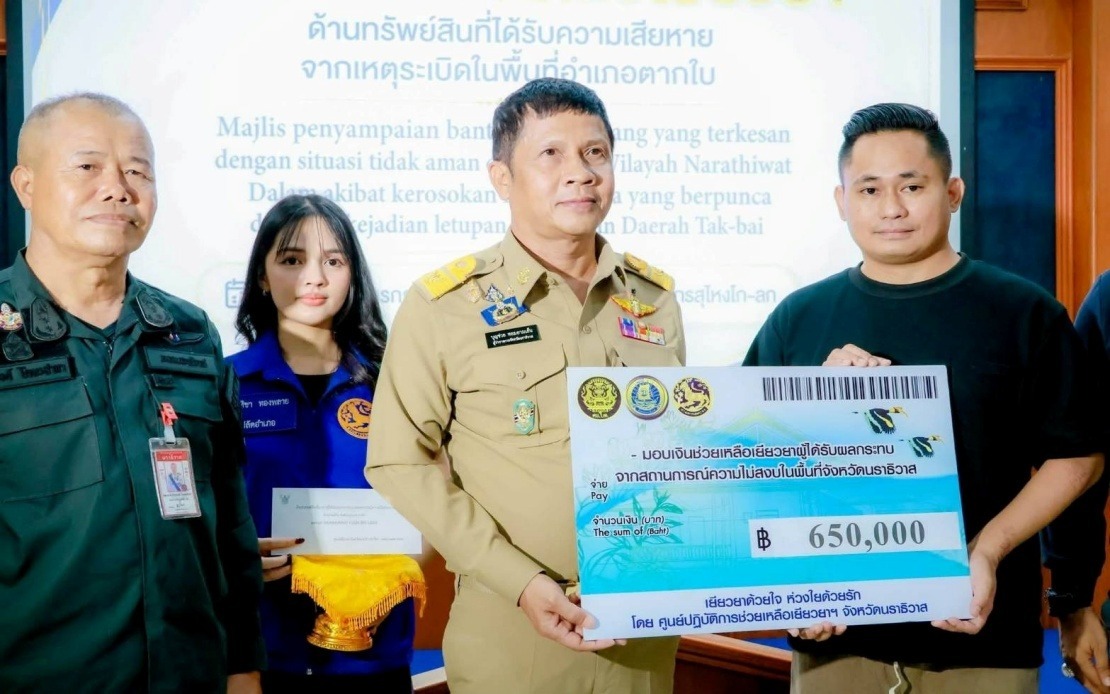
Thailand's government handed over 650,000 baht in compensation on Friday to a Malaysian national injured in a bomb explosion that struck the border town of Tak Bai in Narathiwat province on June 29. Muhammad Yusri Udin, 38, received the payment at a formal ceremony held at the Sungai Golok Customs Office, marking an official Thai response to the incident that wounded two Malaysian citizens without warning.
The roadside detonation occurred near the Sapom junction at approximately 11:40 am local time, when a homemade explosive device concealed within a drainage culvert suddenly ignited. Alongside Muhammad Yusri, Abdullah Syarapi Abd Rahman, 45, sustained injuries in the blast. Thai security authorities determined that the Malaysian pair were incidental victims rather than deliberate targets, suggesting the attack was intended for another objective altogether.
Narathiwat Governor Boonchuay Homyamyen expressed official regret over the incident during the compensation handover, emphasizing that the Thai administration views the attack as a serious breach of public safety. The governor stressed that the kingdom remains committed to protecting both resident populations and international visitors, particularly those transiting through southern Thailand's sensitive border regions where militant activity persists.
The 650,000 baht compensation originated from a dedicated Thai government fund established specifically to assist victims of security-related violence, encompassing both personal injury claims and property destruction cases. This formal mechanism demonstrates Bangkok's attempt to address collateral civilian harm resulting from insurgent operations in the volatile Deep South, an area that has experienced sporadic violence for decades.
Authorities have launched a comprehensive investigation following the explosion. Security forces detained a 40-year-old suspect and conducted extensive forensic analysis at the blast scene, alongside standard explosive ordnance disposal procedures to eliminate any remaining threats. These investigative steps reflect the Thai military and police's standard protocol when handling suspected militant activity in border provinces.
Governor Boonchuay committed to sustained efforts aimed at restoring visitor confidence in Thailand's tourism sector, acknowledging that security incidents in southern provinces can deter international travelers and damage economic activity. The statement carries particular weight given Thailand's heavy dependence on tourism revenue and its efforts to position the southern border region as accessible to foreign investment and visitors despite ongoing security challenges.
The incident underscores persistent instability in Thailand's southernmost territories, where a separatist insurgency rooted in decades of political and cultural grievance continues to generate sporadic violence. While large-scale coordinated attacks have diminished in recent years, smaller-scale bombings and shootings remain frequent enough to warrant continued international concern and diplomatic attention from neighboring nations like Malaysia.
For Malaysia, the incident illustrates the transnational dimensions of security threats in the region. Cross-border movement between the two nations occurs routinely through Tak Bai and other checkpoints, exposing Malaysian citizens to risks emanating from Thailand's internal conflict. The Thai government's prompt compensation and public commitment to enhanced security measures may reflect awareness of the need to maintain diplomatic goodwill with Malaysia while assuring its citizens of reasonable safety protections.
The compensation payment represents more than mere financial redress; it functions as a symbolic gesture acknowledging Thai responsibility for civilian welfare during security operations, even when victims are foreign nationals. Such gestures contribute to maintaining bilateral relations and preventing individual incidents from escalating into broader diplomatic friction between the two governments.
Thailand's Deep South remains an area where security incidents occur with irregular but persistent frequency. Previous bomb attacks, ambushes, and shootings have claimed numerous lives and caused extensive economic disruption to the region. International visitors, business travelers, and cross-border commuters continue navigating this environment despite the ongoing risks, making government-level assurances about protective measures and victim support genuinely consequential for regional confidence.
The detention of the 40-year-old suspect and ongoing forensic investigations may eventually clarify whether the attack was conducted by one of the established militant groups operating in the region or represented isolated extremist action. Such distinctions carry implications for broader security forecasting and the effectiveness of current counterinsurgency strategies employed by Thai authorities.

