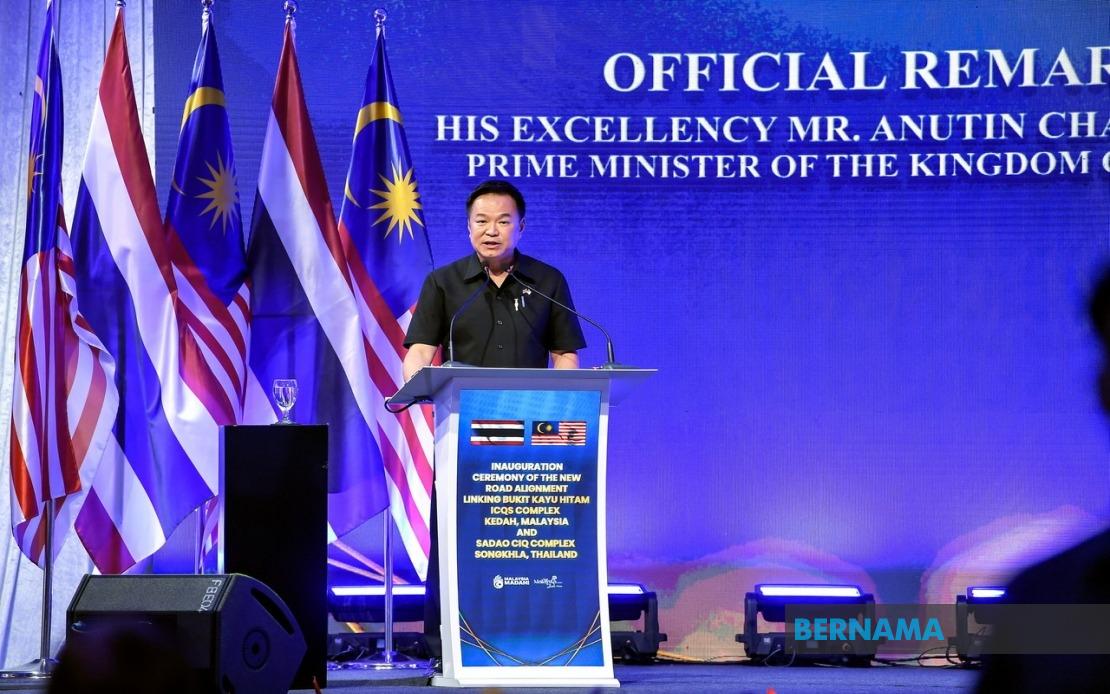
Thailand's government is moving decisively to bridge critical infrastructure gaps that have long constrained regional trade flows, with Prime Minister Anutin Charnvirakul unveiling an ambitious vision for seamless connectivity stretching from Malaysia through Thailand and into China and Russia. Speaking at the inauguration of a newly aligned road connecting the Bukit Kayu Hitam Immigration, Customs, Quarantine and Security Complex in Kedah with the Sadao Customs, Immigration and Quarantine Complex across the border, Anutin articulated a comprehensive strategy to position both nations as crucial nodes in an expanded continental trade network. The initiative, jointly officiated by Anutin and Malaysian Prime Minister Datuk Seri Anwar Ibrahim, represents the tangible outcome of sustained bilateral coordination aimed at dismantling the logistical barriers that have historically slowed commerce along one of Southeast Asia's busiest international borders.
The new road alignment constitutes more than a mere physical infrastructure improvement; it signals a fundamental shift in how Thailand and Malaysia approach their economic interdependence. By reconfiguring the route between the two border complexes, the governments have created a pathway that reduces unnecessary diversions and congestion at what remains the most heavily trafficked crossing along their shared frontier. For Malaysian traders and businesses, this development carries immediate operational significance, as the streamlined crossing promises faster clearance times and lower transit costs for merchandise destined for Thai markets. The bilateral cooperation reflected in this project underscores a recognition that border efficiency directly translates into competitive advantage for firms operating across the region, particularly for industries dependent on time-sensitive deliveries or perishable goods.
Anutin's rhetoric during the ceremony extended well beyond the immediate infrastructure achievement, framing the road alignment as a foundation for a far more ambitious connectivity architecture. His commitment to completing all missing transport links—a phrase laden with significance for regional planners—suggests Thailand intends to systematically eliminate bottlenecks along its primary trade corridors. The Prime Minister explicitly mentioned the possibility of goods flowing from Malaysia through Thailand to China and Russia, indicating that Bangkok's strategic thinking encompasses the entire continental landmass. This continental ambition aligns with Thailand's broader positioning within global supply chains and reflects the country's desire to capture value as a critical transit hub rather than remaining solely a market at the periphery of major trade routes.
The geographical scope of planned connectivity initiatives extends beyond the Bukit Kayu Hitam-Sadao corridor, with both governments identifying three additional cross-border linkage projects. The proposed connections between Songkhla and Kedah, Satun and Perlis, and Narathiwat and Kelantan represent a systematic effort to unlock economic potential across the entire border region rather than concentrating benefits in a single corridor. This multi-pronged approach acknowledges that southern Thailand and northern Malaysia possess distinct economic profiles and development needs, with varied industrial bases and agricultural outputs that could benefit from improved inter-regional integration. For Malaysian policymakers, particularly those focused on developing less-industrialised northern states like Kedah, Perlis and Kelantan, these initiatives promise to catalyse economic activity through enhanced market access and labour mobility.
The efficiency gains promised by improved border infrastructure carry particular resonance for Malaysia's manufacturing and agricultural sectors, which have long grappled with the friction costs imposed by cumbersome cross-border procedures. Enhanced connectivity to Thailand's supply chains could enable Malaysian firms to participate more effectively in regional production networks, particularly in automotive components, electronics and food processing. Conversely, Thai agricultural products and industrial goods could reach Malaysian consumers and businesses more cost-effectively, potentially intensifying competitive pressures within domestic markets while simultaneously creating opportunities for Malaysian retailers and distributors. The two-way flow emphasised by Anutin—allowing goods from Thailand and China to pass through Malaysia to Singapore and Indonesia—positions Malaysia as a beneficiary of the broader economic geography rather than merely a point of transit.
The border crossing at Bukit Kayu Hitam has long functioned as a critical pressure point in regional logistics networks, with congestion during peak periods creating significant delays for commercial traffic. The new road alignment specifically targets this congestion through design improvements that presumably incorporate modern checkpoint infrastructure and flow optimisation principles. For freight operators and logistics companies whose business models depend on predictable transit times, this development promises tangible benefits that directly improve profitability and service reliability. The reduction in congestion carries environmental implications as well, minimising vehicle idling time and associated fuel consumption while decreasing the carbon footprint of regional trade.
Anwar Ibrahim's participation in the inauguration ceremony underscores Malaysia's commitment to the broader regional integration agenda, despite the occasionally contentious nature of Malaysia-Thailand relations on other fronts. His presence alongside his wife Datuk Seri Dr Wan Azizah Wan Ismail, and Anutin's reciprocal gesture of bringing his wife Thananon Charnvirakul, injected a diplomatic symbolism that transcends mere infrastructure inauguration. These bilateral ceremonials serve important functions in building political capital for connectivity initiatives, which often require sustained commitment beyond single political cycles and across changes in government. The two leaders' public affirmations of commitment to resolving outstanding border issues and facilitating easier cross-border movement for citizens suggests a willingness to tackle procedural and administrative barriers that frequently prove more intractable than physical infrastructure.
Thailand's emphasis on completing missing links within a defined timeframe reflects growing recognition that regional competitiveness increasingly depends on logistical excellence. As supply chains throughout Southeast Asia become increasingly integrated and global competition intensifies, the countries that eliminate friction from trade and commerce gain measurable advantages in attracting investment and retaining existing economic activity. Thailand's strategic location makes it a natural hub, but that advantage only accrues if the government can reliably deliver efficient cross-border movements. Anutin's commitments therefore represent not merely gestures of goodwill toward Malaysia but investments in Thailand's broader economic positioning within Asia.
For Malaysian policymakers and business communities, the implications extend beyond immediate commercial considerations to encompass longer-term strategic alignment. Enhanced connectivity to Thailand inevitably increases Malaysia's exposure to Thai and ultimately Chinese economic dynamics, creating dependencies that carry both opportunities and risks. The three additional corridor projects under discussion will determine whether connectivity benefits are distributed broadly across northern Malaysia or concentrated in a few privileged zones. Regional development considerations thus become critical in evaluating how Malaysia structures its participation in these enhanced linkages, ensuring that benefits penetrate local economies rather than merely facilitating through-traffic.
The inauguration ceremony reflected a maturation of Malaysia-Thailand bilateral relations beyond periodic diplomatic incidents toward substantive cooperation on issues affecting daily economic life. Border communities, which frequently suffer disproportionately from poor infrastructure and restrictive crossing procedures, stand to gain most directly from improved connectivity. Enhanced job opportunities and improved cross-border commerce promise to revitalise economies in Kedah, Perlis and the northern regions that have sometimes felt peripheral to Malaysia's main economic centres. The emphasis on creating job opportunities and improving well-being for people living along the shared border suggests that both governments recognise connectivity as having social dimensions beyond mere trade facilitation.
Thailand's commitment to completing all missing transport links will require sustained investment and political resolve, particularly as infrastructure projects frequently face budget pressures, changing priorities, and implementation challenges. The success of the Bukit Kayu Hitam initiative will serve as a crucial test case for whether both governments can maintain momentum across the multi-year timeframes typically required for major corridor development. Malaysian stakeholders should monitor progress on the three additional connectivity initiatives to assess whether the enthusiasm expressed at the inauguration translates into concrete project execution. The regional economic implications of successful border infrastructure development could be substantial, potentially redefining trade patterns throughout northern Southeast Asia and creating new commercial opportunities for Malaysian enterprises positioned to capitalise on improved regional integration.

