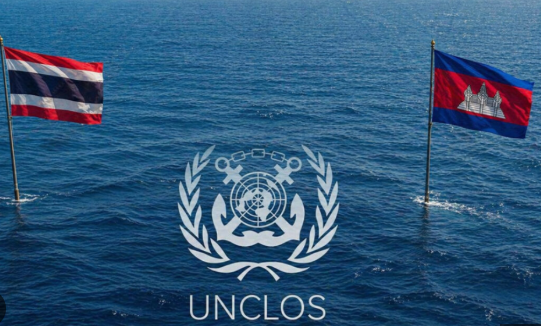
Thailand has formally accepted Cambodia's request to proceed with compulsory conciliation proceedings under the 1982 United Nations Convention on the Law of the Sea, responding to Phnom Penh's June 2 notification with its own formal submission on June 19. However, Bangkok has attached significant caveats to its participation, making abundantly clear that it views the process as a non-binding mechanism for narrowing differences rather than as a quasi-judicial forum that could produce enforceable outcomes. This carefully calibrated position reflects Thailand's determination to retain ultimate control over any settlement and to preserve the possibility of future negotiations should the conciliation recommendations prove unsatisfactory.
The Thai Ministry of Foreign Affairs has appointed Deputy Prime Minister and Foreign Minister Sihasak Phuangketkeow as its Agent in the proceedings, supported by Deputy Agent Songchai Chaipatiyut, Thailand's ambassador to Kuwait and a former official at the Department of Treaties and Legal Affairs. Thailand has also designated two conciliators: South African Judge Albert J Hoffmann and German Judge Rudiger Wolfrum, both acknowledged as internationally respected experts in maritime law. The conciliation mechanism calls for the four conciliators appointed by both countries to jointly select a fifth conciliator within 30 days who will chair the commission, which then has approximately 12 months to produce its findings.
Thailand's emphasis on the non-binding nature of conciliation reflects the inherent difference between this process and binding arbitration or litigation. Thai officials have stressed that the conciliators will function as neutral facilitators rather than adjudicators, tasked with understanding the historical context of the dispute, listening to both countries' positions, and proposing pathways toward mutual agreement. The final output will be a report containing recommendations that either party may accept, modify, or reject. This flexibility is explicitly enshrined in UNCLOS Annex V, which confirms that conciliation commission reports carry no legal force on the parties involved.
The underlying dispute concerns overlapping maritime territorial claims in the Gulf of Thailand, a body of water rich in natural gas and other hydrocarbon deposits that hold significant economic and strategic value for both nations. The conflict has historically intertwined two separate issues: the technical question of where the maritime boundary should be drawn, and the practical question of how to jointly develop and share the benefits of resources in overlapping zones. Thailand's insistence that conciliation focus exclusively on delimitation, rather than on provisional arrangements or resource-sharing formulas, reveals a strategic preference to compartmentalise the problem.
Cambodia's original notification to initiate conciliation appears to encompass not only the boundary question but also frameworks for joint development and equitable resource distribution, according to Thai assessments. Bangkok has rejected this broader framing, arguing that UNCLOS conciliation should address only the maritime boundary itself. This disagreement over scope may prove significant during the process, as the conciliation commission will need to establish clear parameters for its work. Thailand's position effectively limits what the conciliators can address, potentially sidelining resource-sharing questions that Cambodia considers integral to a comprehensive settlement.
Thailand's acceptance of conciliation must be understood against the backdrop of its May 2024 decision to terminate the 2001 memorandum of understanding with Cambodia, sometimes referred to domestically as MoU 44. That agreement had provided a framework for managing overlapping continental shelf claims for over two decades, yet Thai Prime Minister Anutin Charnvirakul characterised it as having produced minimal progress across 25 years of implementation. The Thai government framed the termination not as a hostile act but as a necessary adjustment of the bilateral cooperation structure, insisting that the step did not reflect conflict or a desire to abandon dialogue.
By simultaneously cancelling the old bilateral framework and accepting the new UNCLOS conciliation process, Thailand has effectively pivoted the dispute toward an international legal mechanism while maintaining that such international involvement remains subordinate to bilateral diplomacy. Officials have stated that UNCLOS now serves as the common reference point for future discussions, a formula that appeals to both countries' commitments to the convention while nominally preserving Thailand's room for manoeuvre. This approach allows Bangkok to demonstrate responsiveness to Cambodia's request while resisting any suggestion that it has ceded control over the ultimate resolution.
Cambodia's decision to invoke compulsory conciliation signals Phnom Penh's frustration with the pace of bilateral progress and its confidence that international legal processes favour its position. By pursuing conciliation rather than binding arbitration, Cambodia has chosen a middle path that respects state sovereignty while creating structured international involvement. Thailand's acceptance of this offer, coupled with its insistence on non-binding outcomes, suggests tacit agreement that some form of third-party assessment of the dispute's merits could be valuable, even if not controlling.
The 12-month timeline for the conciliation commission to produce its report represents a compressed schedule for addressing a dispute that has festered for decades. The commission's report, when delivered, will serve as a foundation for renewed bilateral negotiations rather than as a settlement in itself. This sequential approach—conciliation followed by negotiation—essentially grants both countries two opportunities to resolve the matter: once through the conciliators' recommendations, and again through direct talks informed by those recommendations. For Cambodia, the conciliation process offers a chance to obtain an independent assessment of the maritime boundary question that might strengthen its negotiating hand. For Thailand, it provides a safety valve that appears internationalist without obligating acceptance of unwanted outcomes.
The broader regional context amplifies the significance of this dispute. Southeast Asian maritime boundaries remain notoriously contested, with overlapping claims complicating relations among multiple nations. The Thai-Cambodian case demonstrates how smaller countries can leverage UNCLOS mechanisms to raise the stakes in bilateral disputes, compelling their counterparts to engage with international legal frameworks. Thailand's careful navigation of this process—accepting conciliation while rejecting its binding authority—may establish a template for how regional states can participate in international dispute resolution without surrendering the ultimate prerogative of sovereign decision-making.
For Malaysian observers, the Thai-Cambodian conciliation offers instructive lessons about maritime boundary management in Southeast Asia. Malaysia itself faces multiple overlapping maritime claims with neighbours and has generally favoured bilateral negotiation over international litigation. The Thai experience demonstrates both the utility of structured international processes in breaking diplomatic deadlock and the persistent weight of bilateral negotiation even when third parties are involved. As maritime resource competition intensifies across the region and international law becomes increasingly salient to territorial disputes, the approach taken by both Thailand and Cambodia may foreshadow how other regional disputes will unfold.