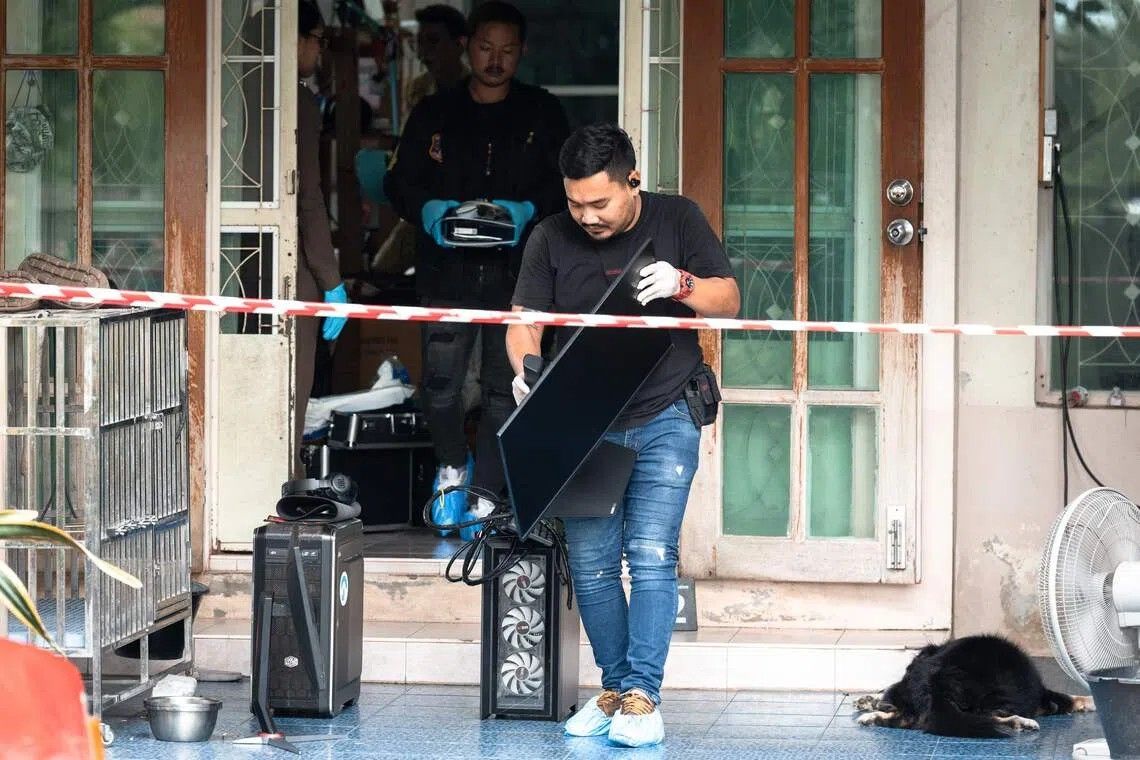
Thai police investigating the shooting at Debsirin Nonthaburi School have turned their attention to the digital footprint of the 14-year-old suspect, uncovering searches related to school shootings in the United States alongside his interest in violent computer games. The discovery marks a significant phase in the investigation as officers attempt to piece together the circumstances and psychological state that may have preceded the violent incident on August 7, with the teenager also suspected of killing his grandparents at their residence before proceeding to the school.
According to Wattana Yichin, commissioner of Provincial Police Region 1, investigators believe the suspect first fatally shot his grandparents at their home in Bang Khu Rat subdistrict, Bang Bua Thong district, in the early hours of August 7. Police discovered the bodies only after officers and forensic teams gained entry to the property. The front door had been secured from the outside, suggesting the teenager left the premises after committing the killings and made his way to the school where the shooting subsequently occurred later that morning.
Forensic examination of the suspect's computer has revealed patterns of behaviour that authorities are now analysing in detail. The preliminary investigation found that he regularly engaged with video games featuring violent content and, beginning around July 30, conducted internet searches seeking information about school shootings that had occurred in the United States. However, police have been careful to clarify that they have not yet established a causal link between these digital activities and the actual shootings, recognising that correlation does not necessarily indicate causation in such complex criminal cases.
Investigators are simultaneously pursuing multiple lines of enquiry to establish a comprehensive understanding of potential contributing factors. These include examining whether the teenager experienced any difficulties or conflicts at school, reviewing his social interactions, and assessing his mental and emotional state in the weeks preceding the incident. The approach reflects modern investigative practice that considers environmental, psychological, and social dimensions rather than attributing responsibility to singular factors.
Family members have provided authorities with background information that paints a portrait of a solitary adolescent with limited social engagement. The suspect's uncle described a young person who had lived with his grandparents since early childhood, spent considerable time isolated at home playing computer games, and maintained a withdrawn lifestyle generally. No family members reported awareness of disputes between household members or observable signs of psychological distress prior to the violence, complicating efforts to identify warning signs that might have preceded the tragedy.
Thananyaporn, the 60-year-old sister of the deceased grandfather, offered additional context about the family structure and relationships. The suspect's parents had separated years earlier, leading his grandparents to assume primary responsibility for his upbringing and care. She emphasised the close bonds between the three household members, characterising the grandparents as deeply affectionate towards the boy despite his withdrawn nature. The grandfather, a retired bank manager, was known for his gentle demeanour, while the grandmother worked as a teacher, suggesting a household environment with educational values and professional stability.
The teenager's social isolation appears to have been pronounced compared to peers of his age. Whereas other children typically maintain friendship groups and participate in recreational activities outside the home, this boy remained largely confined to the house, relying on computer gaming as his primary source of entertainment and stimulation. His grandfather provided daily transportation to and from school, but beyond these structured journeys, the boy engaged minimally with the wider community, a pattern that suggests significant psychological distance even within a seemingly supportive family unit.
The firearm used in the shootings was legally registered to the grandfather, meaning the teenager had access to a registered weapon within the home environment. This detail carries particular significance in the Thai context, where gun ownership is regulated and documented. The presence of a legally held firearm in a household containing a socially isolated adolescent with identifiable digital interests in violent content and school shooting incidents represents a convergence of risk factors that authorities are now examining for systemic implications.
The investigation remains in its active phase, with police continuing to establish a precise chronology of events on August 7 and to identify all factors that may have contributed to the violence. Thai authorities have not rushed to conclusions about causation, instead methodically examining the interplay between the teenager's social isolation, digital behaviour, family circumstances, access to weaponry, and any potential school-related grievances. This measured approach contrasts with some international cases where singular factors have been prematurely identified as explanations for mass violence.
The case has significant implications for Thailand's education system and broader society, raising questions about monitoring vulnerable adolescents, the availability of firearms in households with young people experiencing social isolation, and the role of online content in potentially radicalising or influencing vulnerable individuals. Educators and mental health professionals across Southeast Asia will likely scrutinise the warning signs that preceded this incident, seeking to identify intervention points that might prevent similar tragedies in future. The investigation's findings could influence policy discussions regarding school safety, digital literacy, gun registration protocols, and youth mental health services throughout the region.

