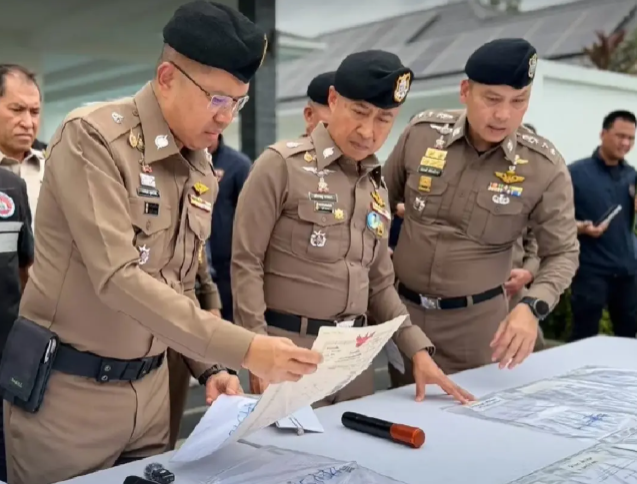
Thailand's national police force has intensified its campaign against foreign property schemes, arresting 13 foreign nationals during a major operation in Hua Hin that targeted 15 separate locations suspected of illegal land ownership arrangements. The raid, conducted on Monday in Prachuap Khiri Khan province, represents the sixth phase of a coordinated nationwide crackdown aimed at dismantling corporate structures used to conceal foreign beneficial ownership of Thai real estate. The operation involved more than 200 police officers and government officials, underscoring the scale and significance authorities have assigned to this investigation.
The arrested foreigners included three British nationals, four Chinese citizens, and one each from Italy, France, the Netherlands, Austria, the Philippines, and the United States. Courts had authorised arrest warrants for an additional 45 foreign nationals, while Thai police summoned 39 Thai nationals for questioning. Though the 13 individuals remain under investigation, none have yet faced charges in court. The operation was orchestrated by Deputy National Police Chief Pol Gen Samran Nuanma and led by senior officers including Pol Lt Gen Nopasil Poolsawat and Provincial Police Region 7 commissioner Pol Lt Gen Phisit Tanprasert, with support from the Prachuap Khiri Khan governor and officials from the Department of Business Development and Department of Lands.
The Hua Hin raids focused on a modern residential development in Thap Tai subdistrict featuring detached houses and pool villas individually valued between 10 and 20 million baht. This specific operation examined six companies allegedly establishing Thai nationals as nominee shareholders to facilitate foreign ownership. However, the broader investigation extends far beyond this single development, encompassing 33 companies suspected of holding land on behalf of foreign nationals. The total property value implicated in this wider probe reaches approximately 300 million baht, revealing the substantial financial stakes underlying these alleged schemes.
Investigators revealed that foreign nationals questioned during the operation claimed they had sought to acquire property in Thailand and consulted legal and accounting firms for guidance on complying with Thai law. These consultants reportedly advised the foreigners to establish corporate entities as a lawful mechanism for holding properties. Many of the accused believed such arrangements provided legitimate ownership structures that would withstand legal scrutiny. Police, however, found no evidence of genuine business operations by these companies, suggesting the corporate vehicles existed solely as property ownership shells.
The Thai nationals listed as shareholders in these companies provided remarkably consistent accounts to investigators, characterising themselves as passive participants in arrangements they scarcely understood. They testified that they had agreed to hold shares nominally on behalf of foreigners but never actually paid for those shares or exercised any management authority over the companies. None reported seeing financial documents, transaction records, or evidence of supposed investments bearing their names. This testimony reinforces police suspicions that the corporate architecture was deliberately engineered to obscure foreign control and beneficial ownership of the properties involved.
Police conducted extensive seizures during the operation, collecting company registration documents, accounting ledgers, computers, mobile phones, and electronic data storage devices from the targeted locations. Investigators plan to subject this material to detailed forensic examination, tracing financial transactions to identify additional participants, beneficiaries, and networks potentially involved in these schemes both within Thailand and internationally. The investigation will specifically examine whether government officials facilitated these arrangements through corruption or improper assistance, acknowledging that such schemes frequently require complicity or negligence within state institutions.
This Hua Hin operation extends a campaign that commenced with investigations on Koh Phangan in Surat Thani province, where authorities first examined nominee companies, law firms, and accounting networks allegedly coordinating property and tourism business control. Subsequent phases systematically expanded geographic coverage, with Phase 3 moving to southern tourist destinations including Phuket, Phang Nga, and Krabi, where authorities examined 89 land parcels and buildings valued at more than 1.05 billion baht. Phase 4 targeted Chonburi province, while Phase 5 focused on 31 companies and 29 land plots in Chiang Mai worth approximately 633 million baht.
The cumulative scope of the investigation across all five preceding phases has been remarkable, covering 233 plots of land and buildings spanning more than 160 rai—equivalent to more than 25.6 hectares—with a combined estimated value of 2.539 billion baht. This aggregate property portfolio demonstrates that nominee schemes have become systematically embedded within Thailand's property market, particularly in economically significant tourist zones where foreign demand for residential properties remains robust. Courts approved 133 arrest warrants from the earlier operations, and police reported that 20 cases had resulted in convictions, suggesting that while enforcement efforts are expanding, the judicial process remains relatively slow.
The continued geographical expansion of the crackdown reflects Thai authorities' recognition that these schemes are geographically dispersed rather than localised phenomena. Each new phase reveals fresh networks of companies, intermediaries, and participants engaged in similar arrangements across different regions. Police have explicitly framed this campaign as targeting illegal foreign business activity and unscrupulous nominee structures rather than legitimate foreign investors who operate within Thailand's legal framework. This distinction is significant because Thailand maintains strict regulations prohibiting foreign ownership of residential land whilst permitting foreign purchase of condominium units under specific conditions, creating legal incentives for foreigners to seek workarounds.
The international dimensions of these investigations underscore how the schemes operate as transnational networks rather than isolated incidents. The involvement of British, Chinese, Italian, French, Dutch, Austrian, Philippine, and American nationals suggests that such arrangements attract foreign buyers from multiple regions and economic backgrounds. Police signalled their intention to pursue these investigations through international channels, with investigators focusing on tracing financial flows and identifying overseas beneficiaries and facilitators. The Thai government has positioned this campaign as part of broader efforts to combat economic crimes and protect national sovereignty over resource allocation.
Authorities appealed to the public to report suspected illegal foreign business activity to local police stations or via the Royal Thai Police hotline at 1599, available continuously. This public engagement strategy reflects recognition that such schemes require extensive grassroots coordination, documentation, and transaction activity that community members often observe but rarely report to authorities. By opening direct reporting channels, Thai police aim to develop intelligence networks that can supplement formal investigative capabilities. The nationwide scope of the announced intentions and the multi-agency coordination demonstrated in the Hua Hin operation suggest that Thailand's authorities have committed sustained resources to dismantling these schemes across all major tourist and expatriate population centres.

