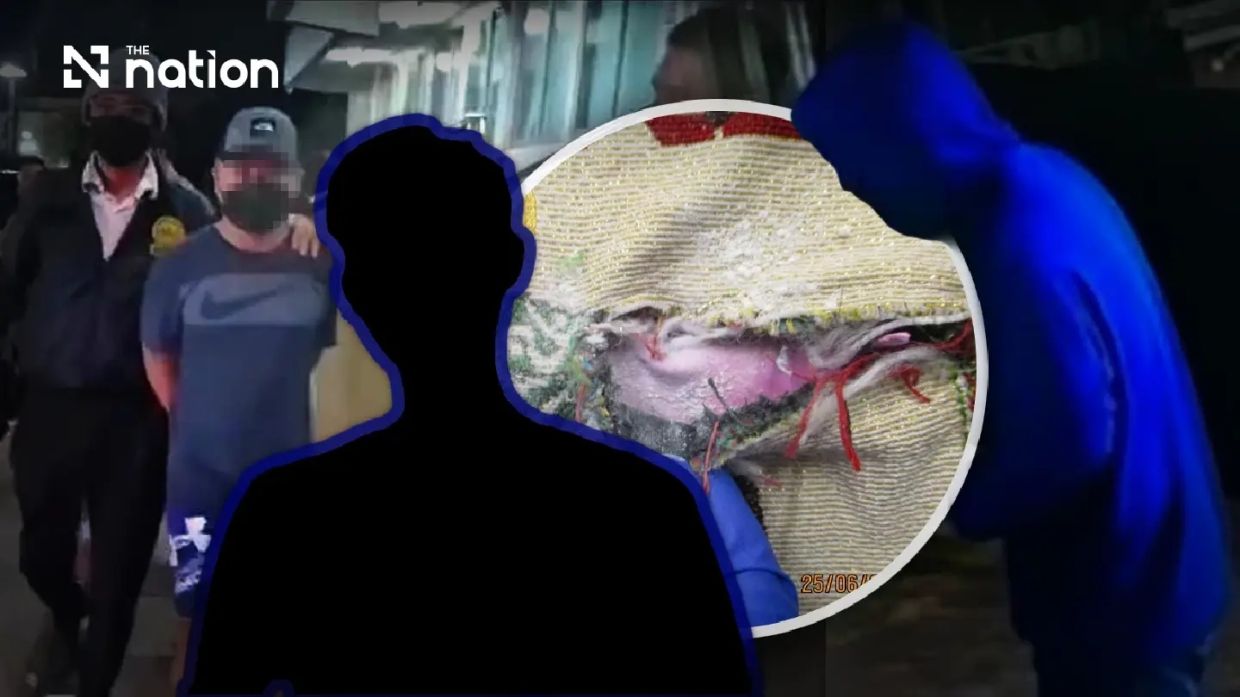
Thai police have widened their crackdown on an international heroin trafficking ring after arresting a man they believe acted as a crucial intermediary between drug suppliers and couriers. The arrest of Ekkawit in Phayao overnight represents a significant development in the investigation into heroin discovered hidden inside an elephant-print fabric bag destined for Australia, according to Pol Maj Gen Theeradej Thamsuthee, deputy commissioner of the Metropolitan Police Bureau.
The operation being dismantled appears to involve a coordinated chain of handlers passing contraband between supply points and international couriers. Police allege that Ekkawit collected the heroin-laden bag from a supplier and delivered it to a man identified only as Uthai, who wore a blue hood during his earlier arrest. Uthai subsequently passed the package to Mina, a flight attendant, who was tasked with carrying it to Australia. The network's use of pseudonyms and encrypted chat applications—Ekkawit communicating under the name "Rin Rin" and receiving instructions from someone using "Rose Rose"—demonstrates the operational security measures employed by those orchestrating the smuggling.
During initial questioning, Ekkawit disclosed that he undertook the intermediary role for THB100,000 per operation. He acknowledged having performed this function between two and three times previously, suggesting the network had established a working model for recruiting handlers willing to participate in international drug smuggling. The suspect admitted to purchasing the elephant-print bag himself in Chiang Mai, following instructions relayed through chat channels. This seemingly innocuous item became the vessel for concealing narcotics destined for distant markets.
The operational structure uncovered by investigators reveals a deliberate compartmentalisation designed to insulate senior figures from direct involvement in street-level transactions. According to police, Ekkawit would purchase the bag in Chiang Mai and leave it at a predetermined kilometre marker. An associate working under the Rose Rose identity would then arrange for the bag to be collected and the heroin concealed inside—though Ekkawit claimed this occurred in Laos, a claim police viewed sceptically. After the drugs were hidden, Rose Rose would coordinate Ekkawit's retrieval of the package, along with THB100,000 cash compensation left at another kilometre marker.
The payment structure further illustrates the network's systematic approach. After obtaining the heroin-filled bag, Ekkawit would arrange for Uthai to receive it and compensate him with THB60,000 deposited through a cash machine, maintaining distance from face-to-face transactions. This method of payment through automated systems rather than direct handovers minimises exposure and creates a layer of operational security. Police believe this structure has allowed the network to conduct multiple successful smuggling operations without detection until now.
Investigators have identified Rose Rose as someone with familial ties to Ekkawit, with both individuals hailing from Phayao province. Photographs show the two travelling together, suggesting the network may rely on family connections to maintain trust and operational cohesion. However, police do not regard Rose Rose as the mastermind orchestrating these activities. Instead, narcotics officers believe a higher-ranking organiser remains above Rose Rose in the hierarchy, someone who has thus far avoided direct involvement in the apprehension phase. This assessment indicates that even with Ekkawit's arrest, the core of the smuggling operation likely remains operational.
Ekkawit's arrest comes as police intensify scrutiny of Uthai, the suspected courier liaison who faces questioning regarding his repeated involvement in similar operations. Uthai initially claimed to have carried out the work five or six times, but investigators suspect this figure substantially underestimates his actual involvement. The discovery that Uthai rented accommodation in Phra Nakhon Si Ayutthaya province for at least five to six months suggests he may have functioned as a permanent resident handler coordinating multiple shipments. Police doubt the veracity of Uthai's initial account, suspecting he had rehearsed his responses before arrest to mislead investigators.
The central figure in coordinating communications remains the person operating the Rose Rose profile. Despite maintaining an anonymous account, narcotics police report obtaining detailed information about this individual's identity and operational methods. Rose Rose appears to function as the organisational hub, using chat messages to contact and coordinate with various willing couriers and handlers. Mina, the flight attendant allegedly hired to carry the heroin to Australia, was recruited through Rose Rose's direct contact. This suggests the network has developed protocols for identifying and recruiting individuals in transportation sectors with access to international routes.
The use of flight attendants as couriers represents a calculated strategy within international drug smuggling. Aviation personnel possess legitimate access to international travel, reduced scrutiny at certain checkpoints, and the ability to move between countries regularly without arousing suspicion. By identifying and recruiting individuals in such positions, networks can establish reliable supply chains to distant markets like Australia. The discovery of this particular operation raises questions about how thoroughly airline staff undergo security screening and whether enhanced protocols might be warranted.
Police transferred Ekkawit to the Narcotics Suppression Bureau for intensive questioning, with Pol Gen Samran Nuanma, deputy national police chief, scheduled to conduct personal interrogation upon his arrival on Friday evening. The involvement of such senior police figures indicates the case's significance within Thailand's broader counter-narcotics framework. The investigation's expansion aims to identify and apprehend remaining network members, from the operational coordinator Rose Rose to the suspected mastermind believed to oversee the entire smuggling enterprise.
For Malaysian readers and Southeast Asian observers, this case underscores the sophisticated methods employed by international drug trafficking networks operating across the region. Thailand's geographical position, extensive borders with Laos, and established transportation infrastructure make it a crucial node in heroin distribution networks extending from the Golden Triangle production zones toward markets in Australia, Europe, and beyond. The arrest reveals how organised crime groups exploit legitimate professions—flight attendants in this instance—and family networks to establish redundancy in their operations. As long as demand persists in distant markets and profit margins remain substantial, such networks will continue adapting their methods to evade law enforcement.

