Thai law enforcement officials have arrested a husband-and-wife team in Loei province as investigators expand their scrutiny of what appears to be a sophisticated transnational narcotics operation. The detention follows the apprehension of a Thai Airways flight attendant, identified in Thai media reports as Mina, by Australian federal police at Melbourne Airport. The attendant was accused of carrying approximately one kilogram of heroin in her checked baggage, prompting Thai authorities to trace the supply chain back to its source within the kingdom.
The investigation represents a significant escalation in Thailand's efforts to combat international drug smuggling networks that exploit vulnerable individuals in the aviation sector. When Australian customs officials discovered the heroin cache at Melbourne Airport, Thai counternarcotics agencies immediately initiated a parallel inquiry to identify who had arranged and dispatched the contraband. This coordination between Thai and Australian law enforcement demonstrates the increasingly coordinated approach nations are taking towards transnational drug operations that rely on commercial flight routes and airport infrastructure.
Operatives from Chiang Khan Police Station, working alongside the Office of the Narcotics Control Board and related police units, initially visited a residence in That subdistrict of Chiang Khan district on Thursday, July 2, acting on intelligence that the couple maintained ties to the area. Finding the house vacant, investigators determined that Athit, 43, and his wife Thatsaphon, 42, had travelled to work in agricultural labour. This pattern—suspected narcotics couriers engaged in ordinary employment—underscores the concealment techniques used by drug networks, which deliberately blend suspects into the local workforce to evade detection.
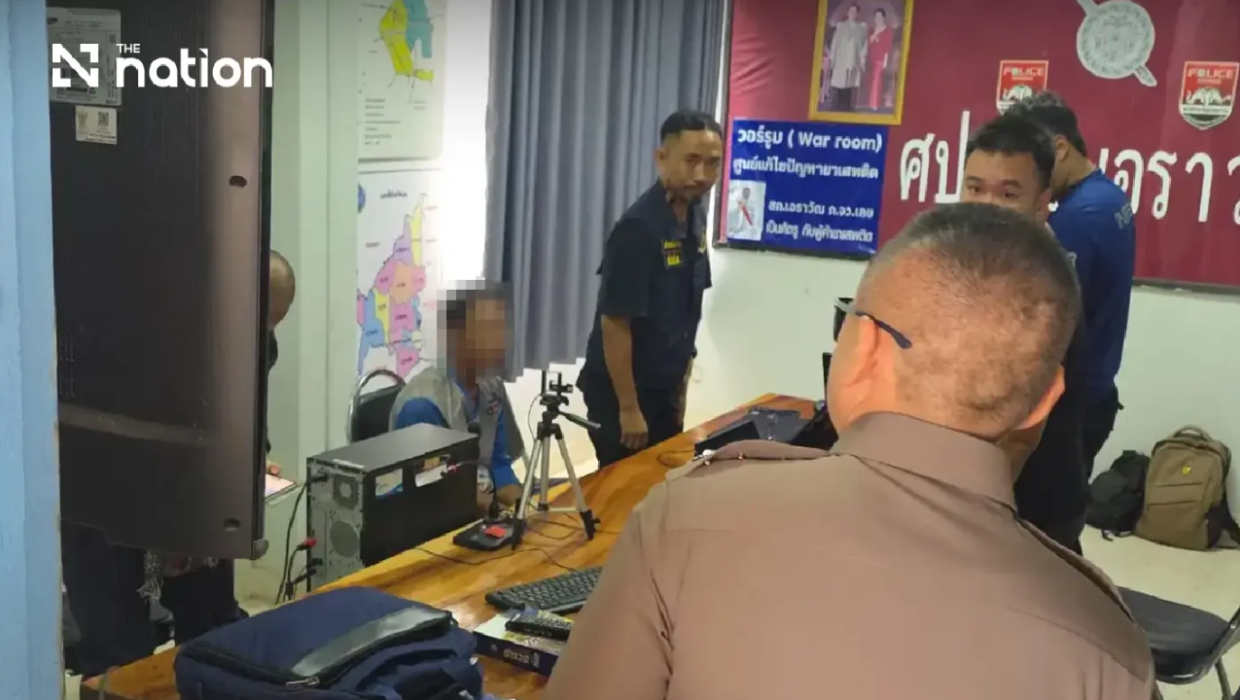
Police successfully located Athit at Wat Tham Pha Mak Ho temple in Wang Saphung district, where he was working on roof repairs. Following his transfer to Erawan Police Station, Athit confessed during questioning to having been engaged in parcel delivery operations on multiple occasions. He acknowledged accepting payment of 8,000 baht (approximately US$240) per shipment from a Laotian national, completing six such deliveries in total. According to the investigation, three parcels were dispatched through a commercial parcel service operating in Chiang Khan, with two originating from Ban That locality and one from Erawan district. The most recent transfer occurred on June 28, 2026, suggesting an active and ongoing operation.
Thatsaphon was apprehended separately after authorities located a black Mitsubishi Triton pickup truck with Loei registration parked in a rubber plantation within Erawan district. The discovery of the vehicle, combined with intelligence linking her to the distribution network, prompted her arrest for questioning at Erawan Police Station. During preliminary interrogation, Thatsaphon denied any participation in or knowledge of the alleged smuggling scheme, though her detention indicates investigators possess evidence suggesting her involvement in facilitating the operation.
The case demonstrates the layered structure typically employed by international drug trafficking organisations to insulate higher-level operatives from direct exposure to contraband. By utilising individuals at different points along the supply chain—from local couriers collecting parcels to international mules boarding commercial flights—trafficking networks create plausible deniability and complicate law enforcement investigations. The husband-and-wife team in this instance appears to occupy a mid-level position, collecting parcels and arranging their transportation to transit points where airline employees could integrate them into passenger luggage destined for Australian markets.
Investigators are now pursuing a broader inquiry to identify additional participants in the network, particularly those responsible for organising the operation, financing the deliveries, and orchestrating coordination with the Thai Airways employee at Melbourne Airport. The Office of the Narcotics Control Board has indicated its intention to pursue legal action against all individuals implicated at every level of the operation, reflecting a comprehensive approach to dismantling transnational trafficking cells rather than simply arresting street-level participants.
The ONCB secretary-general publicly acknowledged that the case exemplifies evolving methodologies employed by organised crime syndicates attempting to exploit international aviation routes and personnel. The agency emphasised that successful detection of the Melbourne shipment resulted from cooperative intelligence-sharing between Thai and Australian law enforcement authorities, highlighting the necessity of cross-border coordination in combating sophisticated drug networks. Thailand's participation in intelligence exchanges and joint investigations with foreign partners has proven essential in identifying links and supply-chain vulnerabilities that remain invisible within national borders alone.
Moving forward, Thai authorities have committed to intensifying investigations while simultaneously strengthening institutional cooperation with international counterparts. The ONCB's strategy encompasses intercepting narcotics in transit, disrupting established trafficking routes, and disrupting financial mechanisms that sustain criminal operations—a three-pronged approach aligned with the Thai government's overarching drug-suppression policy. The agency recognises that combating transnational narcotics requires not merely reactive law enforcement responses to individual cases but rather proactive intelligence gathering and route interdiction capabilities.
For regional observers, the case underscores the vulnerability of Southeast Asian aviation hubs to drug trafficking exploitation. Thailand's geographic position, combined with its status as a major international travel destination, makes Bangkok and its surrounding airports frequent transit points for narcotics destined for markets in Australia, East Asia, and North America. The reliance on lower-level couriers drawn from economically disadvantaged communities in northeastern Thailand reveals how poverty and financial desperation create recruitment opportunities for trafficking networks capable of offering substantial immediate payments to individuals with limited legitimate income prospects.
The investigation also highlights the risks posed to aviation sector workers, particularly flight attendants from developing nations who may face pressure or inducement to participate in smuggling operations. The apparent involvement of a Thai Airways employee suggests that international airlines operating within Southeast Asia remain targeted by trafficking organisations seeking to exploit staff members' access to passenger baggage and immigration procedures. This vulnerability extends across the region's carriers, creating pressure on airport operators and aviation companies to enhance security protocols and staff vetting procedures.
As the case progresses through Thailand's criminal justice system, it will provide valuable intelligence regarding broader trafficking networks operating between Southeast Asia and Australia. The cooperation demonstrated in this investigation serves as a template for future bilateral and multilateral efforts to address the region's persistent narcotics challenge, demonstrating that sustained pressure on transnational operations requires sustained commitment from multiple agencies working across jurisdictional boundaries.

