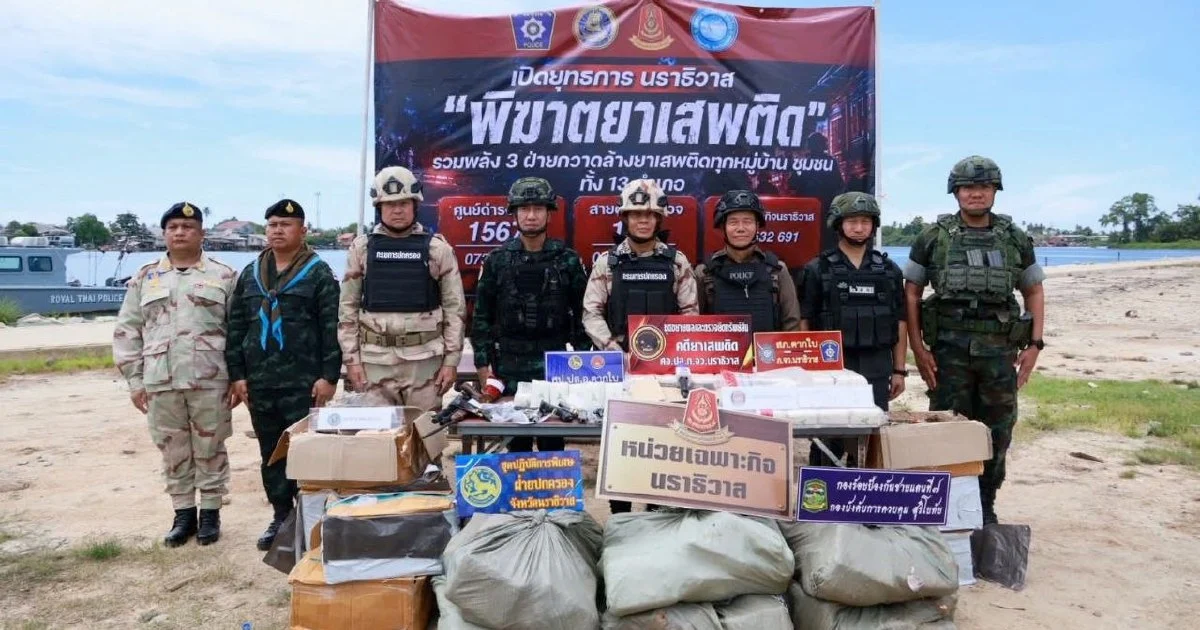
Thai law enforcement has dismantled a significant portion of the drug trafficking infrastructure operating across the Thai-Malaysian border after apprehending 233 suspected members of organised narcotics syndicates during an intensive month-long operation in Narathiwat province. The scale of the operation underscores the growing challenge posed by transnational criminal networks in Southeast Asia, where geography and porous border controls create conditions favourable to smuggling operations.
The arrests made in Narathiwat, Thailand's southernmost province adjacent to Malaysia's Kelantan state, revealed that some of the detained individuals maintained active connections with Malaysian drug trafficking organisations. This finding highlights the deeply integrated nature of narcotics trade across the Malay Peninsula, where supply chains operate seamlessly despite existing border security measures. The collaborative networks between Thai and Malaysian traffickers represent a persistent vulnerability in regional law enforcement efforts.
Narathiwat province has long served as a crucial transit point for illegal drugs moving between Thailand and Malaysia, making it a focal point for authorities determined to disrupt smuggling operations. The province's proximity to Malaysian territory, combined with its complex terrain and historical instability in parts of the southern region, has made it an attractive base for criminal organisations seeking to move contraband across the border. The month-long crackdown represents a coordinated effort to address this persistent security concern.
The operation reflects Thailand's renewed commitment to combating drug trafficking at a time when methamphetamine and other synthetic narcotics have become endemic problems across the region. The scale of arrests—233 individuals—demonstrates the vast human infrastructure required to sustain smuggling operations, encompassing not just manufacturers and distributors but also couriers, lookouts, and logistical coordinators. Breaking up these networks, even temporarily, disrupts supply chains and increases operational costs for criminal enterprises.
For Malaysian law enforcement agencies, the Thai operation provides valuable intelligence about trafficking patterns and the identities of local individuals involved in transnational smuggling. Cross-border cooperation between Thai and Malaysian authorities has improved substantially in recent years, though information sharing and coordinated operations remain challenging due to differences in investigative protocols and jurisdictional complexities. The Narathiwat crackdown demonstrates that bilateral efforts, when sustained, can yield significant results.
The involvement of Malaysian-connected suspects raises important questions about the extent of domestic narcotics syndicates' international reach. Malaysian trafficking organisations have increasingly expanded operations into neighbouring countries, establishing distribution networks and sourcing arrangements that span multiple jurisdictions. Understanding these connections is critical for Malaysian law enforcement in identifying targets for prosecution and dismantling the upper echelons of criminal hierarchies.
The arrest of 233 individuals will inevitably lead to follow-up investigations in both Thailand and Malaysia as authorities seek to trace the flow of drugs and money through the supply chain. Such investigations often uncover additional layers of criminal organisation, revealing relationships between suspects and identifying previously unknown participants in trafficking networks. Intelligence gathered from detainees can prove invaluable in targeting major distributors and financiers operating in Malaysia.
Economic analysis of the Thai crackdown suggests that while disrupting local smuggling operations produces tangible short-term benefits, the fundamental demand for drugs—particularly methamphetamine—across Southeast Asia ensures that criminal networks will quickly seek to reconstitute themselves. The profitability of drug trafficking, driven by substantial price differences between production countries and consumer markets, incentivises rapid recruitment and reorganisation of networks after law enforcement actions.
The month-long operation in Narathiwat also demonstrates the resource-intensive nature of effective drug enforcement, requiring sustained police presence, informant networks, and coordination with border agencies. Maintaining such operations over extended periods strains police budgets and personnel in developing countries, creating pressure to shift resources between different provinces and regions. Thai and Malaysian authorities must therefore balance intensive targeted crackdowns with maintenance of routine enforcement capacity elsewhere.
For Malaysian citizens and residents, the Thai operation carries implications for local drug availability and prices. Successful disruptions of supply chains typically result in temporary shortages and price increases in end markets, though the duration of such effects depends on how quickly criminal organisations restructure operations. The crackdown may provide temporary relief in Malaysian communities affected by methamphetamine addiction, though sustained reduction in drug availability would require equally intensive enforcement within Malaysia itself.
The arrests also underscore the importance of regional cooperation frameworks that enable authorities to pursue suspects across borders and share intelligence systematically. Organisations like the ASEAN Regional Forum on drug trafficking and the various bilateral agreements between Thailand and Malaysia provide institutional frameworks for coordination, though their effectiveness depends heavily on political will and adequate resourcing. The Narathiwat operation represents positive utilisation of these mechanisms.
Moving forward, the challenge for Southeast Asian law enforcement lies in transitioning from episodic crackdowns to sustained, intelligence-led operations that target the financial and logistical infrastructure underpinning transnational trafficking. While the arrest of 233 individuals demonstrates significant operational capacity, long-term progress against organised narcotics syndicates requires addressing root causes—including poverty, corruption, and demand reduction—that sustain trafficking networks across the region.

