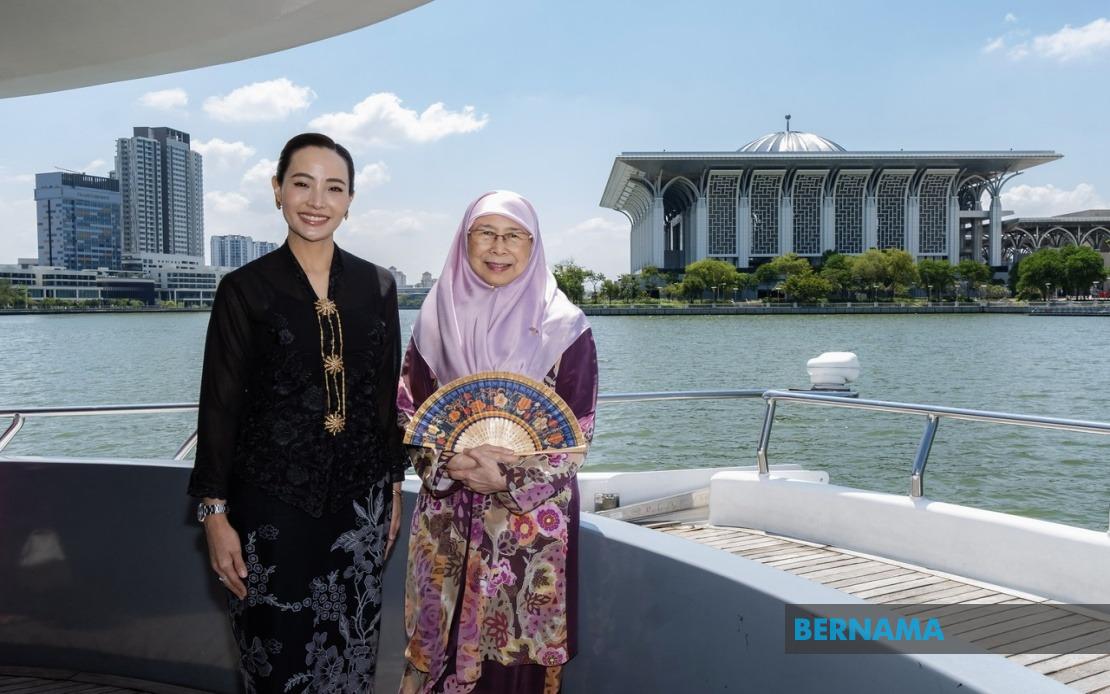
Thailand's Prime Minister Anutin Charnvirakul and his wife Thananon Charnvirakul landed in Malaysia on Thursday for a two-day official state visit, marking the Thai leader's first trip to the country in his capacity as prime minister since his reappointment to the post in March 2026. The visit underscores the enduring commitment both nations have made to deepen their bilateral relationship and unlock fresh avenues for cooperation across sectors of shared significance.
Immediately after their arrival at Kuala Lumpur International Airport, where they were formally received at the Bunga Raya Complex with full ceremonial honours, the Thai delegation proceeded to Putrajaya. There, Thananon embarked on a leisurely 45-minute cruise across Tasik Putrajaya shortly after midday, giving her an intimate vantage point from which to observe the carefully planned landscape and architectural landmarks that define Malaysia's purpose-built administrative centre.
Greeting the Thai First Lady upon her arrival at approximately 12.10 pm was Datuk Seri Dr Wan Azizah Wan Ismail, wife of Prime Minister Datuk Seri Anwar Ibrahim. The reception reflected the warmth and formality expected between the spouses of two regional leaders, with both women engaging in substantive conversation as they traversed the lake's scenic route. Minister Hannah Yeoh, who holds the portfolio of Minister in the Prime Minister's Department overseeing Federal Territories, was also present to facilitate the visit and represent the Malaysian administration.
The cruise itself served as a cultural and diplomatic exchange, allowing Thananon to absorb the distinctive character of Putrajaya from a vantage point that showcases the capital's deliberate urban planning and signature landmarks. The serene waters of the man-made lake offer unobstructed panoramas of government buildings, monuments, and public spaces that collectively represent Malaysia's vision for a modern administrative hub. Such informal diplomatic moments—when senior figures experience a nation's identity through its physical environment—often prove influential in shaping perceptions and fostering personal connections between delegations.
The timing of Anutin's visit carries particular significance for Southeast Asian regional dynamics. Thailand and Malaysia share a 641-kilometre land border and have longstanding historical, cultural, and economic ties. Both nations are ASEAN members with overlapping interests in maritime security, trade liberalisation, and transnational development challenges. The Thai premier's decision to prioritise Malaysia as his destination following his reappointment signals confidence in the bilateral relationship and suggests his administration intends to pursue an active engagement strategy with key regional partners.
Anutin's previous political trajectory has been unconventional within Thai governance. His return to the prime ministerial office in March 2026 came after a period of political flux in Thailand, where coalition-building and military-influenced political arrangements have characterised recent transitions of power. His explicit acceptance of Anwar's invitation to visit demonstrates a willingness to normalise diplomatic engagement and project an image of stability and forward-looking governance to Thailand's neighbourhood.
For Malaysia, receiving the Thai delegation during this particular moment reflects Anwar Ibrahim's broader foreign policy emphasis on strengthening ASEAN solidarity and regional cooperation networks. Since assuming office, Anwar has made diplomatic outreach a cornerstone of his administration's identity, positioning Malaysia as a stabilising force and reliable partner within the region. Hosting high-level visits from neighbouring countries and allocating personal time for such engagements demonstrates this commitment tangibly.
The two-day visit itinerary suggests a comprehensive programme designed to showcase Malaysian governance, economic achievements, and institutional functioning to the Thai leadership. Beyond ceremonial elements, such visits typically include ministerial-level discussions, bilateral meetings between leaders, and working sessions focused on specific areas of cooperation. For observers of Southeast Asian affairs, the substantive outcomes of these meetings—whether in trade agreements, security cooperation, or people-to-people exchange programmes—will be more consequential than the ceremonial dimensions alone.
Thananon's participation in such activities underscores a modern diplomatic convention wherein the spouses of heads of state function as active elements of state delegations rather than purely ceremonial accompaniments. Her engagement with the Putrajaya landscape and interaction with Dr Wan Azizah signals Thai recognition of Malaysia's institutional achievements and demonstrates reciprocal respect between the two administrations. Such personal diplomatic moments, while appearing routine, contribute to the texture of bilateral relationships and can influence the tone of official negotiations that follow.
The visit occurs amid a period of relative stability in Thai-Malaysian relations, following periods when border security challenges and bilateral disagreements had strained connections. In recent years, both governments have worked toward collaborative approaches to shared security concerns and have expanded economic ties through various ASEAN-led frameworks. Anutin's visit represents a continuation of this positive trajectory and an opportunity to reset expectations and deepen commitments across multiple domains.
Looking forward, the practical outcomes of this state visit will likely include renewed bilateral commitments on trade facilitation, potential expansions of existing cooperation agreements, and possibly new frameworks for addressing emerging regional challenges. For Malaysia and Thailand alike, strengthening this relationship remains strategically important given the evolving geopolitical environment in Southeast Asia. The formal reception accorded to Anutin and the attention lavished on his wife's programme indicate that both sides view this engagement as consequential rather than merely perfunctory.

