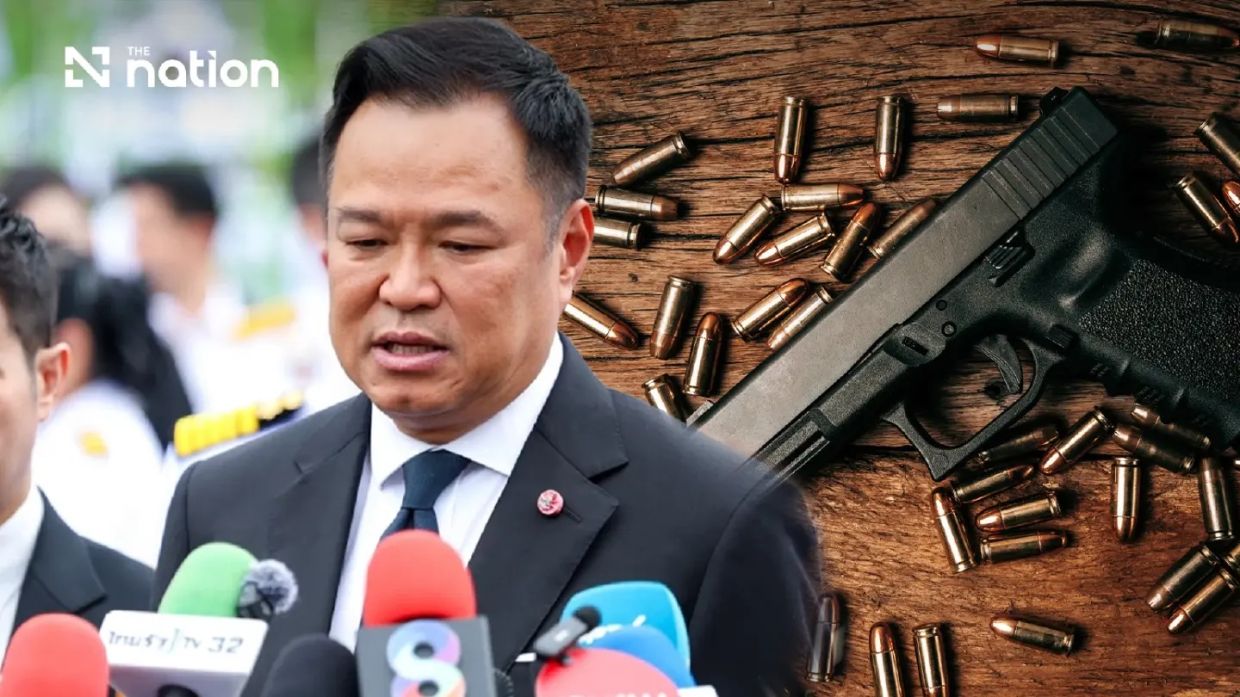
Thailand's government is moving toward more stringent firearms legislation in response to a mass shooting at Debsirin Nonthaburi School, with Prime Minister Anutin Charnvirakul announcing plans to strengthen controls on gun ownership and usage across the kingdom. Following a personal visit to the school and consultations with national police chief Pol Gen Kittharath Punpetch at Government House, Anutin outlined a comprehensive approach to curbing illegal firearms while resisting proposals that would expand access to weapons.
The prime minister has instructed Deputy Prime Minister Pakorn Nilprapunt to prepare legislative amendments that would establish more rigorous oversight of firearm possession. At the heart of this initiative is a commitment to intensify checkpoint operations and inspections throughout urban and rural areas, with enforcement directed at individuals carrying weapons without valid professional justification. Anutin emphasised that unlawful firearm possession—whether in public spaces, vehicles, or residential areas—must result in serious criminal consequences for offenders. This enforcement-first strategy reflects the government's determination to transform gun control from a matter of voluntary compliance into a criminal justice imperative with substantial penalties.
A significant point of contention has centred on whether teachers should be permitted to carry firearms for self-defence purposes. Anutin categorically rejected this proposal, arguing that educators lack the legal standing and professional training required to function as armed security personnel. The prime minister's position reflects a broader principle that civilian gun ownership should remain restricted to those with specific occupational needs, and that schools must develop security protocols that do not depend on arming staff members. This stance positions Thailand differently from some international approaches that have considered firearms in educational settings as part of active threat response strategies.
The government is considering reviving an earlier amnesty programme that would have allowed citizens holding illegal or unauthorised firearms to surrender them without facing prosecution. However, Anutin's comments suggest significant constraints on such an initiative. He maintained an uncompromising stance that illegally held weapons cannot be legitimised retroactively, and that possession remains a criminal offence regardless of intent or duration. Rather than relying on voluntary surrenders with legal protection, the government is emphasising the risks associated with retention. Anutin stressed that individuals harbouring illegal weapons face substantial personal jeopardy, as such firearms can result in additional criminal charges when discovered during investigations into other matters.
The machinery for voluntary weapons surrender remains available through established channels, with the Department of Provincial Administration, district offices, and police stations designated as collection points. This infrastructure creates a formal mechanism for citizens to relinquish weapons while generating official documentation, which may provide limited protection against retroactive prosecution depending on judicial interpretation. The government's emphasis on proper registration and custody requirements suggests that legitimate firearm holders must now comply with enhanced storage and safety standards. Weapons kept within homes—even if never removed—must be officially registered and secured in ways that prevent unauthorised access, particularly by minors. This requirement transforms gun ownership from a private matter into one subject to state verification and inspection.
Responsibility for firearm-related offences extends both to registered owners and to individuals who actually deploy weapons in criminal acts. This dual-liability framework aims to create multiple pressure points discouraging gun ownership. Even if a registered owner does not personally commit violence, they face legal consequences if their weapon is stolen or misused by another person. This approach represents a significant expansion of criminal liability beyond the direct perpetrator, effectively making gun ownership itself a higher-risk endeavour requiring greater vigilance and investment in security.
Regarding the circumstances surrounding the Nonthaburi shooting, Anutin cautioned against premature speculation, particularly regarding allegations that the shooter had experienced bullying or that other students might face similar treatment. The prime minister called for police investigations to be completed before public judgments are rendered, and urged media and citizens to refrain from amplifying unverified narratives that could fuel anxiety or inspire copycat incidents. This stance reflects awareness that detailed coverage of school shootings can inadvertently normalise such violence in public discourse, particularly among vulnerable populations.
The government's comprehensive strategy extends beyond policing and legislation to encompass multiple agencies. Police forces and other authorised officials have received explicit orders to conduct thorough weapons inspections as part of broader law enforcement operations. This decentralised approach ensures that firearms screening occurs across multiple contexts rather than through centralised enforcement alone. Officers are empowered to investigate weapons possession during routine patrols, traffic stops, and investigations into unrelated offences, creating cumulative pressure on illegal gun ownership.
Thailand's approach to this issue carries implications for other Southeast Asian nations grappling with firearms regulation. The kingdom's decision to prioritise enforcement over amnesty or voluntary compliance suggests confidence in police capacity and public acceptance of intensive security measures. For Malaysia and other regional neighbours, Thailand's experience provides a test case for whether stricter laws without significant weapons buyback programmes can effectively reduce illegal gun circulation. The emphasis on prosecutorial vigour and multi-agency coordination also offers a model for countries seeking to tighten existing regulations without necessarily implementing comprehensive gun confiscation or recall schemes that prove politically contentious.

