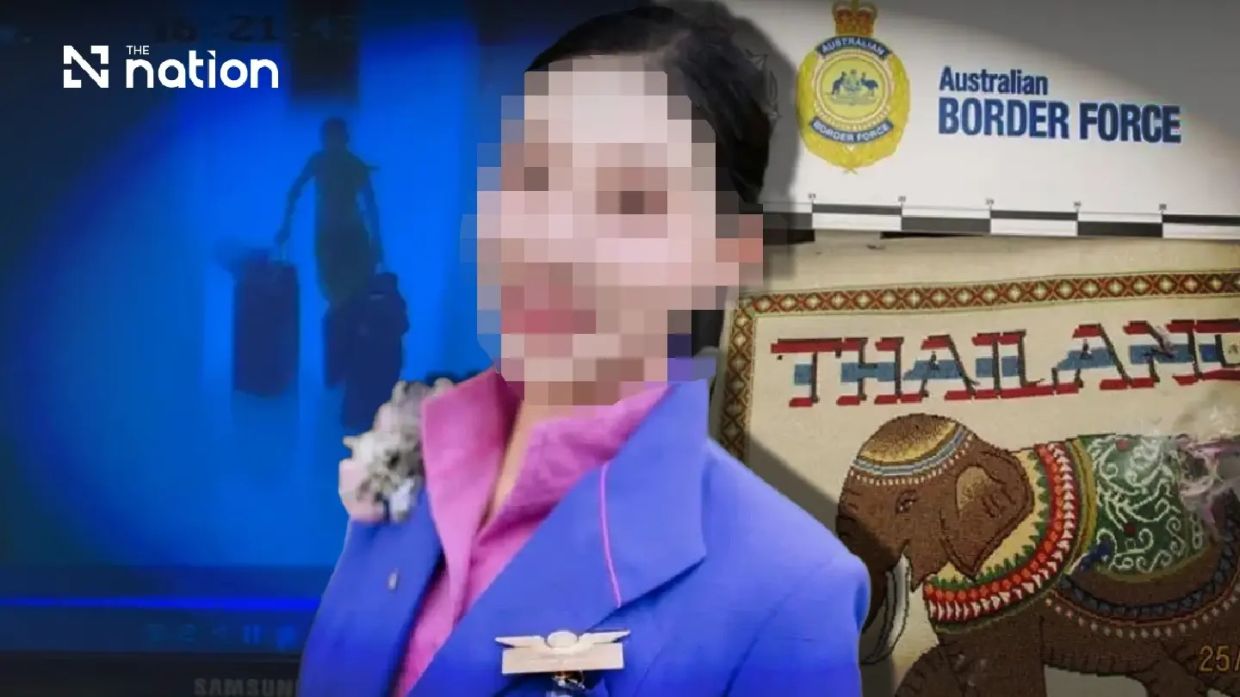
Thai authorities are intensifying their investigation into the apprehension of a flight attendant at Melbourne Airport with 900 grammes of heroin, working on the theory that she may have been manipulated by a transnational criminal network operating out of the Golden Triangle region. The woman currently remains classified as a detainee rather than a formal suspect, while Thai officials coordinate with Australian counterparts and diplomatic missions to build her legal defence case.
Arising from the Melbourne incident, officials have identified what appears to be a sophisticated operation spanning multiple countries. Thai law enforcement agencies have already made three to four related arrests within Bangkok that resulted in the seizure of over 26 kilogrammes of heroin, pointing to a large-scale transnational criminal enterprise. The Department of Special Investigation has taken the lead on the Bangkok operations due to the apparent scale and international dimensions of the network, reflecting Thai authorities' assessment that this extends well beyond a simple courier operation.
Investigators have uncovered a recruitment method designed to exploit people who travel frequently for work. The network operators allegedly created fake social media profiles and sent unsolicited messages to flight attendants and other international travellers, offering payments in exchange for carrying packages across borders. This approach appears calculated to target individuals with legitimate reasons to cross international boundaries, making detection at customs checkpoints more difficult. The scheme represents a deliberate adaptation by smuggling organisations to exploit professional mobility in ways that traditional courier networks cannot.
The Australian end of the operation appears equally significant. Investigators have identified the intended recipient in Australia as a Thai national operating under the alias "Dear," who has resided in the country for approximately a decade. The status of this individual—whether as a resident, permanent resident, or citizen—remains unclear to Thai authorities. What is more concerning is evidence suggesting this person has previously received similar shipments through the same network, indicating an established distribution chain rather than isolated transactions. Thai authorities have transferred multiple pieces of evidence to the Australian Federal Police to support their investigation.
The mechanics of the alleged deception illuminate how the operation functioned. According to statements from the flight attendant's boyfriend, a delivery rider brought a parcel containing elephant-patterned bags to their residence. The flight attendant unpacked the bags and found nothing suspicious upon inspection. She subsequently placed them into her luggage. The bags passed through Thai airport screening without detection before being seized upon arrival in Australia. This sequence of events suggests the heroin may have been added after the initial inspection, or that screening procedures failed to identify it, raising questions about whether the flight attendant genuinely knew what she was transporting.
Financial transactions associated with the case present contradictory information that investigators are still attempting to clarify. The Australian Federal Police discovered evidence of 8,800 baht (approximately US$264) on a mobile phone, yet Thai investigators have identified references to two separate transfers of 1,700 baht each, allegedly made upon receipt of goods and again when airline tickets became available. However, examination of the flight attendant's bank records has failed to confirm these transfers, and the account balance itself was minimal. This inconsistency between Australian findings and Thai banking records remains a critical investigative gap that could significantly affect how courts interpret her level of culpability.
The delivery rider who transported the package to the flight attendant has provided statements claiming he completed three or four similar deliveries previously, but that this was his first transaction involving this particular individual. This detail carries substantial implications, as it could suggest the flight attendant was not a regular participant in the operation but rather a target of opportunity, recruited specifically for this single transaction. The distinction between habitual smuggling and a first-time victim of manipulation could prove decisive in determining intent and criminal liability. Thai authorities are treating this evidence seriously as it may support arguments about her lack of awareness regarding the operation's true nature.
The investigation has revealed how enforcement pressures in one region force smuggling networks to shift routes and methods. Previously, Golden Triangle syndicates primarily moved narcotics southward through northern Thailand, where intensified interception efforts have degraded their operational effectiveness. Consequently, trafficking groups have adapted by routing drugs through the north-east region bordering Laos, particularly across the Mekong River near provinces including Nakhon Phanom, Bueng Kan, Loei, and Nong Khai. The river in these areas is narrower and the border longer than in the north, creating surveillance challenges that criminal networks exploit. Drugs entering through these routes are pre-packaged and systematically transferred between operatives before reaching storage facilities within Thailand.
Thai authorities emphasise this does not reflect negligence by Laotian authorities, noting that Thailand and Laos maintain continuous coordination and intelligence sharing on drug trafficking. Nevertheless, the reality of geographic constraints and resource limitations means that trafficking organisations successfully transit some narcotics across shared borders. Officials believe the heroin involved in the flight attendant's case may constitute merely one operational strand within a much larger Golden Triangle network, suggesting that dismantling the complete organisation will require sustained international cooperation and investigation beyond the immediate Melbourne incident.
The case illustrates evolving transnational smuggling tactics that exploit legitimate international travel and social engineering methods to recruit unwitting or inadequately informed participants. Rather than relying solely on established criminal couriers, networks now target vulnerable professionals through deceptive recruitment practices. This evolution presents particular challenges for law enforcement, as it complicates the distinction between knowing participants and manipulated individuals. For Malaysian readers and broader Southeast Asian observers, the case demonstrates how Golden Triangle production networks continuously adapt their distribution methods to evade enhanced border security, and how criminal organisations increasingly weaponise globalisation and digital communication to expand their operational reach across the region.

