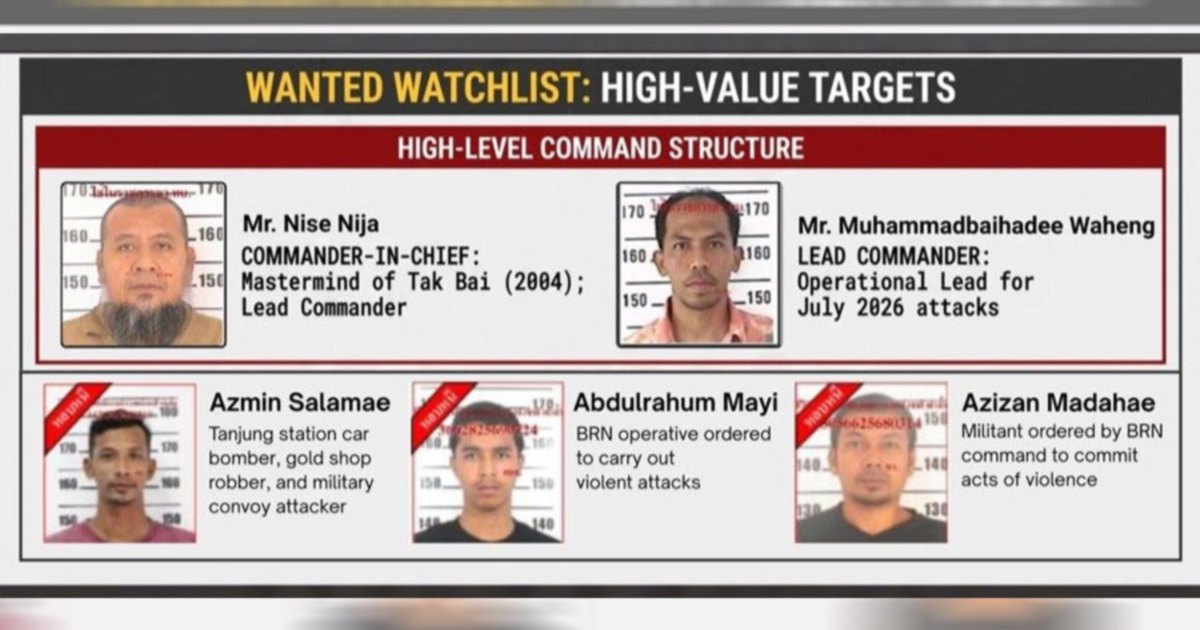
Thai law enforcement authorities have moved swiftly to apprehend five individuals implicated in a coordinated attack on a security installation in Thailand's troubled southern province. The ambush, which unfolded on Bukit Sami Municipal Road in the Tanjong Mas subdistrict of Rangae, Narathiwat, has prompted investigators to issue formal arrest warrants as they work to dismantle the network suspected of orchestrating the violence.
The attack represents a continuation of the long-running insurgency that has characterised Thailand's southernmost provinces for more than two decades. Narathiwat, situated in the heart of this volatile region and separated from Malaysia's Kelantan state only by the Golok River, remains one of the most conflict-affected areas in the kingdom. Such incidents underscore the persistent security challenges that authorities grapple with in maintaining order across the porous border zone.
The July 22 incident follows a familiar pattern observed throughout the deep south, where militant groups have periodically targeted government security personnel and installations. The checkpoint itself represents a strategic asset in the region's broader counterinsurgency architecture, making it an attractive target for groups seeking to demonstrate operational capability and inflict casualties on state forces.
Investigators have prioritised identifying and apprehending the five suspects through the issuance of warrants, a procedural step indicating that police possess sufficient evidence to justify prosecution. The investigation has likely involved analysing witness testimonies, ballistics evidence, and intelligence gathering operations coordinated between Thai authorities and regional agencies. Such cross-border coordination has become increasingly important given the proximity to Malaysian territory and the transnational dimensions of security threats in Southeast Asia's most volatile region.
For Malaysian observers, developments in Narathiwat carry direct relevance given the shared border and historical movement of suspects across jurisdictional lines. The Malaysian state of Kelantan, which runs parallel to Narathiwat across the Golok River, has occasionally seen spillover effects from the Thai insurgency. Border communities in both nations remain acutely conscious of security dynamics in neighbouring territories, and coordinated intelligence sharing between Malaysian and Thai counterparts remains essential for comprehensive regional security.
The southern Thai insurgency has claimed thousands of lives since 2004, evolving through various operational phases and tactical adjustments. While overall violence has declined from peak years, incidents such as the Narathiwat checkpoint ambush demonstrate that organised militant capabilities remain intact. The ability to coordinate simultaneous personnel and firepower to breach or strike at security installations indicates that perpetrators possess training, resources, and command structures capable of executing complex operations.
Thailand's approach to the deep south has historically combined military operations, police work, and sporadic attempts at dialogue with representatives of separatist movements. The issuance of arrest warrants reflects the continuing emphasis on law enforcement mechanisms rather than exclusive reliance on military interventions. However, critics argue that arrest and detention alone have proven insufficient to address underlying grievances or substantially reduce the frequency of attacks.
The specific targeting of the Bukit Sami checkpoint warrants examination of its tactical significance. Security installations along municipal roads in rural subdistricts typically represent softer targets than major provincial facilities, yet their destruction or successful attack generates propaganda value within insurgent circles and demonstrates continued operational reach. The attack therefore likely served both practical objectives—inflicting casualties and damaging government infrastructure—and symbolic purposes within the militant movement's communications strategy.
Regional security analysts have noted that the southern Thai conflict increasingly exhibits characteristics of protracted insurgency rather than acute emergency, suggesting that perpetrators have adapted to sustained counterinsurgency pressure whilst maintaining capacity for periodic spectacular attacks. The five suspects now subject to arrest warrants represent nodes within a larger organisational structure that likely extends beyond Narathiwat into neighbouring provinces and potentially across borders into Malaysia.
Malaysian security and law enforcement agencies maintain close operational liaison with Thai counterparts through established bilateral mechanisms. Intelligence sharing regarding suspect movements, funding flows, and weaponry acquisition helps constrain militant operational space, though the challenge of comprehensive border security across such terrain remains significant. The identification and apprehension of the five suspects will likely trigger information exchanges with Malaysian agencies seeking to establish whether any individuals crossed into Kelantan or utilised Malaysian territory for planning or logistical purposes.
The investigation into the checkpoint ambush also reflects broader Thai security sector capabilities in forensic analysis, witness identification, and intelligence synthesis. Thai police and military intelligence services have invested substantially in developing investigative capacity, though resource constraints and corruption allegations occasionally undermine public confidence in their effectiveness. The relatively rapid issuance of arrest warrants suggests that investigators have successfully identified credible leads through established intelligence networks.
For Malaysia, the continued volatility in Thailand's southern provinces serves as a reminder that regional stability depends partly on developments beyond national borders. Cross-border security cooperation, whilst operationally sound, cannot fully insulate Malaysian communities from effects of unresolved conflicts in neighbouring territories. The southbound migration of militants, transnational weapons trafficking, and occasional bomb attacks affecting Malaysian border communities all trace roots to the persistent Thai insurgency.
Looking forward, the success or failure of Thai authorities to apprehend the five suspects will carry implications beyond law enforcement statistics. Their capture might disrupt specific operational networks and yield intelligence regarding broader organisational structures, whilst their continued evasion would underline the challenges that security forces face in containing an insurgency that has proven remarkably resilient across successive administrations and counterinsurgency strategies.

