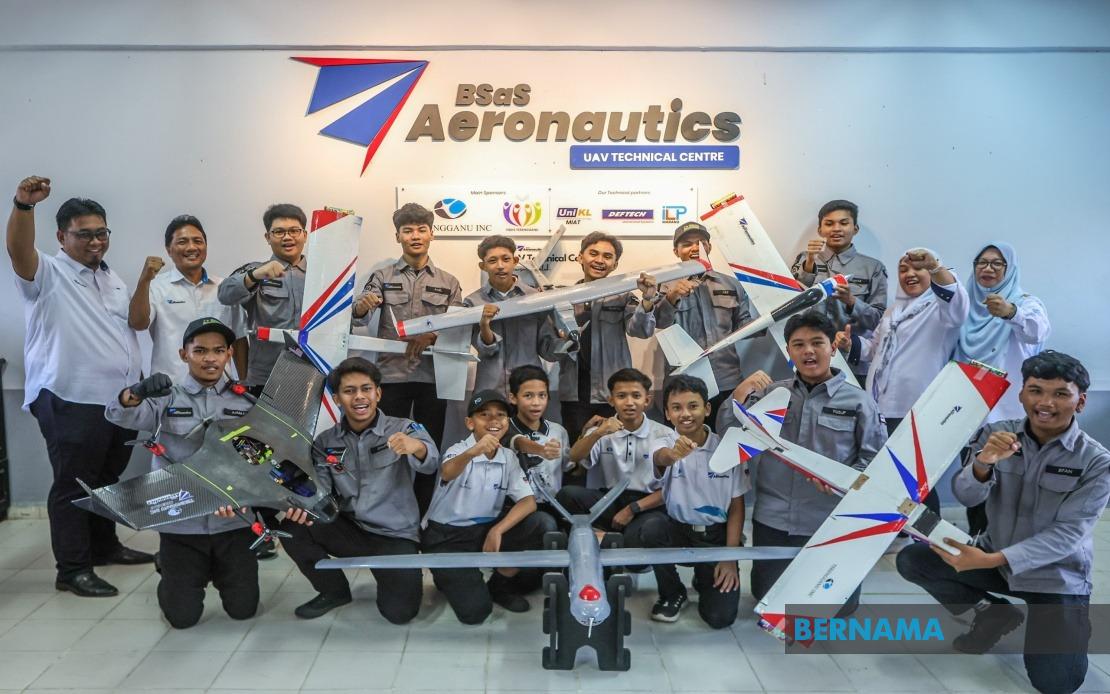
A secondary school in Terengganu has transformed classroom learning into practical aerospace engineering, enabling 35 students to design and construct their own unmanned aerial vehicles as part of an ambitious initiative to nurture homegrown aviation talent in Malaysia. The project, housed at SMK Bukit Sawa in Marang, represents a growing effort to move beyond theoretical education and equip young Malaysians with the technical expertise needed for emerging industries that face chronic shortages of skilled personnel.
The driving force behind this initiative is Badrul Hisyam Zakaria, an English teacher whose passion for remote-controlled aircraft has evolved into a sophisticated educational model. Since the TI-BSAS UAV In School programme launched in 2023, Badrul Hisyam and two colleagues have guided students through the construction of more than five fully functional unmanned aerial vehicles. Each aircraft represents a substantial investment of between RM6,000 and RM10,000 and incorporates professional-grade engineering principles and materials drawn directly from the aerospace manufacturing sector, though adapted to an educational setting.
The vehicles currently in use by SMK Bukit Sawa students incorporate Global Positioning System technology for autonomous navigation and target tracking. However, the school is advancing its capabilities by developing the next generation of UAVs equipped with artificial intelligence and computer vision systems capable of identifying targets visually rather than relying solely on preprogrammed flight paths. This progression from GPS-guided systems to AI-enabled detection represents a significant technological leap and positions the student-built aircraft on par with contemporary commercial and research applications.
The credibility of the programme received considerable validation when SMK Bukit Sawa captured top honours in the UAV Avionics Integration Challenge for secondary schools at the MyAERO Challenge 2026 competition held at MAEPS Serdang in Selangor last June. This recognition from the wider aviation community confirms that the school's pedagogical approach translates into competitively viable outcomes, demonstrating that students can master skills equivalent to those required in professional settings.
Perhaps more compelling than the trophy are the documented career trajectories of programme participants. Two former students from SMK Bukit Sawa who participated in the initiative are currently enrolled in aircraft engineering programmes at Universiti Kuala Lumpur, while three additional graduates have progressed to science-focused matriculation studies. These pathways underscore the programme's capacity to redirect ambitious students toward technical disciplines that command both institutional demand and market relevance. For a school in a region that has historically exported talent to established urban centres, retaining and developing such expertise represents a meaningful shift in economic dynamics.
Badrul Hisyam emphasised that the programme operates with sustained, multi-year objectives. Rather than treating secondary school completion as the endpoint, the school deliberately monitors graduates' progression through tertiary education and into professional careers. By this logic, the TI-BSAS initiative is expected to produce its first cohort of qualified aircraft engineers within three to four years, creating a repeating cycle of local expertise production that reduces dependence on foreign recruitment in the aviation sector.
Beyond individual student advancement, the programme addresses a strategic national concern: Malaysia's reliance on imported UAV technology and foreign expertise. By developing indigenous capacity to design, build, and iterate unmanned systems, the school contributes to broader efforts to cultivate a domestic aerospace industry capable of technological independence. This aligns with longstanding government policy objectives to reduce technology transfer risks and establish commercially viable local champions in high-technology sectors.
Financial backing has proven essential to realising these ambitions. Terengganu Incorporated, a state-linked development company, has committed RM75,000 in corporate social responsibility funding since 2023. The company initially provided RM45,000 at programme inception and allocated an additional RM30,000 in 2026 for ongoing activities and technological advancement. Datuk Burhanuddin Hilmi Mohamed, president and group chief executive of Terengganu Inc, framed this investment as targeted assistance for students from B40 households—those in the bottom forty per cent of income earners—granting them early exposure to aviation careers and the technical skills that such sectors increasingly demand.
The emphasis on equitable access distinguishes this programme from more exclusive initiatives often concentrated in urban or higher-income areas. By rooting the project in a government secondary school in Marang rather than elite institutions, the TI-BSAS programme creates pathways for students who might otherwise lack exposure to cutting-edge aerospace work. This democratisation of technical opportunity carries implications for regional economic mobility and the distribution of innovation capacity across Malaysia's geography.
The collaboration binding together the school, the Terengganu State Education Department, and corporate partners reflects an emerging model of skills development in Southeast Asia where traditional educational institutions, government agencies, and private enterprise coordinate around shared workforce imperatives. Rather than leaving aviation expertise to universities alone, or treating skills development as purely corporate responsibility, the partnership distributes roles and investments across stakeholders with complementary advantages.
For Malaysian policymakers navigating questions about STEM adoption and technical workforce resilience, SMK Bukit Sawa offers a practical case study. The school demonstrates that secondary institutions with sufficient institutional support, teacher expertise, and financial backing can operate as genuine centres of applied engineering capability. The fact that students construct vehicles meeting professional specifications—not toy models—indicates that the gap between secondary education and industry standards is far narrower than commonly assumed when resources are thoughtfully allocated.
Looking ahead, the success of the TI-BSAS model may catalyse similar initiatives elsewhere in Malaysia, particularly in states with growing aerospace clusters or emerging technology sectors. If other schools adopt comparable frameworks, the cumulative effect could substantially alter Malaysia's technical talent pipeline within a decade, generating homegrown expertise that keeps innovation cycles internal and strengthens industrial competitiveness in an increasingly critical global domain.

