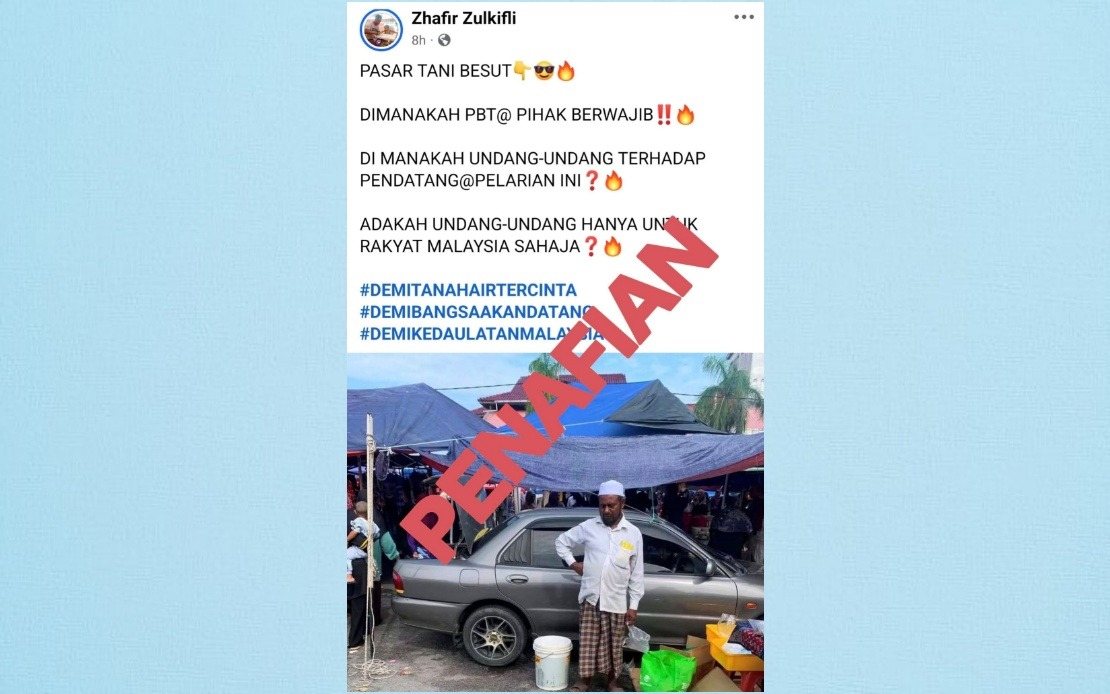
The Terengganu branch of the Federal Agricultural Marketing Authority (FAMA) moved swiftly to address spreading allegations on social media that non-Malaysian citizens had been sanctioned to operate as traders at farmers' markets within its jurisdiction. The authority issued a formal statement rejecting these claims, which had gained significant traction online following the circulation of images purporting to show a foreign vendor selling vegetables at a morning market in the Besut district.
According to FAMA's response, the incident in question did not involve any of the farmers' markets overseen by the agency. The authority clarified that the vendor and market referenced in the viral post were located at Kuala Besut Morning Market, which operates under a different administrative framework and is not part of FAMA's network of managed agricultural trading venues.
Terengganu FAMA outlined the specific markets under its direct supervision within the Besut locality. The agency operates two dedicated farmers' markets in the district: Jerteh Farmers' Market, which conducts business on Thursdays between 7 am and 1 pm, and Alor Lintang Farmers' Market, operating on Saturdays during the same hours. Both venues maintain scheduled operations designed to provide consistent marketing opportunities for licensed agricultural producers and traders.
The viral social media post that triggered the controversy emerged yesterday and featured imagery of what appeared to be a foreign national engaged in vegetable sales at a morning market venue. The photograph rapidly accumulated shares and comments across Facebook, with users expressing concern about the inclusion of non-citizens in formal agricultural trading channels. The post touched upon sensitivities regarding employment opportunities and market access for Malaysian citizens within the agricultural sector.
This incident reflects broader concerns within Malaysia regarding the oversight of informal and formal trading markets, particularly in smaller towns and districts where regulatory enforcement can sometimes prove challenging. The agricultural marketing sector has periodically faced scrutiny regarding compliance with regulations governing trader credentials, citizenship requirements, and operational permits. FAMA's swift public response indicates an awareness of how misinformation can rapidly spread through social channels and damage institutional credibility.
The clarification issued by Terengganu FAMA serves to distinguish between formal, regulated farmers' markets managed by the authority and informal morning markets that operate under municipal or local council supervision. This distinction is significant because it delineates regulatory responsibility and demonstrates that the agency maintains control over its managed venues. The authority's statement implicitly reinforces that participation in FAMA-supervised markets is subject to the agency's governance standards and trader qualification requirements.
For Malaysian stakeholders within the agricultural supply chain, including smallholder farmers and legitimate traders, this clarification carries practical implications. The distinction between FAMA-supervised markets and other trading locations affects market access, pricing transparency, and competitive conditions. Farmers' markets managed by FAMA typically implement structured systems for vendor registration, produce quality standards, and operational hours, which differ substantially from informal morning markets that may lack equivalent regulatory frameworks.
The incident also highlights the role of social media in shaping public perception of institutional performance and regulatory compliance. A single photograph, whether accurately contextualized or not, can generate widespread concern and reputational risk for government agencies. Terengganu FAMA's rapid response demonstrates institutional awareness of the need to address misinformation proactively and maintain public confidence in the integrity of its market management operations.
The underlying concern about foreign participation in agricultural trading venues reflects practical considerations regarding employment distribution and market accessibility for Malaysian citizens. Regulatory frameworks governing traders typically prioritize Malaysian nationals, and compliance with citizenship requirements represents a standard operational expectation. However, the application of these standards across diverse market settings—formal FAMA venues versus informal morning markets—requires clear communication and consistent enforcement.
Looking forward, this episode may prompt broader discussions about standardizing trader qualification requirements across different market categories within Terengganu. Enhanced coordination between FAMA and local municipal authorities responsible for informal morning markets could facilitate consistent application of citizenship and licensing standards across the entire agricultural trading ecosystem.
For residents and agricultural producers in Besut and surrounding areas, the clarification confirms that FAMA-managed farmers' markets maintain established operational standards and vendor management protocols. The two dedicated venues—Jerteh and Alor Lintang—continue to provide structured trading opportunities with defined operating schedules and regulated vendor participation, distinguishing them from other informal market settings that may operate with different governance arrangements.

