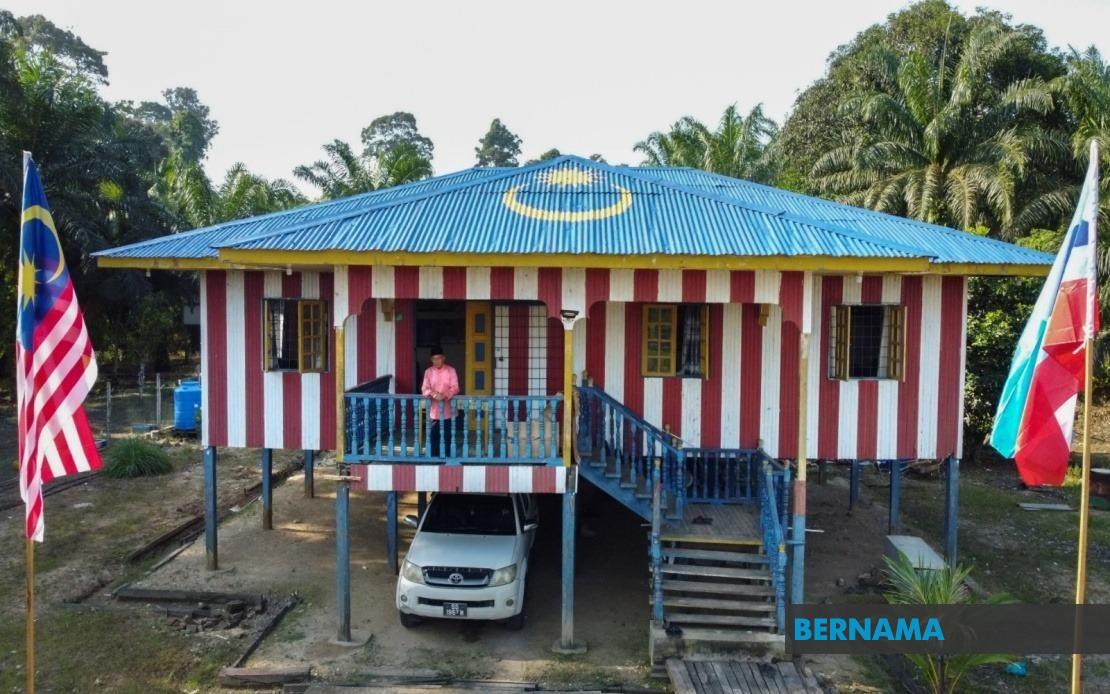
In the Sandakan neighbourhood of Batu 15, Jalan Labuk, one residence stands out as a bold proclamation of national devotion. Teratak Gemilang, the brainchild of 68-year-old entrepreneur Mohd Halikin Angga, has become far more than a house painted in the colours of Malaysia's flag—it represents a living, breathing testament to one man's profound connection to his nation and his desire to preserve the patriotic spirit for future generations.
The transformation of Mohd Halikin's wooden dwelling began in 2004, emerging from a deeply personal inspiration rooted in both familial gratitude and national sentiment. Having witnessed his parents navigate life during the colonial era, he felt compelled to create a permanent expression of his love for Malaysia at independence. The genesis of this idea struck him during a particularly poignant moment: observing how National Day flags were carefully removed when celebrations ended, only to be carelessly discarded or blown away on Kuala Lumpur streets. That melancholy observation crystallised into creative action.
The visual impact of Teratak Gemilang is immediately arresting. A deep-blue roof crowns the structure, emblazoned with a golden-yellow crescent moon and fourteen-pointed star mirroring the national emblem. Below, bold red and white stripes dominate the walls, while multiple Jalur Gemilang flags flutter proudly throughout the compound's perimeter. Every architectural element deliberately echoes Malaysia's national symbols, transforming the ordinary residential property into an unmissable beacon of civic pride that has drawn countless photographers and visitors over more than two decades, particularly during August's National Month.
Yet Teratak Gemilang transcends mere aesthetics. Stepping inside reveals a carefully curated mini gallery that functions as an intimate museum of Malaysian leadership and history. The living room walls display formal portraits spanning from Tunku Abdul Rahman Putra Al-Haj through to the current prime minister, alongside images of the Yang di-Pertuan Agong and the Yang di-Pertua Negeri Sabah. This domestic hall of honour serves as a physical reminder of the nation's constitutional journey and the individuals who have steered its course. Each portrait represents a chapter in Malaysia's democratic narrative, making the space an educational venue for anyone seeking to understand the country's political heritage.
Among Mohd Halikin's most treasured possessions is a historic photograph capturing Tunku Abdul Rahman in discussion with twenty North Borneo leaders in 1961—a pivotal moment in Malaysia's pre-formation discussions. The story of how he acquired this image reveals his dedication to his patriotic mission. While aboard an aircraft heading to Umrah in 2005, he spotted the photograph in a newspaper. Acting on impulse, he sought permission from cabin crew to retain and subsequently frame the image. That spontaneous decision led to decades of preserving a tangible piece of Malaysian history within his home, where it now educates and inspires visitors about the nation's formative political moment.
Mohd Halikin's commitment to national values extends into the personal sphere in unconventional ways. Among his seven children, three carry names honouring prominent Malaysian figures and statesmen. His eldest child bears the name of Tun Dr Mahathir Mohamad, his second child that of Tun Abdullah Ahmad Badawi, while his sixth child, Nur Zahirah, was named after the 13th Raja Permaisuri Agong. Rather than viewing names as mere identifiers, Mohd Halikin conceptualises them as vessels of hope—symbolic conduits through which the next generation might remember and appreciate the contributions of previous leaders who built the nation. This philosophical approach to nomenclature embeds patriotic education into the very fabric of family life.
The decision to maintain Teratak Gemilang in its patriotic attire reflects Mohd Halikin's unwavering commitment to preserving the spirit of nationalism. He has committed to keeping the house painted in Jalur Gemilang colours indefinitely, ensuring that what began as a personal tribute evolves into a permanent cultural landmark. In a Malaysian context where the rhythm of patriotic expression tends to concentrate around specific dates and celebrations, his decision to sustain constant national symbolism offers a counterbalance—a daily, visible reminder that love for country need not be cyclical or seasonal.
For residents of Sabah specifically, Teratak Gemilang holds additional significance within discussions of national unity and cohesion. Sabah's diverse ethnic composition—comprising Kadazan, Bajau, Murut, Chinese, and other communities—means that expressions of unified patriotism carry particular weight. Mohd Halikin has explicitly articulated his hope that his home continue to strengthen the spirit of unity among Sabah's multiracial population, particularly as Malaysia approaches the 2026 celebrations of National Day and Malaysia Day. In this interpretation, Teratak Gemilang becomes not merely an individual's artistic expression, but a potential catalyst for communal bonding across ethnic and cultural boundaries.
The broader implications of Mohd Halikin's initiative extend into regional contexts. Across Southeast Asia, questions about civic engagement, generational transmission of national values, and creative expressions of patriotism remain relevant. His approach—combining visual symbolism, historical documentation, and familial naming practices—demonstrates how individuals can architect grassroots initiatives that strengthen national consciousness without governmental intervention. This model of citizen-led patriotism offers a counterpoint to top-down commemorative strategies, suggesting that organic, personally-motivated expressions of national love can possess their own authentic power.
Moreover, Teratak Gemilang illustrates how physical spaces can function as contested territories of meaning-making. By transforming his residential property into a patriotic monument, Mohd Halikin has effectively reclaimed domestic architecture as a medium for political and cultural expression. This phenomenon—homeowners using their properties as platforms for broader national narratives—reflects evolving patterns of civic participation, particularly in non-urban settings like Sandakan where alternative venues for public expression may be limited.
For Malaysian policymakers and cultural commentators, Teratak Gemilang raises important questions about how to encourage and recognise citizen-initiated patriotic endeavours. The home has become an informal tourist attraction, yet likely receives minimal institutional support or formal acknowledgement. Whether through heritage listings, community recognition programmes, or media documentation, there exists potential for Malaysian authorities to formalise appreciation for individuals like Mohd Halikin who voluntarily dedicate personal resources and time to sustaining national pride. Such recognition might inspire additional grassroots initiatives across the country.
As Malaysia navigates contemporary challenges of social cohesion and generational engagement with national identity, Teratak Gemilang stands as a powerful reminder that patriotism need not be abstract or rhetorical. Through paint, portraiture, and personal naming conventions, one Sandakan entrepreneur has constructed a tangible, visitor-accessible celebration of Malaysian identity. His determination to maintain this painted monument indefinitely suggests that genuine love for nation, when channelled through creative action, can leave indelible marks on both physical landscapes and collective consciousness. Whether visitors arrive by car during National Month or simply encounter the striking blue roof and red-white walls during routine journeys, they encounter a standing challenge: what does our own patriotism look like, and how do we express it?

