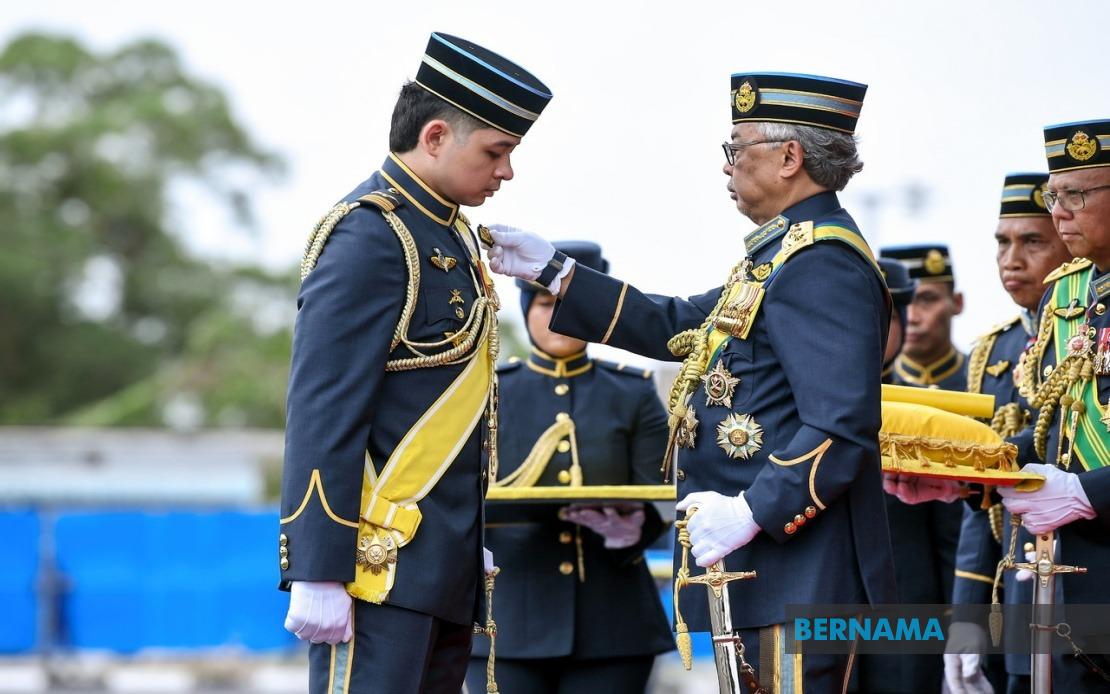
The Tengku Mahkota of Pahang, Tengku Hassanal Ibrahim Alam Shah Ibni Al-Sultan Abdullah Ri'ayatuddin Al-Mustafa Billah Shah, has etched his name into Malaysian aviation history by becoming the first royal family member to successfully complete the Basic Helicopter Flying Course at the Royal Malaysian Air Force Air College in Alor Setar. His achievement represents a significant symbolic moment for the armed forces, as members of the royal household have traditionally maintained more ceremonial roles within military structures. The milestone was marked on August 15 when the Sultan of Pahang, Al-Sultan Abdullah Ri'ayatuddin Al-Mustafa Billah Shah—who serves as Colonel-in-Chief of the RMAF—personally conferred flying wings on the Tengku Mahkota and 39 other military graduates during the 2026 Flying Wings Presentation Parade.
The training course that led to this historic moment spanned two months, from early June through the end of July, during which the Tengku Mahkota flew the EC120B Colibri helicopter alongside his fellow trainees. Rather than receive any special treatment or abbreviated curriculum, he completed the same rigorous assessment battery required of all pilots entering the service. This included the Basic Handling Test, which evaluates fundamental aircraft control skills; the Instrument Flying Test, which certifies a pilot's ability to navigate using instruments alone; the Final Navigation Test, which assesses real-world route planning and execution; and the Final Handling Test, the capstone examination that measures comprehensive competency. By excelling across these multiple evaluations, the Tengku Mahkota demonstrated genuine mastery of helicopter operations rather than merely fulfilling a ceremonial obligation.
The 2026 Flying Wings ceremony honoured graduates from four distinct training tracks within the RMAF's pilot development pipeline. Beyond the Tengku Mahkota's helicopter cohort, the wings were conferred on 37 additional student pilots and two weapons systems officers representing Malaysia's three military branches. The diversity of courses—including the 67/25 Basic Helicopter Flying Course, the 87/25 Basic Flying Course for fixed-wing aircraft, and the 01/25 Basic Weapon Systems Officer Course—reflects the RMAF's commitment to developing comprehensive aerospace capability across multiple aircraft types and operational roles. This breadth of training ensures the air force can field specialists in both piloting and the sophisticated sensor and weapons management systems that modern military aviation demands.
Air Force Chief General Tan Sri Muhamad Norazlan Aris used the ceremony as an opportunity to reflect on the deeper significance of earning combat wings. He emphasized that completing flight training represents far more than mastering technical skills; it requires the development of psychological fortitude, unwavering discipline, and the mental resilience necessary to handle high-stress operational environments. According to the air force leader, the graduates' success ultimately stems from months of sustained effort driven by determination and warrior spirit—qualities that cannot be manufactured through classroom instruction alone. The general's remarks underscored that military aviation demands a particular calibre of individual willing to push beyond conventional limits and maintain composure when lives depend on split-second decisions.
The remarks also acknowledged the often-invisible support network surrounding every successful pilot. General Muhamad Norazlan Aris highlighted the critical role of families—parents who pray for their children's safety and progress, siblings who provide encouragement during demanding training blocks, and spouses who manage household responsibilities while their partners undergo the intense concentration required by flight instruction. This recognition reflects an important truth within military aviation: individual achievement represents only the visible portion of a much larger ecosystem of sacrifice and commitment. For the Tengku Mahkota, this family support would naturally involve palace networks and royal protocols, yet the fundamental dynamic remains consistent with every other graduate crossing the parade ground to receive their wings.
Perhaps most striking among the air force chief's remarks was his assertion that earning flying wings marks not an ending but a beginning. This philosophical framing carries particular weight within military culture, where the receipt of credentials often carries the burden of heightened responsibility. For a royal family member entering active aviation service, the symbolic weight becomes even more pronounced—the Tengku Mahkota's wings now represent not only his personal achievement but also the monarchy's commitment to direct engagement with national defence. The general noted that from this moment forward, the wings adorning each graduate's chest symbolize the accumulated honour, aspirations, and trust of the entire service and nation. This formulation transforms the ceremony from a celebration of past accomplishment into an induction into a community bound by shared risk and responsibility.
The recognition of six additional award recipients at the ceremony highlighted that merit and competitive achievement remain central to RMAF advancement. These awards, distributed across flying proficiency, academic performance, discipline, and leadership, underscore that the air force maintains high standards throughout its pipeline and does not grant advancement based on seniority or background alone. This meritocratic emphasis carries particular resonance given the Tengku Mahkota's participation—his completion of the full course without preferential treatment or modified standards reinforces public confidence that the royal family remains committed to institutional integrity within the armed forces. Such symbolic commitments matter enormously in maintaining civil-military relationships and public trust in the professionalism of Malaysia's defence apparatus.
For Southeast Asia more broadly, the Tengku Mahkota's achievement reflects evolving patterns within regional monarchies regarding royal engagement with military modernization. As nations across the region invest heavily in upgrading aviation capabilities and training personnel to operate increasingly sophisticated aircraft, the direct participation of senior royals in these programmes can signal serious commitment to defence excellence. Malaysia's investment in helicopter pilot training through institutions like the RMAF Air College demonstrates recognition that helicopter operations remain central to regional security—whether for search and rescue, internal security, counter-insurgency, or support for maritime operations in the Strait of Malacca and South China Sea. The presence of a senior royal family member within this training pipeline communicates that Malaysia takes these missions with appropriate seriousness at the highest institutional levels.
The specific choice of the EC120B Colibri helicopter for the Tengku Mahkota's training warrants consideration as well. This French-manufactured light helicopter has become a workhorse across Asian militaries due to its reliability, relatively modest operational costs, and versatility across numerous mission profiles. By training on this platform, the Tengku Mahkota underwent instruction on equipment he will likely encounter repeatedly throughout any ongoing aviation service, ensuring his technical knowledge translates directly to operational utility. The aircraft's prominence within Asian defence forces also means that proficiency in the EC120B provides practical knowledge transferable to regional military cooperation scenarios—an increasingly important consideration as multilateral security arrangements expand throughout Southeast Asia.
The 2026 graduation class represents part of the RMAF's ongoing effort to replenish and expand its pilot corps as senior aviators retire and new mission requirements emerge. Malaysia's air force has undergone substantial modernization over the past two decades, acquiring new aircraft types and upgrading operational capabilities across multiple domains. Maintaining a steady stream of well-trained pilots remains critical to sustaining these investments and ensuring the service can respond to evolving regional security challenges. The presence of the Tengku Mahkota within this cohort, symbolically representing the nation's institutional commitment to aviation excellence, should reinforce recruitment and training efforts across the broader pilot development system. Young Malaysians considering military aviation careers can draw confidence from seeing senior leadership—both civilian and royal—taking these programmes seriously enough to participate directly.
Looking forward, the graduation of the Tengku Mahkota and his cohort establishes a benchmark for future royal family engagement with military professional development. Whether this ceremony represents an isolated moment or the beginning of a pattern in which royal family members pursue substantive military credentials will likely depend on how the Tengku Mahkota's wings translate into operational involvement. If his aviation training leads to ongoing flying duties, training missions, or operational participation, it could establish precedent for deeper royal engagement with air force activities. Conversely, if the flying wings remain primarily ceremonial, the achievement, while still historically significant, may mark a singular rather than repeated milestone. Either path carries implications for how Malaysians understand their armed forces' professionalism, their monarchy's role within national defence, and the degree to which institutions maintain merit-based standards across all personnel categories regardless of background.

