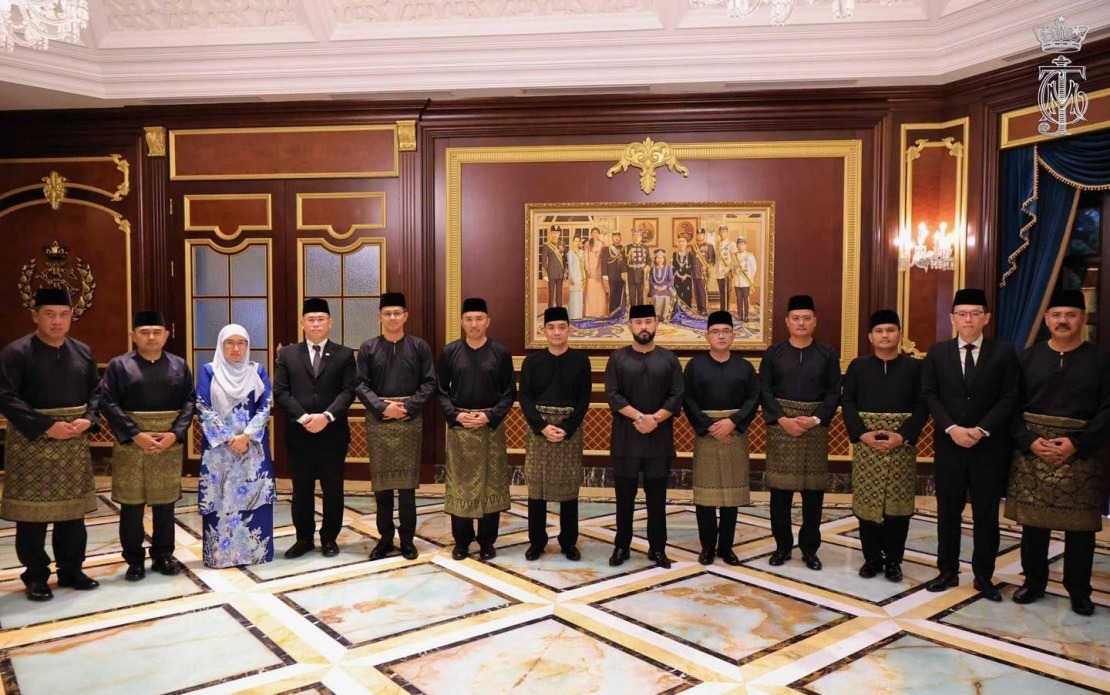
Ten newly appointed members of the Johor State Executive Council took their oaths of office before the Regent of Johor, Tunku Mahkota Ismail, at the grand setting of Istana Bukit Serene on July 18. The ceremony marked the formal induction of these assemblymen into the highest decision-making body of the state administration, reflecting the completion of the government formation process that followed Johor's recent state elections.
The appointed Exco members represent a mix of experience and fresh talent within the Johor administration. Six of the positions went to seasoned assemblymen: Mohd Hairi Mad Shah representing Larkin, Datuk Mohd Jafni Md Shukor from Bukit Permai, Mohd Fared Mohd Khalid of Semerah, Ling Tian Soon representing Yong Peng, Lee Ting Han from Paloh, and Mohamad Fazli Mohamad Salleh who holds the Bukit Pasir seat. Their appointment reflects the Menteri Besar's confidence in their administrative capabilities and political standing within their respective constituencies.
Four first-time Exco members also took their oaths, signaling the Johor government's commitment to bringing new perspectives into the state executive. These newcomers—Md Israk Abdullah (Kukup), P. Pannir Selvam (Perling), Hasrunizah Hassan (Pulai Sebatang), and Muhammad Naqib Md Ghazali (Panti)—represent diverse backgrounds and will bring varied experiences to state governance. Their elevation represents a significant recognition of emerging political leadership in the state and adds demographic diversity to an institution traditionally dominated by long-serving members.
The ceremony's presiding over by the Regent underscores the constitutional significance of the Exco appointments within Johor's political system. The presence of Menteri Besar Datuk Onn Hafiz Ghazi, alongside other senior state officials including Royal Court Council Yang Dipertua Datuk Dr Abdul Rahim Ramli and State Secretary Datuk Mohammed Ridha Abd Kadir, highlighted the formal and ceremonial importance placed upon the transition. This gathering of top administrative and constitutional figures reinforced the legitimacy and continuity of state governance.
Menteri Besar Onn Hafiz, who himself was sworn in the previous Sunday, is beginning his second consecutive term at the helm of Johor's administration. His retention as Menteri Besar came after a decisive mandate from voters in the 16th Johor state election, where his Machap constituency delivered him a commanding victory margin of 15,375 votes. This personal electoral strength, combined with his coalition's broader success, positioned him to continue executing his government's agenda for the state.
The broader political context makes the Exco appointments particularly significant for Malaysia's political trajectory. Barisan Nasional's capture of 48 out of 56 state seats represents one of the coalition's strongest electoral performances in recent years, particularly in a major state like Johor. This decisive mandate provided the new administration with considerable political capital and a stable parliamentary foundation to pursue its legislative agenda without the fractious coalition dynamics that have characterized other state governments.
For Malaysian political observers, the composition of the Exco reflects broader trends within BN regarding generational renewal and inclusivity. The appointment of four first-time members alongside six experienced assemblymen suggests a deliberate strategy to balance continuity with fresh leadership. This approach allows the state government to maintain institutional memory while preventing the ossification that can occur in long-standing administrations, a concern that has plagued governance in several Malaysian states.
The diversity of the appointed Exco members also carries implications for representation in Johor's state cabinet. With members drawn from constituencies across different regions and demographic profiles, the executive council mirrors the heterogeneous nature of Johor's population. This composition matters for policy formulation, as Exco members typically champion the interests of their constituencies within state-level decision-making forums.
For Southeast Asian observers monitoring Malaysian political developments, the smooth transition and comprehensive cabinet formation in Johor demonstrate institutional resilience in Malaysia's constitutional monarchy system. The formal swearing-in ceremonies, conducted with proper constitutional protocols, illustrate how Malaysia's federal and state systems continue to function predictably despite periodic political turbulence at the national level. Johor's stability and the clarity of its electoral mandate provide a contrast to more volatile political environments in the region.
Looking forward, the composition and appointment of this Exco will shape policy priorities for Johor over the coming years. The ten assemblymen now hold portfolios that will influence decisions on state economic development, education, health, agriculture, and infrastructure. Their effectiveness in these roles will substantially impact Johor's trajectory as the nation's second-largest state by population and a crucial economic center in the southern corridor of Peninsular Malaysia.
The swearing-in also sets the tone for inter-party dynamics within BN's Johor coalition. How effectively these ten members, particularly the newcomers, integrate into the party structures and work with federal-level initiatives will influence the stability and cohesion of the broader coalition arrangement. Given BN's renewed national prominence following recent electoral successes, the performance of state-level executives like those in Johor carries implications beyond the state's boundaries.
The appointment of these Exco members essentially completes the institutional architecture of Johor's new administration. With the Menteri Besar already sworn in and the cabinet now formally inducted, the state government can now focus entirely on policy implementation and addressing the substantive challenges facing Johor, from economic diversification to managing rapid urbanization in key districts.

