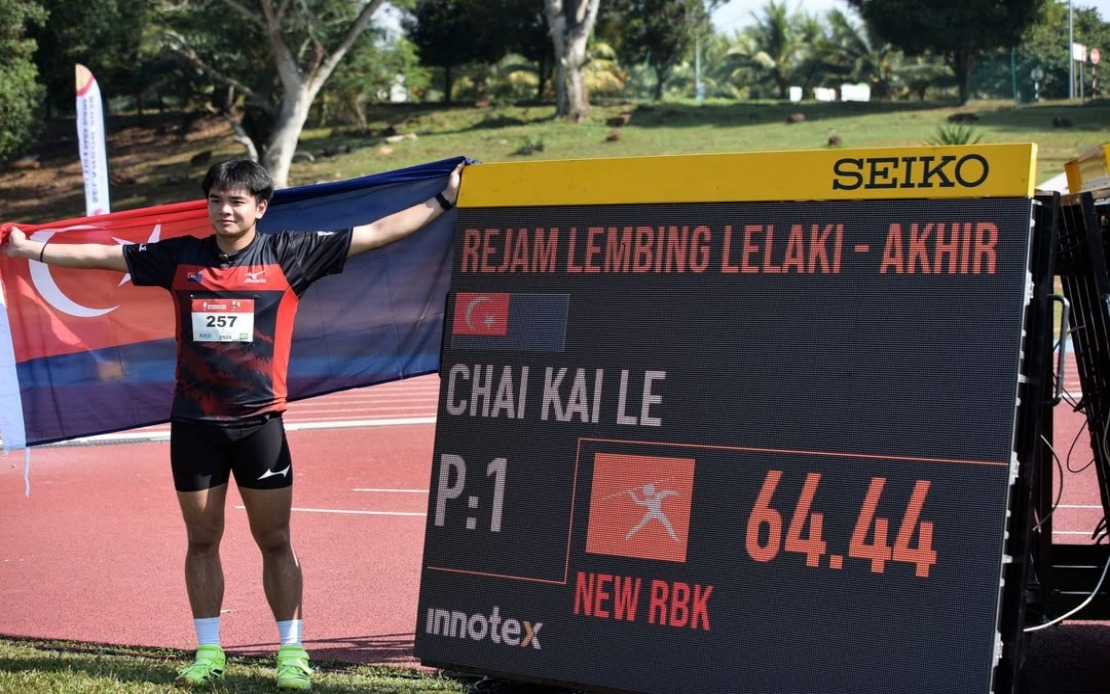
Johor's Chai Kai Le has announced himself as one of Malaysia's most promising track and field talents by spectacularly breaking a 26-year-old Games record in the men's javelin at SUKMA 2026, held at the Universiti Putra Malaysia Sports Centre in Serdang. The 18-year-old's second-attempt throw of 64.44 metres decisively surpassed the previous Malaysia Games standard of 62.33 metres, which had stood since Sarawak's Kho Mei Kuan set it at the 2000 edition hosted in Penang.
The significance of Kai Le's achievement extends beyond mere statistics. For nearly three decades, the javelin record represented a benchmark that few had come close to matching, making his obliteration of it all the more striking. The margin of his victory—approximately 2.1 metres clear of the previous mark—suggests that Malaysian throwing talent has undergone substantial development in the intervening years, potentially positioning the nation more competitively within the broader Southeast Asian sporting landscape.
Kai Le's dominance at SUKMA 2026 was comprehensive. Penang's Tan Chun Wei claimed the silver medal with a 60.43 metre throw, a respectable distance that nonetheless fell well short of the champion's capabilities. His Johor teammate Mohd Noor Iman Norman rounded out the podium with a bronze medal performance of 59.04 metres, indicating the strength running through Johor's throwing programme at present.
When addressing media representatives immediately after his victory, Kai Le conveyed a maturity beyond his years, revealing that his record-breaking accomplishment aligned with pre-competition objectives rather than representing an unexpected breakthrough. His preparation for SUKMA had extended across two years of focused training and development, suggesting a methodical approach to athletic improvement that has yielded tangible results. The young athlete expressed satisfaction with his performance, underscoring the culmination of years of dedication to the sport.
However, Kai Le's post-competition remarks also illuminated the physical demands inherent in elite javelin throwing. Following his record-shattering second attempt, he encountered a technical execution flaw that triggered lower back discomfort and fatigue, forcing a strategic recalibration of his remaining throws toward injury management and damage prevention rather than pursuing further distance gains. This disciplined approach—prioritising long-term physical integrity over marginal competitive gains—demonstrates a sophisticated understanding of athletic sustainability that bodes well for his future prospects.
Contextualising his achievement within his broader athletic profile adds another dimension to Kai Le's significance. The 18-year-old already holds the national under-20 record at 65.65 metres, a mark that exceeds even his Games-winning throw. This discrepancy suggests considerable potential for future improvement, as he transitions into senior competition categories and continues physical maturation. His current trajectory indicates that substantial additional performance gains may reasonably be anticipated in coming seasons.
Beyond the javelin circle, Malaysian athletics produced another notable achievement at SUKMA 2026 through the men's 10,000 metres race walk. Penang's Mohammad Aiman Haikal Sahrudin claimed the gold medal, crossing the finish line in 47 minutes 28.84 seconds, a performance that represented improvement upon his previous Games appearance. His commanding margin of victory over Kelantan's Ahmad Farish Irfan Ahmad Fahmi, who finished second in 47:37.17 seconds, underscored his dominance in the demanding discipline.
The Federal Territories' Khor Jing Hong secured bronze with a time of 47:49.27 seconds, rounding out a competitive field in an event that demands exceptional endurance and technical proficiency. Mohammad Aiman's ascent from silver medalist at the preceding SUKMA in Sarawak to gold medalist in Selangor reflects the calibre of preparation undertaken by Malaysia's race walking contingent.
Mohammad Aiman's post-event commentary revealed the strategic thinking underpinning contemporary Malaysian athletics programme development. The 18-year-old athlete articulated clear progression pathways, targeting integration into the national senior squad as an immediate objective, with qualification for the 2027 SEA Games representing a broader competitive ambition. His acknowledgement that the 10,000 metres race walk format lacks inclusion in SEA Games competition, prompting reorientation toward the 20,000 metre alternative, demonstrates the necessity for athletes and coaches to navigate complex international competition calendars strategically.
For Malaysian athletics, the performances at SUKMA 2026 carry implications extending well beyond the immediate competition. Kai Le's record-breaking javelin throw exemplifies the talent emerging through the domestic Games system, while Mohammad Aiman's progression pathway toward regional and potentially international representation suggests that systematic athlete development frameworks are yielding measurable outcomes. These results collectively indicate that Malaysian track and field, long challenged by regional competitors, may be experiencing a performance renaissance built upon sustained investment and strategic programme development.
The emergence of athletes such as Kai Le and Mohammad Aiman—both demonstrating not merely competitive success but also tactical sophistication and future-oriented goal-setting—suggests that Malaysia's sporting infrastructure has matured beyond producing isolated individual successes toward developing cohorts of athletes capable of sustained high-level performance. As these young talents continue their career progression, their trajectories will substantially influence Malaysian athletics' competitive standing across Southeast Asia and potentially beyond, making SUKMA 2026 a genuinely consequential juncture for the sport's development within the nation.

