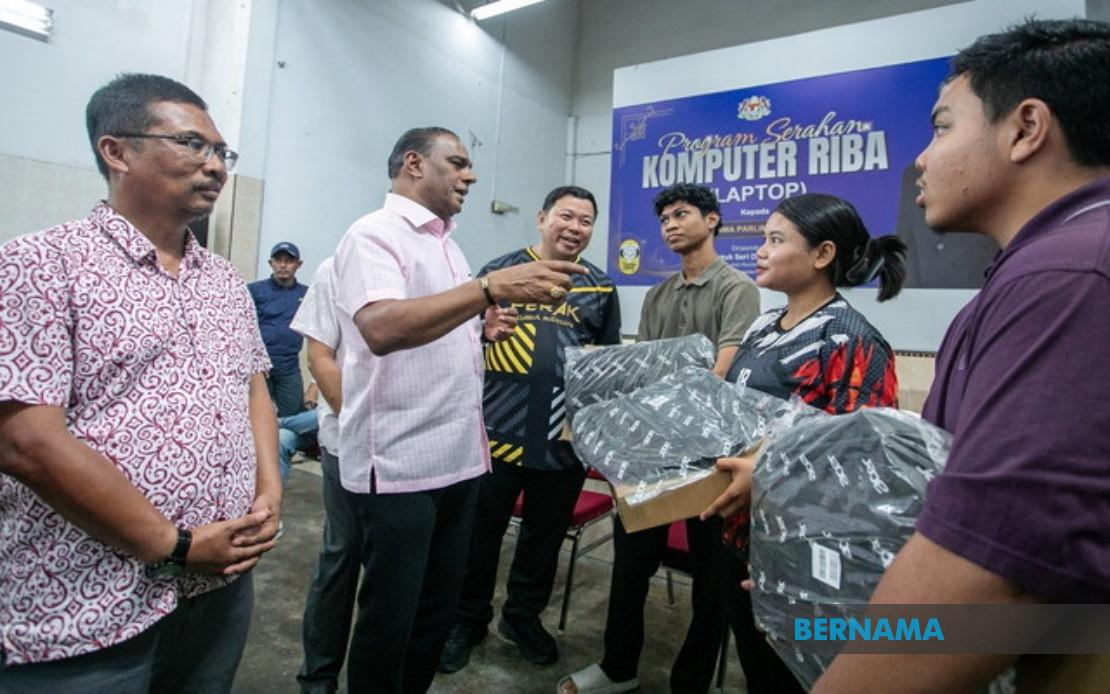
Forty-five university students from B40 households in the Tapah parliamentary constituency have received laptops under an ongoing assistance scheme that has supported more than 1,000 learners since launching in 2008. The distribution took place at Mahatma Gandhi Hall in Tapah, where Tapah Member of Parliament Datuk Seri M. Saravanan handed over the devices to beneficiaries spanning multiple educational levels and programmes.
This year's cohort demonstrated diversity in academic pathways, with the largest group comprising 30 diploma-level students. The remainder included five certificate-level pupils, four matriculation participants, three pursuing degrees, and individual recipients from SPM, STPM, and foundation programme streams. Such breadth reflects the recognition that device access barriers affect students across the entire tertiary education spectrum, not merely those pursuing conventional university routes. The varied selection underscores how technological inequality intersects with educational choices available to economically disadvantaged families.
Saravanan emphasised that laptops have transcended their former status as convenience items, now functioning as indispensable educational infrastructure. Modern pedagogical practices increasingly depend on digital platforms for assignment submission, research access, collaborative learning, and course delivery. For B40 families operating with constrained disposable income, the absence of a functional device creates tangible academic disadvantages. The MP framed the initiative as ensuring that financial circumstances do not become barriers to educational participation, positioning technology provision as a fundamental equity measure rather than charitable surplus.
The selection methodology demonstrates institutional rigour aimed at directing resources toward genuine need. A dedicated committee evaluated each application, cross-referencing information obtained from District Education Offices and consulting local community leaders. This multi-layered verification approach acknowledges that self-reported eligibility claims require contextual validation, particularly in areas where poverty rates remain elevated. The process reflects growing sophistication in targeted assistance delivery, moving beyond simple income thresholds to incorporate qualitative assessments of household circumstances.
One dimension Saravanan highlighted concerned emerging educational trajectories among Orang Asli youth in the Tapah constituency. Over the preceding two decades, increasing numbers of indigenous young people have accessed higher education and subsequently entered professional occupations as doctors, lawyers, and specialists across various fields. This progression represents substantial intergenerational mobility, with contemporary Orang Asli professionals serving as role models for younger cohorts historically excluded from professional pathways. The laptop distribution programme functions partly as infrastructure supporting this expansion, removing technological obstacles that might otherwise constrain ambitions among Orang Asli students contemplating tertiary education.
Aidil Iskandar Ramlan, an 18-year-old former student of SMK Syeikh Abdul Ghani in Bidor, exemplifies the programme's intended beneficiaries. Preparing to commence a Diploma in Public Administration at Universiti Teknologi MARA Raub in Pahang the following month, Aidil recognised the laptop as instrumental for completing assignments and executing study-related tasks. His household configuration—with his father employed as a school security guard and his mother managing domestic responsibilities—represents the economic profile targeted by B40 assistance initiatives. The device acquisition substantially eases financial pressure on his parents, redirecting expenditure that would otherwise burden an already constrained household budget.
Similarly, 19-year-old Ea Endry Iana Aslan, pursuing a Diploma in Early Childhood Education at FELCRA College, articulated how the laptop lightens familial burden whilst enabling her to access resources that would otherwise remain financially inaccessible. For students from lower-income households, the cost differential between laptop ownership and non-ownership can represent weeks or months of household income, creating effective barriers to device acquisition even when the item proves academically necessary. Ea's acknowledgment of the assistance as burden-lightening speaks to the material realities confronting B40 families navigating educational ambitions within economic constraints.
The programme's persistence since 2008 represents consistent policy commitment across multiple parliamentary cycles, suggesting cross-factional recognition that technology access constitutes legitimate assistance scope. Sixteen years of continuous operation and cumulative support for over 1,000 students indicates institutionalisation transcending individual political cycles or partisan preference shifts. This longevity contrasts with episodic assistance initiatives that commence with fanfare but dissolve through bureaucratic atrophy or resource reallocation. The Tapah laptop programme has achieved sufficient embedding within constituency mechanisms to persist as routine rather than exceptional.
From a Malaysian governance perspective, the initiative offers a localised case study in targeted assistance mechanics. Rather than universal provisions that extend benefits across all income groups regardless of need, means-tested approaches concentrate resources toward those facing greatest disadvantage. The Tapah programme exemplifies this philosophy applied to educational technology—a domain increasingly central to learning outcomes yet prohibitively expensive for lower-income households without intervention. As educational systems worldwide accelerate digital integration, such programmes become more rather than less necessary, expanding from peripheral support to foundational infrastructure.
The broader Southeast Asian context renders such initiatives increasingly relevant. Across the region, educational technology divides mirror and potentially exacerbate existing income disparities. Countries grappling with uneven development trajectories find that digital access correlates strongly with educational outcomes and employment prospects. Malaysia's B40 assistance frameworks, including provisions like the Tapah laptop programme, position the nation relatively progressively within the regional landscape concerning technology equity. However, scaling such initiatives to reach all eligible students nationwide remains a substantial undertaking requiring sustained budgetary commitment and administrative capacity.
Saravanan's emphasis on selection rigour and genuine need assessment also addresses a persistent governance challenge: ensuring assistance reaches intended beneficiaries rather than leaking toward ineligible recipients or accruing inefficiently. By establishing verification mechanisms involving education authorities and community stakeholders, the programme attempts to minimise displacement—wherein assistance intended for the genuinely disadvantaged reaches relatively advantaged individuals through information asymmetries or social capital advantages. This institutional architecture, though labour-intensive, generates greater confidence that limited resources achieve their equity objectives.
The student narratives underscore an often-overlooked dimension of B40 assistance: psychological and emotional dimensions alongside material provision. Both Aidil and Ea expressed gratitude and acknowledgment of familial burden relief, suggesting that assistance operates partly through validating students' aspirations and demonstrating systemic recognition of their circumstances. For youth from economically marginalised backgrounds, institutional acknowledgment that their educational participation warrants public investment can reinforce educational commitment and aspirational orientations. The laptop thus functions simultaneously as material resource, symbolic validation, and confidence-building intervention.

