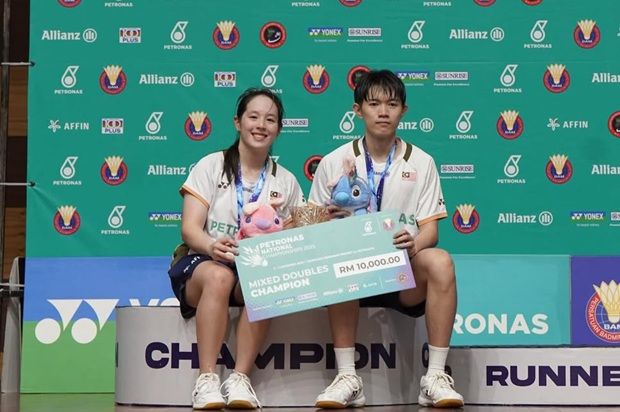
Clarissa San enters the most significant chapter of her badminton career next week at the Japan Open, carrying with her reassuring counsel from her newly assigned mixed doubles partner Chen Tang Jie. The 20-year-old shuttler will experience the full intensity of one of the Badminton World Federation's elite tournaments for the first time, stepping into a role vacated by injured teammate Toh Ee Wei, who sustained an anterior cruciate ligament injury and is currently recovering in Melbourne. Despite the circumstances that created this opportunity, Clarissa has embraced the challenge with measured optimism, framing her approach around absorbing experience rather than chasing immediate results.
The pairing of Clarissa with Tang Jie represents a practical solution to Malaysia's mixed doubles depth at the elite level. Tang Jie, an established figure on the international circuit, has assumed an informal leadership role beyond his duties on court, functioning as both a senior partner and a stabilising influence for the younger player. During training sessions and preparation meetings, he and head coach Nova Widianto have repeatedly reinforced a singular message: that maintaining composure and finding enjoyment in the competitive environment will prove far more valuable than succumbing to the pressure inherent in competing at such a prestigious venue. This psychological scaffolding appears designed to prevent Clarissa from becoming overwhelmed by the magnitude of the occasion.
Clarissa's own reflections on her readiness reveal a player with impressive self-awareness about her development trajectory. While acknowledging the gap between her current abilities and the demands of the Japan Open's competitive ecosystem, she has set realistic targets for her performance. Rather than fixating on tournament outcomes or seeding positions, her primary objective is to execute the technical and tactical principles she has refined during recent training blocks. This grounded mentality suggests maturity beyond her years and an understanding that incremental progress typically matters more than sudden breakthroughs at major events.
The relationship Clarissa has developed with Tang Jie extends beyond conventional teammate dynamics. She describes him explicitly as a mentor and older brother figure, someone whose experience allows him to provide corrective feedback without creating defensiveness or discouragement. When she commits unforced errors or misjudges tactical situations during matches, Tang Jie's guidance appears positioned to help her learn rather than simply react to failure. For a player making her debut at this level, having such a stable reference point on court may prove invaluable in managing the emotional fluctuations that accompany high-stakes competition.
The pairing faces immediate intensity in their opening encounter against Taiwan's Yang Po-hsuan and Hu Ling-fang, a matchup that will test whether the preparation and psychological readiness Clarissa has developed translates into competitive performance. The tournament structure will also provide multiple additional opportunities for growth; Clarissa mentioned anticipating three or four additional tournaments alongside Tang Jie following Japan, suggesting this partnership carries medium-term continuity rather than serving as a temporary fix.
Clarissa's debut arrives within a broader Malaysian mixed doubles contingent competing across multiple pairings at the Japan Open. Jimmy Wong and Cheng Su Yin will encounter Japan's Yuichi Shimogami and Sayaka Hobara in an opening-round fixture that carries its own complications. The independent pairing of Goh Soon Huat and Shevon Lai Jemie will test themselves against Americans Chen Zhi Yi and Francesca Corbett, while Wong Tien Ci and Lim Chiew Sien face a considerably steeper assignment against China's fifth-seeded combination of Guo Xinwa and Chen Fanghui. This array of matchups demonstrates that Malaysia's mixed doubles representation spans various experience levels and competitive contexts.
The circumstances surrounding Clarissa's opportunity underscore the vulnerability of elite sports teams to injury setbacks. Toh Ee Wei's ACL injury represents not merely a personal setback for that athlete but a disruption to established partnership dynamics that the national program must accommodate through reshuffling. That Clarissa could step into a pairing with an established player like Tang Jie reflects both the depth available within Malaysia's badminton infrastructure and the inherent fragility of building consistency around specific partnership combinations.
From a developmental perspective, this situation carries significant implications for how Malaysia cultivates its next generation of mixed doubles players. Clarissa's insertion into elite competition alongside a mentor figure offers her accelerated exposure to the tactical and physical demands of World Tour tournaments, potentially compressing her learning curve compared to a more gradual progression through secondary-tier events. However, it simultaneously places immediate performance pressure on both her and her partner, requiring Tang Jie to balance his own competitive objectives with the mentoring responsibilities he has clearly accepted.
Clarissa's willingness to view the Japan Open primarily as a learning opportunity rather than a proving ground suggests a psychological orientation that should serve her long-term development well. In professional badminton, where marginal gains often determine tournament progression, athletes who can maintain perspective during early major competition typically build stronger foundations for sustained improvement than those who treat debut appearances as win-or-bust scenarios. The advice from Tang Jie and coach Nova Widianto to stay calm and enjoy the matches reflects this philosophy of treating the occasion as a milestone rather than a referendum on her abilities.
The mixed doubles category holds particular importance within Malaysia's badminton programme, as it represents an area where the nation has traditionally sought to maintain competitiveness against stronger regional rivals. Each successful pairing that emerges from the talent pipeline contributes to the overall health of the domestic program and Malaysia's standing in international rankings. Clarissa's performance at the Japan Open, regardless of immediate results, will provide valuable data about her trajectory and whether she can eventually anchor a sustained partnership at this level.
Looking ahead, the coming weeks will reveal whether the partnership between Clarissa and Tang Jie possesses the potential for medium-term development or whether adjustments will be necessary as Toh Ee Wei continues rehabilitation. The mentoring dynamic that Tang Jie has established suggests he views this role as more than temporary bridging, potentially signalling confidence in Clarissa's ability to contribute meaningfully to Malaysian mixed doubles within a reasonable timeframe. For Clarissa herself, the Japan Open represents both an endpoint—the fulfilment of reaching a major stage—and a beginning, as she embarks on multiple tournaments where the lessons absorbed this week will face repeated testing.

