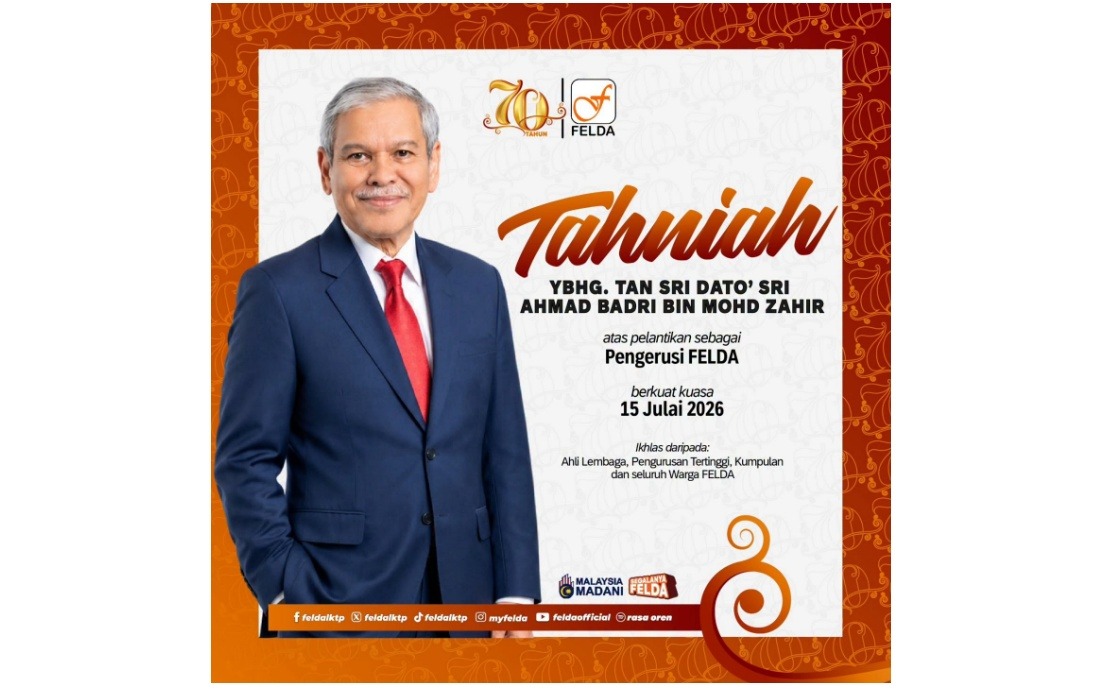
Tan Sri Ahmad Badri Mohd Zahir has assumed the role of chairman at the Federal Land Development Authority (FELDA), marking a significant leadership transition at one of Malaysia's most consequential development agencies. The appointment, announced by FELDA on July 15, reflects governmental confidence in Ahmad Badri's proven track record steering major institutions through complex economic and organisational challenges.
The new FELDA chairman brings formidable credentials accumulated over more than thirty years navigating both public administration and commercial sectors. His career trajectory began at the Ministry of Finance in 1989, establishing a foundation in fiscal policy and government operations that would inform his subsequent responsibilities. Between 2018 and 2020, Ahmad Badri served as Treasury Secretary-General, a pivotal position overseeing national financial operations during a period of considerable economic transition following the 2018 change of government.
Beyond his Treasury tenure, Ahmad Badri has occupied commanding positions at several institutions fundamental to Malaysia's financial and economic architecture. His chairmanship of the Employees Provident Fund positioned him at the centre of retirement savings management for millions of Malaysian workers, while his board memberships at Bank Negara Malaysia, Permodalan Nasional Berhad, and Tenaga Nasional Berhad demonstrated his involvement in shaping monetary policy, sovereign investment strategy, and energy infrastructure respectively. These roles collectively underscore his familiarity with the mechanics of national economic governance and long-term strategic planning.
Currently, Ahmad Badri chairs RHB Bank Bhd and the Malaysian Rubber Board whilst serving on Sime Darby Bhd's board, illustrating his ongoing engagement with both financial services and commodity-dependent enterprises. His educational foundation, encompassing a Master of Business Administration from the University of Hull and a bachelor's degree in Estate Management from Universiti Teknologi MARA, provides technical grounding particularly relevant to FELDA's land-centric operations and development mandate.
FELDA itself operates in a context of significant contemporary pressures. The agency manages landholdings on behalf of approximately 3.2 million settlers across peninsular Malaysia and Sabah, making it custodian of one of the nation's largest consolidated land bases and the livelihoods dependent upon it. Rubber and palm oil cultivation remain central to FELDA's economic model, yet these commodities face mounting international scrutiny regarding environmental sustainability and labour practices. Ahmad Badri's appointment comes amid broader expectations that FELDA will accelerate modernisation and economic diversification within its settlement schemes.
The emphasis within FELDA's statement on governance strengthening and management excellence suggests acknowledgment that the agency requires institutional rejuvenation. Transformation agendas at large government-linked organisations typically encompass operational efficiency improvements, financial sustainability enhancement, and strategic repositioning to reflect contemporary development paradigms. For FELDA specifically, this likely encompasses land-use diversification, value-addition within agricultural operations, and adaptation to climate-related agricultural challenges increasingly affecting plantation productivity across Southeast Asia.
Ahmad Badri's background in Treasury management and sovereign wealth operations positions him to address FELDA's financial sustainability questions, particularly regarding the allocation of resources between immediate settler welfare and longer-term organisational viability. The agency historically functions simultaneously as a development institution serving settler communities and a commercial enterprise generating returns on state-held assets—a dual mandate that frequently creates operational tensions requiring sophisticated balancing.
For Malaysian settlers and the broader development community, Ahmad Badri's appointment signals governmental intention to apply technocratic rigour to FELDA's operations whilst maintaining commitment to settler welfare. His prior experience navigating institutional change within large, legacy organisations suggests familiarity with managing stakeholder expectations across multiple constituencies—critical given the political sensitivity surrounding settler livelihoods and land rights within Malaysian governance discourse.
Regionally, FELDA's trajectory carries implications for Southeast Asian agricultural development patterns. As a substantial landowner engaged in commodity production across multiple jurisdictions, institutional decisions regarding sustainability standards, labour practices, and environmental management at FELDA influence broader regional approaches to plantation agriculture. Ahmad Badri's leadership will likely shape FELDA's positioning within increasingly stringent global supply-chain governance standards affecting palm oil and rubber exporters throughout the region.
The timing of this appointment reflects broader governmental recalibration regarding institutional leadership following recent political transitions. Positioning experienced technocrats with substantial track records in strategic institutions suggests prioritisation of organisational stability and economic continuity. Ahmad Badri's three-decade career progression demonstrates mastery of Malaysia's bureaucratic systems whilst maintaining commercial credibility—a combination increasingly valued as government-linked entities navigate competitive market environments alongside developmental responsibilities.
Looking forward, Ahmad Badri's stewardship will be evaluated against his capacity to maintain settler welfare protections whilst advancing FELDA toward greater financial independence and operational resilience. The organisation's success in modernising agricultural operations, expanding non-traditional revenue streams, and maintaining relevance within Malaysia's evolving economic structure will substantially depend on the strategic clarity and implementation discipline brought by this new leadership. For stakeholders ranging from settler communities to commodity markets and environmental advocates, Ahmad Badri's direction-setting during his initial tenure will indicate FELDA's institutional trajectory through the coming decade.

