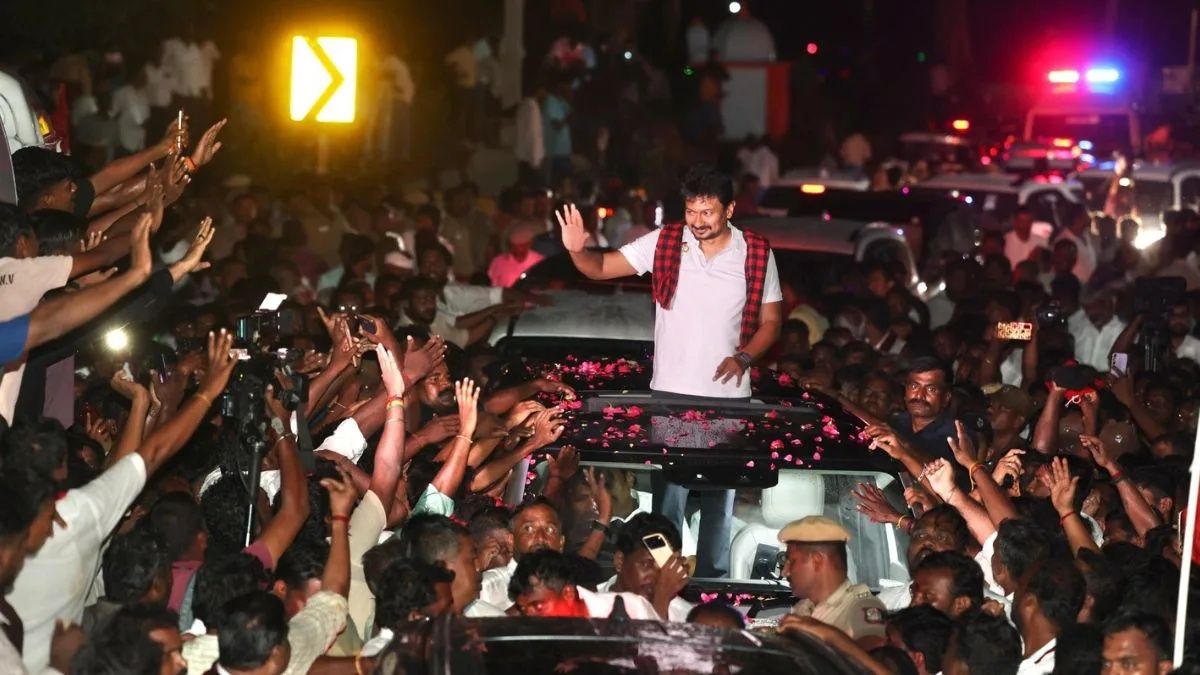
Udhayanidhi Stalin, the Leader of Opposition in Tamil Nadu, walked free on station bail late Tuesday evening after an extended questioning session by police, closing a dramatic 24-hour period that saw him arrested over contentious remarks allegedly aimed at actress Trisha Krishnan. The former deputy chief minister had been detained at Sengipatti police station, where hundreds of DMK party workers gathered outside the facility to greet him upon his release, transforming the evening into a political show of strength with supporters chanting slogans criticising Chief Minister Vijay and his recently formed TVK government.
The controversy centres on Stalin's speech during a DMK-organised protest in Thanjavur focused on water-sharing disputes with Karnataka over the contentious Mekedatu dam project. While addressing grievances about the Cauvery River allocation, Stalin paused when supporters in the crowd shouted the name of Trisha, a prominent Tamil film actress perceived to have close ties to CM Vijay. Stalin responded with a measured pause and smile before remarking, "Wherever water comes, whether it comes or not, water should come there"—a statement that many observers have interpreted as carrying double meanings with sexual undertones.
The ruling TVK swiftly characterised the utterance as "verbal harassment" and a clear case of objectifying a woman, escalating the matter beyond a simple political jab. The party filed formal complaints with both the National Commission for Women and local police authorities, framing the incident as a gender-based attack rather than political theatre. This framing proved consequential: police arrested Stalin from his Chennai residence, signalling the CM Vijay administration's determination to pursue the case aggressively and set a precedent for handling inflammatory political speech.
At a press conference following his release, Stalin categorically denied any improper intent, arguing that his words carried only a single, literal meaning pertaining to water distribution for agricultural purposes. He portrayed his detention as a retaliatory tactic employed by the TVK government to silence opposition criticism of its policies and to distract public attention from governance failures. The DMK leader asserted that his arrest contradicted democratic norms and dismissed the ruling administration as lacking legitimacy, using characteristically sharp language to describe it as a "circus" rather than genuine government.
Stolin's assertion that he harboured no disrespect toward women represents a standard defensive posture in such cases, yet his broader framing—that the arrest itself constitutes political persecution—speaks to deepening animosity between Tamil Nadu's ruling and opposition camps. The DMK leader positioned his detention within a pattern of alleged harassment targeting opposition legislators, claiming the TVK government's immediate instinct upon encountering DMK politicians is arrest rather than dialogue. This narrative, whether persuasive or not, resonates with his party's base and reinforces perceptions of a combative governing style.
The incident reflects broader currents in Tamil Nadu politics, where personal attacks and double-entendre-laden rhetoric have become normalised campaign tools across party lines. However, the regulatory response through women's commissions and police action suggests a shift toward stricter enforcement of decorum standards, at least selectively. Whether this represents genuine commitment to protecting women or strategic weaponisation of gender politics remains contested, particularly given Tamil Nadu's history of sexualised language directed at female politicians and public figures across the political spectrum.
For Malaysian and broader Southeast Asian observers, the Stalin case illustrates how rapidly political disputes in Indian states can intersect with gender politics and regulatory mechanisms, creating novel legal jeopardy for politicians whose off-hand remarks invite unfavourable interpretation. The involvement of a national-level women's commission alongside state police action demonstrates how vertically integrated India's political system permits escalation from local incidents to multi-institutional responses. This contrasts markedly with more compartmentalised governance structures in several ASEAN nations, where state-level incidents often remain contained within regional frameworks.
The timing of Stalin's arrest and release—spanning roughly 24 hours—suggests police processing rather than extended detention, yet the rapid mobilisation of regulatory apparatus signals political intent to establish consequences for contentious speech. Stalin's defiant tone upon release, reinforced by DMK supporters' celebratory gathering, indicates the party views the episode as a martyrdom narrative that strengthens internal cohesion and external support among core constituencies already alienated by the TVK government's authoritarian reputation.
The controversy also highlights the precarious position of opposition leaders in states where ruling parties command both electoral and administrative machinery, creating asymmetric consequences for identical rhetorical transgressions. If similar remarks by TVK politicians toward DMK-associated figures went unprosecuted, the weaponisation argument would gain traction; conversely, if enforcement proves genuinely symmetrical, it would represent a departure from Tamil Nadu's partisan policing traditions. The coming weeks will clarify whether this incident marks a genuine shift in enforcement norms or reflects selective application of regulatory power.
As the case advances through judicial channels, Stalin and the DMK will likely frame it as political persecution aimed at intimidating opposition voices and discrediting legitimate criticism of government policy. The TVK will maintain that protecting women from verbal harassment transcends partisan considerations. These competing narratives will shape public perceptions independent of legal outcomes, cementing the incident's significance in Tamil Nadu's 2026 election cycle and influencing how opposition parties in other Indian states approach political discourse involving figures close to ruling dispensations.

