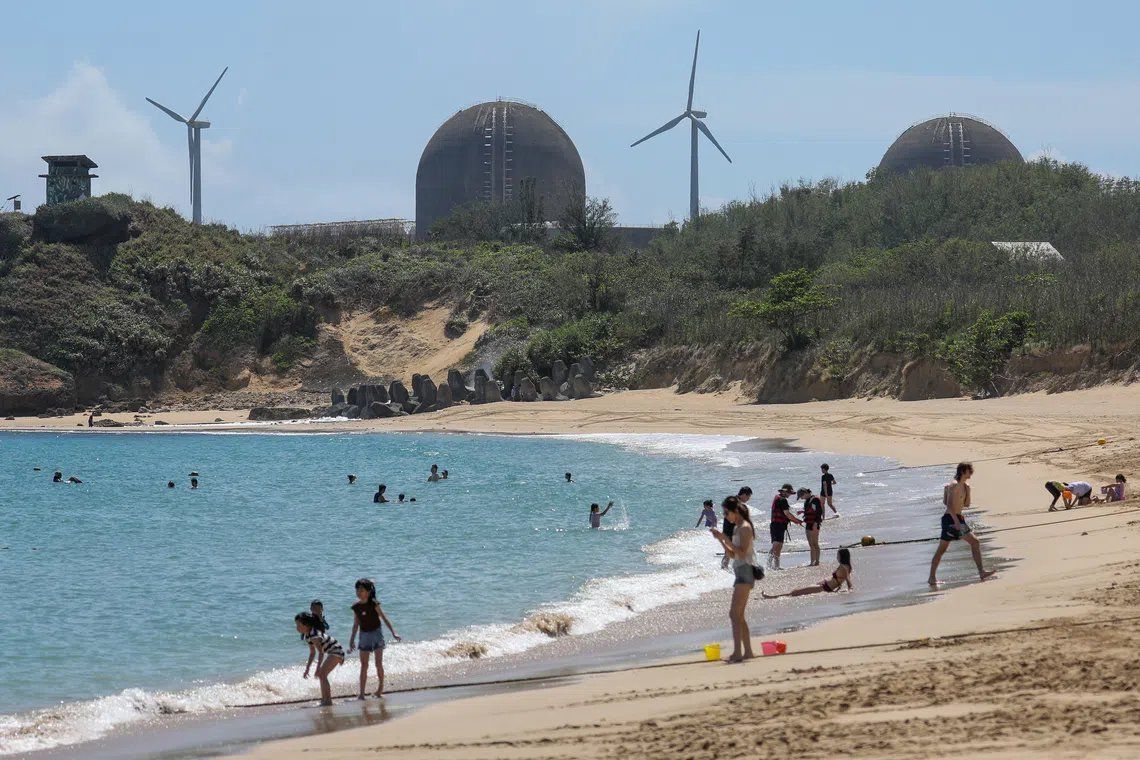
Taiwan faces another reckoning on nuclear power next month, as voters prepare to weigh in on whether the government should abandon its long-standing "Nuclear-Free Homeland" policy. The referendum, scheduled for November 28 alongside the island's "nine-in-one" local elections, has reignited debate not just about energy security but about the role and misuse of direct democracy in Taiwan's political system. This marks the fourth nuclear-focused referendum in just eight years, suggesting that something more than genuine policy recalibration is at work beneath the surface of this recurring national conversation.
The nuclear referendum question specifically asks citizens whether the government should reverse course on its nuclear phase-out commitment to address three stated concerns: protecting public health, ensuring stable and affordable electricity, and strengthening national defence resilience while supporting artificial intelligence industry development. Three referendums were submitted to Taiwan's Central Election Commission this year, though only the nuclear proposal cleared the hurdle for inclusion on the November ballot. The commission rejected a second referendum on legalising corporal punishment for serious crimes, citing human rights concerns, while a third proposal regarding traffic fine revenue allocation also failed to gain approval. The selective approval process itself underscores how contentious and fraught the referendum mechanism has become in Taiwanese politics.
On its surface, the timing and substance of the nuclear question seem reasonable. Significant shifts in global energy markets have occurred since voters last weighed in on this issue just one year ago. The blockade of the Strait of Hormuz has created genuine uncertainty about oil supply chains, while the explosive growth of artificial intelligence consumption is straining Taiwan's electricity infrastructure in real and measurable ways. These material changes in the energy landscape provide legitimate grounds for revisiting public opinion, and proponents can point to genuine policy reasons for asking voters again. Yet experts who study Taiwanese politics argue that electoral calculation, rather than substantive policy concern, ranks equally or even higher in the minds of those who initiated these referendums.
The opposition parties, the Kuomintang (KMT) and Taiwan People's Party, appear to view November's referendums as tools to mobilise their core constituencies of conservative-leaning voters. Historical evidence supports this strategic logic. In 2018, when 10 national referendums were held alongside local elections, the KMT achieved exceptionally strong results in those contests. Higher turnout among voters motivated by conservative social and security issues tends to benefit opposition candidates, particularly in close local races where margins can be razor-thin. Qi Dongtao, a senior research fellow at the East Asian Institute at the National University of Singapore, emphasises that "this electoral consideration is probably at least as important as the policy substance of the referendums themselves." The KMT's support for a now-rejected caning referendum illustrates this point with unusual clarity, as party politicians openly discussed its potential to drive turnout among their supporters.
Beyond simple turnout mechanics, opposition parties see referendums as a vehicle for setting the political agenda. By placing issues like nuclear power and crime on the ballot alongside local elections, they create opportunities to frame themselves as defenders of values their supporters cherish. Chong Ja Ian, an associate professor of political science at NUS, notes that the KMT deliberately positions itself in comparison with Singapore, which many Taiwanese associate with law and order alongside prosperity. This framing allows the opposition to argue they are attempting to be tough on security and safety issues but are constrained by the ruling Democratic Progressive Party's policies and legislative positions. In this sense, referendums function less as mechanisms for genuine democratic deliberation and more as campaign tools for broadcasting partisan messages.
Taiwan's exploding referendum culture represents a relatively recent phenomenon with clear institutional origins. Before 2017, the threshold for holding and passing referendums was far more demanding. Referendums required a 50 percent turnout to be valid, which explains why former President Chen Shui-bian's two referendums on cross-strait relations failed in 2004 despite overwhelming support from those who actually voted. The 2017 reform dramatically lowered these barriers, establishing that a referendum passes if "Yes" votes exceed "No" votes and valid "Yes" votes reach at least 25 percent of the overall electorate. This change opened the floodgates. The number of referendums held increased sharply in the years following the revision, transforming Taiwan into a jurisdiction holding more frequent national referendums than most democracies globally.
Legal and political scholars have raised serious concerns about whether Taiwan's referendum system now serves genuine democratic purposes or has been captured by partisan competition. Lin Jia-he, an associate professor at National Chengchi University's College of Law, points out that even Switzerland, the global exemplar of direct democracy, requires three to five years between initial proposal and final referendum vote. This extended timeline allows government agencies and the public adequate space to deliberate complex policy questions thoroughly. By contrast, Taiwan's nuclear referendum was announced on August 28 and will be decided on November 28—a three-month window that Lin argues is insufficient for meaningful public discussion of "rigorous, complex and diverse" energy policy combinations. Voters lack the time to educate themselves about genuine technical tradeoffs between nuclear power, renewable energy, and other generation sources.
The erosion of referendum integrity as a democratic institution appears to be corroding public confidence. Taipei resident Sean Chang, a 39-year-old public relations professional who voted in the 2018 referendum, describes how his initial faith in the mechanism has curdled into skepticism and disengagement. He observes that while referendums began with good intentions, they have devolved into "a tool for each political party to manipulate public opinion." The sheer frequency and contentious nature of ballot questions have exhausted voters' capacity and willingness to engage seriously. After considering multiple perspectives on successive waves of referendums, many citizens have simply checked out, declining to invest the cognitive effort required to make informed choices. This represents a troubling inversion of direct democracy's promise—instead of empowering citizens, the proliferation of referendums appears to be alienating them from political participation.
Qi Dongtao articulates the deeper structural problem. When political parties have strong incentives to propose highly contentious issues specifically to attract media attention and mobilise supporters, referendums transform from an instrument of deliberative democracy into merely another arena for partisan warfare. The institution loses its distinctive character and purpose, becoming simply one more campaign tactic indistinguishable from television advertising or social media messaging. Qi argues that referendums should ideally be reserved for genuinely major constitutional or policy questions where there exists a compelling reason to seek direct popular authorisation, rather than being deployed routinely as supplementary weapons in ongoing party competition. The current Taiwanese system has drifted far from this ideal.
The November 28 elections will determine winners for 11,051 local public offices, including county magistrates and municipal administrators across Taiwan. Though local in scope, these elections serve as a crucial bellwether for Taiwan's national political trajectory leading toward presidential elections due by 2028. The campaigning typically emphasises domestic governance issues, from infrastructure to public services, yet the way voters respond to these combined local and referendum ballots will reverberate through Taiwan's broader political landscape. Opposition parties are betting that nuclear and security referendums can shift the electoral terrain in their favour by activating their core constituencies. Whether this strategy succeeds may depend less on the substantive merits of the nuclear policy question and more on whether voters can be mobilised by issues that, however important in principle, have been subordinated to instrumental partisan calculations. Taiwan's democratic system faces a crucial test: whether it can preserve the integrity of direct democracy mechanisms or whether those institutions will be fully absorbed into the machinery of party competition.

