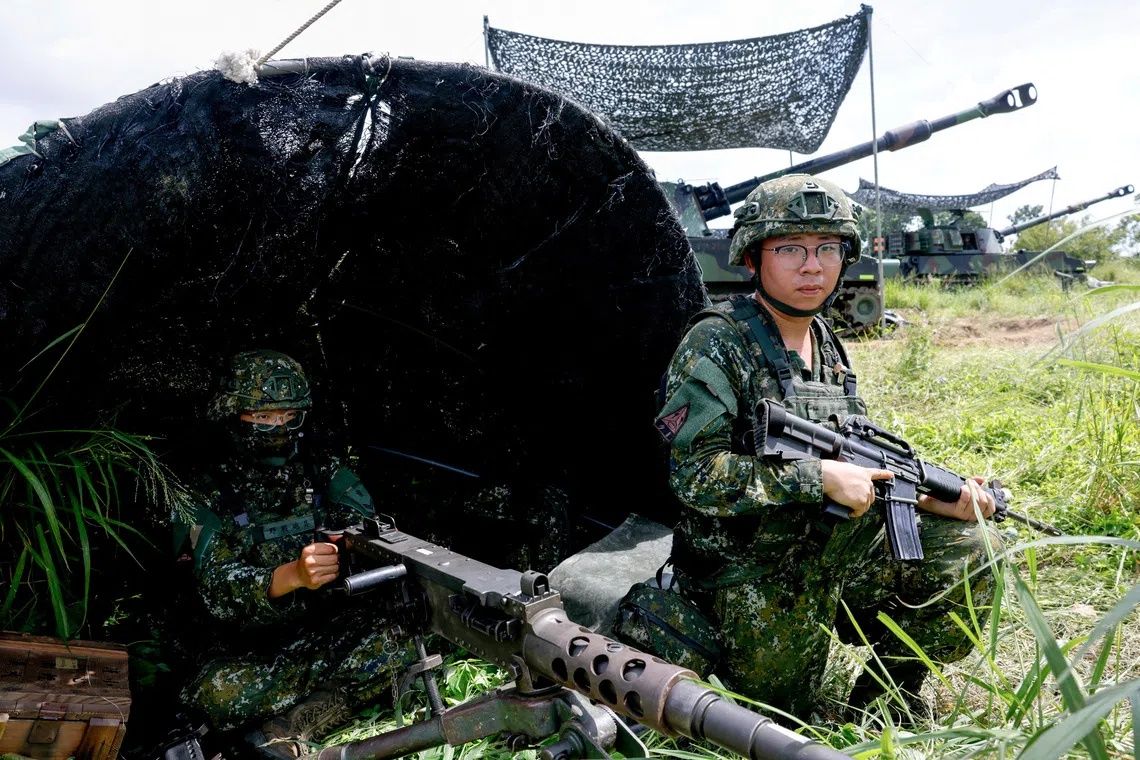
Taiwan's armed forces commenced their largest annual military exercise on Wednesday, marking a significant shift toward more realistic and adaptable warfare readiness as the island faces intensifying military pressure from China. The 10-day Han Kuang drills, initiated from an underground command centre in Taipei, represent a departure from formulaic training by introducing variables designed to mirror the chaos and unpredictability of actual combat operations. Over 20,000 troops, including approximately 5,000 reservists, will participate in the exercise, which runs through August 14 and incorporates several operational innovations previously absent from Taiwan's defence protocols.
The exercise's most distinctive feature involves a deliberate slowdown of mobile internet speeds across the island for the first time in the drills' 40-year history. This unprecedented measure aims to simulate the communication constraints Taiwan's civilian population would face if China attempted to sever the island's digital infrastructure during an actual conflict. By throttling bandwidth during the exercise, Taiwan's defence planners seek to identify vulnerabilities in how government agencies, emergency services, and critical infrastructure operators would coordinate responses when conventional communication networks become compromised. The approach reflects growing concern that any military confrontation could extend beyond purely military targets to encompass systematic attacks on civilian command and control systems.
Central to this year's training emphasis is improving coordination between commanders and their subordinates through adoption of a so-called backbrief mechanism modelled on United States military doctrine. Under this system, junior officers receiving operational orders must restate the mission's objectives and details back to their superiors before executing commands. This seemingly simple procedural change addresses a historically persistent vulnerability in Taiwan's military operations: ensuring that commanders at multiple hierarchical levels maintain synchronized understanding of strategic intent, particularly when battlefield conditions change rapidly or communications deteriorate. Defence officials stressed that this innovation targets a fundamental coordination challenge that could prove catastrophic if commanders misinterpret orders or subordinates misunderstand mission parameters during actual hostilities.
The drills specifically emphasise scenarios where China, which maintains a territorial claim on Taiwan despite the island's democratic self-governance, executes coordinated strikes against command centres, ports, logistics networks, and defence industry facilities in the campaign's opening hours. Taiwan's military planners view this opening phase as potentially decisive, recognising that paralysing the island's command infrastructure early could degrade Taiwan's ability to mount an effective defence. By rehearsing responses to such targeting, Taiwan aims to develop redundancies and alternative communication pathways that would allow military operations to continue even after primary command facilities are damaged or destroyed. The exercise includes simulated emergency relocation of major military arsenals and mobilisation of civilian factories for wartime production, underscoring Taiwan's strategy of distributing critical military functions across broader economic and civilian sectors.
Naval operations feature prominently in this year's drills, with emphasis on escort missions conducted off Taiwan's Pacific coast. These exercises address a strategic vulnerability that defence officials view with particular urgency: China's potential capacity to sever Taiwan's supply lines to regional allies, particularly the United States and Japan. As Chinese naval and air capabilities expand, Taiwan recognises that maintaining control over sea lanes and demonstrating credible capacity to defend maritime commerce has become increasingly critical to national survival. The escort drills test Taiwan's navy's ability to operate amid contested sea conditions and develop tactics for protecting civilian shipping essential to the island's economic functioning and wartime sustenance.
Taiwan's defence establishment has previously faced criticism that its military exercises operated in an artificial, controlled environment that failed to capture warfare's unpredictable dimensions. This year's drills represent an intentional shift toward what officials characterise as a real field environment confronting genuine bottom-line operational conditions. Field commanders will be presented with unexpected scenarios that deliberately deviate from pre-planned enemy assumptions, forcing officers to reassess situations, adjust tactical approaches, and rapidly issue modified orders. This emphasis on adaptability and improvisation reflects an evolved understanding within Taiwan's defence community that modern conflict requires commanders capable of thinking critically rather than merely executing pre-rehearsed plans.
The exercise incorporates novel measures for managing information during wartime, including an embedded reporter mechanism designed to assess how the military would communicate with the public while simultaneously countering adversary disinformation campaigns. Taiwan's defence officials recognise that modern conflicts involve battles for information supremacy alongside kinetic operations, and that civilian morale and accurate understanding of military developments significantly influence national resilience. By testing how the military would manage news releases and combat false narratives during wartime conditions, Taiwan aims to develop institutional capacity for maintaining public cohesion and accurate information flow during crisis scenarios that could last months or longer.
Resilience and continuity of government operations form another critical component of Taiwan's evolving exercise framework. Beyond purely military drills, Taiwan has increasingly incorporated exercises testing how local officials would sustain government functions during cascading crises ranging from natural disasters to military invasion. This whole-of-society approach reflects recognition that defending against a Chinese military assault requires not merely military resistance but sustained civilian organisation, economic function, and governmental coherence across extended conflict periods. The drills test whether administrative systems can continue operating if primary facilities are damaged, whether supply chains for essential goods can be maintained, and whether government services essential to civilian survival and morale can persist despite infrastructure disruption.
The exercise's design also acknowledges Taiwan's increasingly precarious diplomatic and strategic position. As Chinese military capabilities expand and as regional security dynamics shift, Taiwan faces narrowing margins for error in its defensive preparations. The island's defence officials emphasise that exercises must progressively approximate actual wartime conditions rather than remaining laboratory-like simulations. This evolution reflects sobering assessments within Taiwan's security establishment that the window for developing credible defensive capabilities may be narrowing, and that every training iteration must maximise learning outcomes applicable to genuine conflict scenarios.
For regional security observers, Taiwan's Han Kuang drills offer revealing windows into how the island perceives military threats and which vulnerabilities most concern its defence planners. The emphasis on command flexibility, civil-military coordination, information warfare, and supply line protection suggests Taiwan views a potential conflict as protracted, involving attacks on civilian infrastructure, and dependent on sustained popular resilience alongside military defence. The exercise also signals Taiwan's integration with American military doctrine and doctrine-sharing with US defence planners, an alignment that China views as provocative but which Taiwan considers essential given the massive asymmetry in military resources between the island and mainland China.
China's defence ministry declined to comment on the Taiwan drills, maintaining its longstanding position that the island remains a breakaway province over which Beijing reserves the right to exercise force. However, Taiwan's growing emphasis on realistic, adaptive military training and civilian resilience reflects an island bracing for scenarios that could unfold with limited warning. The Han Kuang exercise represents more than procedural military training; it embodies Taiwan's attempt to transform its entire society and governance systems into structures capable of withstanding and persisting through sustained military pressure from an incomparably larger adversary.

