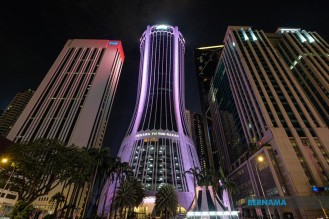
Tabung Haji's controversial RM193.5 million acquisition of a 30 per cent stake in Putrajaya Perdana Bhd came to light during a parliamentary special sitting, with Finance Minister II Datuk Seri Amir Hamzah Azizan revealing that the entire approval process occurred when the construction company was allegedly under the control of fugitive businessman Low Taek Jho, commonly known as Jho Low. The disclosure emerged during deliberations on a Royal Commission of Inquiry report examining the pilgrimage fund's management and operational practices, raising fresh questions about governance failures that resulted in substantial losses to depositors' funds.
According to sworn testimony from court proceedings in the SRC International case, Putrajaya Perdana remained under Jho Low's influence through Utama Banking Group Bhd throughout the period in which Tabung Haji's investment was being evaluated and approved. The testimony specifically referenced how SRC International, itself a former subsidiary of the scandal-plagued 1Malaysia Development Bhd, channelled RM170 million into Putrajaya Perdana's subsidiary between July and August 2014. This financial link established during the investment approval window raises concerning implications about the nature of corporate relationships and control structures that Tabung Haji's decision-makers failed to adequately investigate.
The chronology of approvals spanning mid-2014 reveals a compressed timeline that left little room for thorough scrutiny. Tabung Haji's Investment Panel gave its approval on July 24, followed by board endorsement on August 25 and ministerial sign-off on August 27 of that year. The sale and purchase agreement was subsequently signed in December 2014, with Tabung Haji transferring the full investment amount to Cendana Destini Sdn Bhd that same month. Notably, Jho Low's Utama Banking Group did not complete its sale of Putrajaya Perdana until April 13, 2015, meaning the company remained within the alleged sphere of the fugitive businessman's influence well after Tabung Haji had committed its capital.
Minister Amir Hamzah acknowledged that while sworn testimony on record placed the company under Jho Low's control during this period, no court has formally made a finding regarding his beneficial ownership of Putrajaya Perdana at that time. However, this technical caveat provided little comfort regarding the broader governance failures that the parliamentary inquiry exposed. The minister's own presentation highlighted that Tabung Haji's Investment Panel explicitly requested on July 24, 2014, that management identify the ultimate shareholder of the seller—a reasonable safeguard given the known involvement of parties associated with 1MDB and SRC International. Remarkably, no documented response to this critical request appears in the transaction records, yet the approval process proceeded regardless.
The valuation of the investment itself presents a troubling narrative of escalating costs disconnected from underlying fundamentals. Tabung Haji's Research Division initially assessed the 30 per cent stake at between RM124 million and RM155 million, substantially below the RM206 million price tag ultimately proposed. The investment panel approved RM193.5 million without providing written justification for accepting a valuation significantly above the research division's upper estimate, nor did it adequately explain the simultaneous increase from a proposed 25 per cent stake to 30 per cent. This deviation from standard prudent investment practices suggests that decision-makers either lacked confidence in their assessment methodology or simply failed to enforce proper controls.
Perhaps most alarming was the abandonment of standard due diligence protocols. Formal due diligence work was conducted only after all approvals had already been obtained and the contractual agreement signed—a reversal of proper procedure that deprived decision-makers of critical information at the moment they could have acted upon it. The Investment Panel and board of directors never received due diligence findings before authorising the transaction. A subsequent 2023 fact-finding assessment similarly documented that four investments within Tabung Haji's portfolio failed to undergo required due diligence procedures, while recommendations from the fund's Risk Management Department were systematically disregarded, indicating systemic deficiencies rather than isolated lapses.
The magnitude of the overvaluation becomes apparent when examined against Cendana Destini's acquisition history. Putrajaya Perdana's seller had acquired its entire equity stake in the company for RM260 million in 2012, implying that a 30 per cent stake was valued at approximately RM78 million at that time. Within two years, Tabung Haji paid RM193.5 million for the identical stake—a two-and-a-half fold increase despite no apparent change in the company's operational status or market conditions that would justify such appreciation. For Malaysian workers and their families whose savings fund the pilgrimage scheme, this pricing disparity represented wealth transfer rather than investment.
The failure of promised returns compounded the original poor investment decision. Tabung Haji accepted the investment based on two critical assurances: that Putrajaya Perdana would be relisted within twelve months and achieve RM86 million in profit during 2015. Neither materialised. Instead of these performance milestones validating the investment thesis, the fund's management discovered that the chairman of Tabung Haji simultaneously held the chairmanship of Putrajaya Perdana—a conflict of interest that should have triggered immediate recusal from decision-making processes. By 2018, Tabung Haji was forced to exercise a put option demanding the seller repurchase the shares at RM210.7 million, yet the seller never provided payment. As of the 2024 financial year, the entire RM193.5 million investment had been written off as a total loss.
The consequences of these governance failures extend beyond simple financial loss. For Malaysian pilgrims whose mandatory contributions built Tabung Haji's investment portfolio, the revelation that funds were deployed based on inadequate due diligence and linked to individuals connected with 1MDB's scandals undermines confidence in institutional stewardship of retirement savings. The involvement of parties associated with SRC International and Jho Low adds a security dimension—it suggests that the fund's assets became entangled with assets that were themselves the subject of international fraud investigations and asset recovery efforts. Southeast Asia's broader investment climate is affected as well, since instances where major institutions deploy capital based on overvalued pricing and inadequate governance undermine regional market credibility.
Tabung Haji's current legal action represents an attempt to recover losses through the courts, with a writ filed and a Mareva injunction freezing related assets. Court-directed mediation was scheduled for the same day as the parliamentary disclosure, with trial proceedings set for June 23, 2027—a timeline that reflects the complexity and contested nature of the underlying transaction. However, litigation cannot restore the years of opportunity cost represented by RM193.5 million that could have been invested in assets with transparent ownership structures and superior governance. The parliamentary inquiry documented this case as emblematic of broader institutional failures that characterised Tabung Haji's management during the period in question, suggesting that multiple stakeholders and decision-makers bore responsibility for deploying pilgrims' funds in transactions where the identity and legitimacy of counterparties remained inadequately verified.

