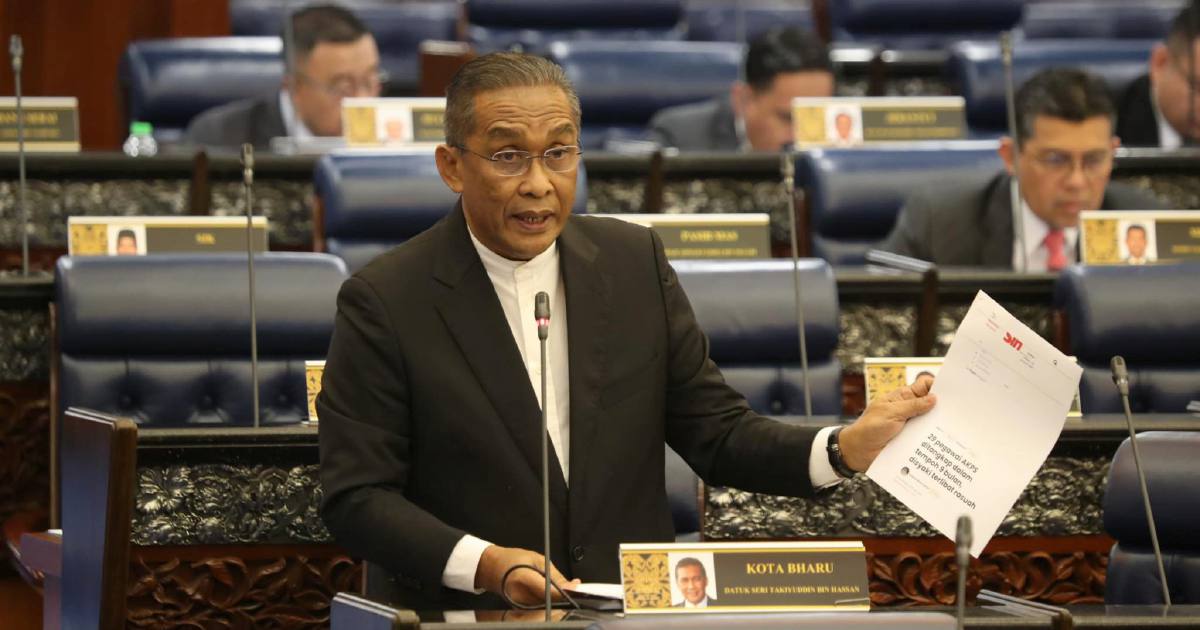
Datuk Seri Takiyuddin Hassan, the Opposition's chief whip, has formally requested postponement of an extraordinary sitting of the Dewan Rakyat scheduled to examine findings from the Royal Commission of Inquiry into Tabung Haji, pending the return of Prime Minister Datuk Seri Anwar Ibrahim to the legislative chamber. The timing of this intervention reflects broader parliamentary procedural considerations and the significance both sides of the House accord to the government's chief executive in such proceedings.
The Tabung Haji RCI, which examined the governance and operations of Malaysia's pilgrimage savings board, has emerged as a matter commanding attention across the political spectrum. The inquiry's conclusions carry implications for the management of sacred trust invested by Malaysian Muslims in the institution, making parliamentary scrutiny an essential democratic exercise. Yet the mechanics of how and when such scrutiny occurs remains contested between government and opposition benches.
Takiyuddin's position underscores a convention observed in Westminster-derived parliaments where major policy pronouncements or debates of national importance ideally occur with the Prime Minister present. In Malaysia's context, this reflects not merely theatrical deference but substantive legislative practice: allowing the head of government to address the chamber directly lends both authority and responsibility to responses offered regarding matters affecting public institutions and citizen interests.
The request assumes particular weight given Anwar's periodic absences from parliament, whether occasioned by international commitments, medical considerations, or other official duties. The Opposition chief whip's gambit suggests that opposition parties perceive advantage in having the PM directly engage with questions surrounding Tabung Haji's administration, management failures, and potential reforms. This positioning allows them to hold the executive to account through direct examination rather than confronting government representatives of lesser rank.
For Malaysian Muslims who maintain Tabung Haji accounts—representing millions of depositors nationwide—the RCI outcomes carry direct personal and financial significance. The institution manages savings accumulated specifically for hajj pilgrimage, one of Islam's five pillars, making governance failures peculiarly sensitive within religious and community contexts. Parliamentary debate conducted with full attendance of senior government figures signals to stakeholders that their concerns receive appropriate institutional recognition.
The Tabung Haji organization has historically faced scrutiny regarding investment strategies, operational transparency, and benefit returns to members. An RCI investigation suggests findings of sufficient gravity to warrant formal parliamentary examination. Whether such examination occurs with or without the PM's presence affects both the political optics and the substantive quality of parliamentary discourse surrounding remedial measures.
Takiyuddin's intervention also reflects tactical parliamentary mathematics. If the government proceeded without the PM's presence, the Opposition could subsequently characterize the debate as inadequate, arguing that serious issues deserved the attention of Malaysia's chief executive. By requesting postponement, the Opposition establishes itself as the voice of procedural propriety and institutional seriousness, positioning the government as potentially dismissive if it proceeds with the sitting as originally scheduled.
The special sitting itself represents parliamentary acknowledgment that Tabung Haji matters transcend routine business. The deliberate scheduling of a dedicated sitting indicates that findings warrant extended debate beyond ordinary oral question time. This extraordinary procedure typically accompanies matters deemed of substantial national concern, raising expectations among depositors and the broader public that parliament will engage seriously with whatever shortcomings the RCI has identified.
From a governance perspective, postponement until Anwar's return allows his government to present a united front in responding to RCI conclusions. If particular administrative changes, policy reforms, or accountability measures emerge as necessary, the PM's direct parliamentary statement carries greater authority than ministerial exposition alone. It also permits government coordination—ensuring that Finance Ministry, Islamic Affairs Ministry, and other relevant portfolios align their responses.
The broader institutional context involves questions about whether Malaysia's pilgrimage savings scheme requires structural overhaul, enhanced regulatory oversight, or management replacement. These determinations fall naturally to government and require executive capacity to implement. A parliamentary debate without the PM might yield robust critique but prove frustratingly distant from actual decision-making authority.
Regional observers note that Southeast Asian nations increasingly emphasize institutional accountability for religiously-anchored organizations. Indonesia's hajj fund management similarly attracts parliamentary and public scrutiny. Malaysia's handling of the Tabung Haji RCI thus carries visibility within Muslim-majority and Muslim-significant societies across the region, influencing perceptions of Malaysian governance standards.
Takiyuddin's proposal reflects institutional maturity—the Opposition simultaneously holds government accountable while respecting parliamentary convention. Rather than proceeding with a debate potentially diminished by the PM's absence, the Opposition stakes its credibility on demanding adequate senior executive engagement. This approach elevates the discussion from partisan point-scoring toward substantive institutional examination.
The ultimate decision rests with the government and the Dewan Rakyat Speaker regarding the special sitting's scheduling. Whether the sitting proceeds as planned or accepts Takiyuddin's postponement proposal will clarify whether government and opposition share commitment to examining Tabung Haji governance with appropriate seriousness and executive involvement.

