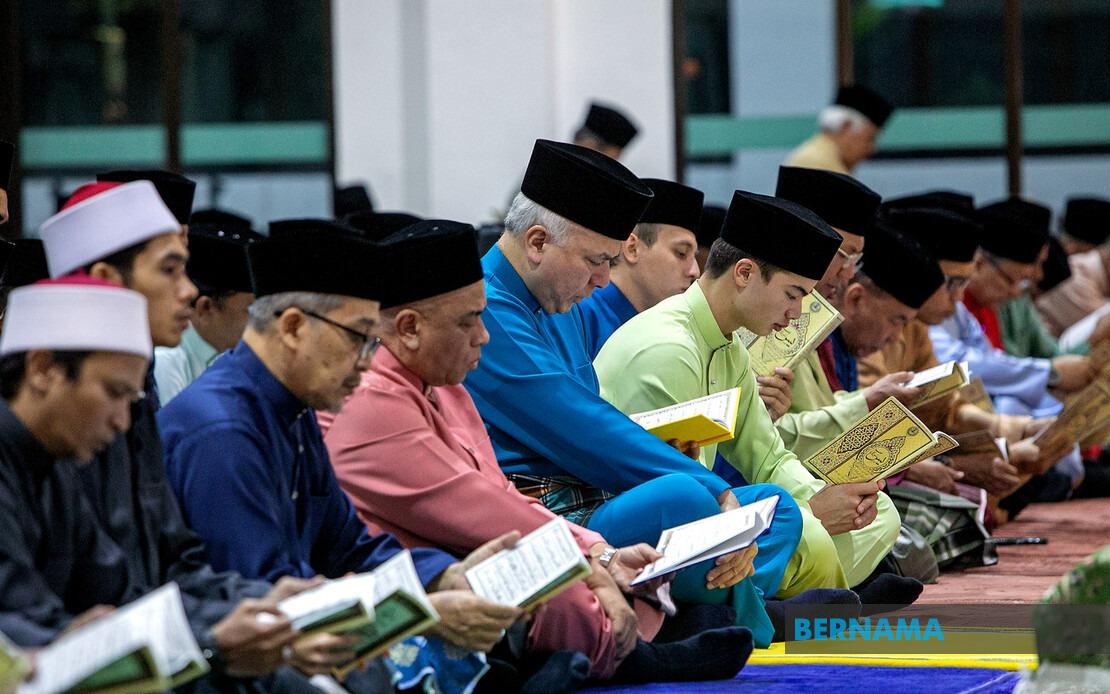
Sultan Nazrin Shah, the reigning monarch of Perak, graced the state-level National Day celebration in Ipoh with his presence, participating in religious observances at a newly completed mosque that stands as a modern addition to the state's Islamic infrastructure. The evening gathering on August 30 brought together prominent government officials, religious leaders, and approximately 1,000 congregants to mark the occasion with Yasin recitation, tahlil, and doa selamat ceremonies at Masjid Imam As Syafie.
The mosque itself represents a significant investment in Perak's religious and community facilities. Constructed at a cost of RM8.7 million and completed within the past year, the structure has been engineered to accommodate approximately 1,600 worshippers simultaneously, reflecting the growing demand for prayer spaces in the state capital. The facility underscores ongoing efforts by state authorities to enhance religious infrastructure that serves both daily congregational needs and special occasions such as national celebrations.
During the official opening ceremony, Sultan Nazrin performed the symbolic act of unveiling the plaque marking the mosque's inauguration, a gesture that formally confirmed the facility's readiness for public use. Following this ceremonial duty, His Royal Highness joined the assembled congregants in performing doa selamat, a traditional Islamic prayer seeking blessings and protection for the nation and community. This active participation demonstrated the monarchy's commitment to engaging directly with religious observances rather than maintaining a purely ceremonial distance.
Among the distinguished attendees was Menteri Besar Datuk Seri Saarani Mohamad, who accompanied the Sultan throughout the evening's proceedings. Also present was Tan Sri Mohd Annuar Zaini, the president of the state Islamic Religious and Malay Customs Council (MAIPk), whose attendance reflected the formal coordination between state religious authorities and the secular government apparatus in managing the celebration.
The religious programme proceeded under the leadership of Masjid As Syafie Imam II Muhammad Luqmaan Mohd Helmi, who guided attendees through the Yasin recitation and tahlil. Sultan Nazrin's participation in these devotional practices extended beyond the formal opening, as His Royal Highness joined the congregational Isyak prayer performed later in the evening. This demonstrated a deep engagement with the spiritual dimensions of the National Day observance, connecting the secular celebration of national identity with Islamic religious practice.
The choice of a mosque as the venue for state-level National Day commemorations reflects Malaysia's constitutional framework, which recognises Islam's special position within the federation whilst accommodating the religious pluralism of its diverse population. The decision to hold such observances in religious settings carries particular significance in Perak, a state with a substantial Muslim majority and long-established traditions of royal patronage of Islamic institutions.
The scale of attendance—approximately 1,000 people gathered for the evening ceremony—indicates substantial public interest in formal national observances when combined with religious activities. This convergence of patriotic and spiritual dimensions appears to resonate with many Malaysians, who view their Islamic faith and national identity as intertwined rather than competing loyalties.
From a developmental perspective, the completion and opening of Masjid Imam As Syafie represents part of broader infrastructure expansion in Ipoh and greater Perak. As urbanisation continues across Malaysia, local authorities prioritise construction of religious facilities alongside schools, hospitals, and transport networks. The substantial investment of RM8.7 million signals recognition that contemporary religious infrastructure must meet modern standards in design, capacity, and amenities.
The Sultan's active participation in such ceremonies carries constitutional and symbolic weight beyond ceremonial protocol. As both spiritual figurehead and constitutional monarch, the Sultan's presence at religious observances reinforces the interconnection between the institution of monarchy and Islamic practice in Malaysian governance. This relationship has historical roots extending through the constitutional settlement of 1957 and remains central to understanding Malaysian political culture.
For Perak specifically, the development of new major mosques in the state capital contributes to broader efforts to position Ipoh as a modernising regional centre. Contemporary infrastructure investments, coupled with preservation of traditional Islamic practice and royal ceremony, present a vision of development that integrates modernity with cultural continuity—a balance that remains important for political legitimacy across much of Malaysia.
The attendance of approximately 1,000 congregants reflects the capacity of religious gatherings to mobilise public participation in ways that secular political events sometimes struggle to achieve. The combination of National Day commemoration with established Islamic rituals creates occasions where national identity and religious faith reinforce rather than compete with one another, a dynamic that Malaysian religious and political leaders have long recognised as essential to social cohesion.

