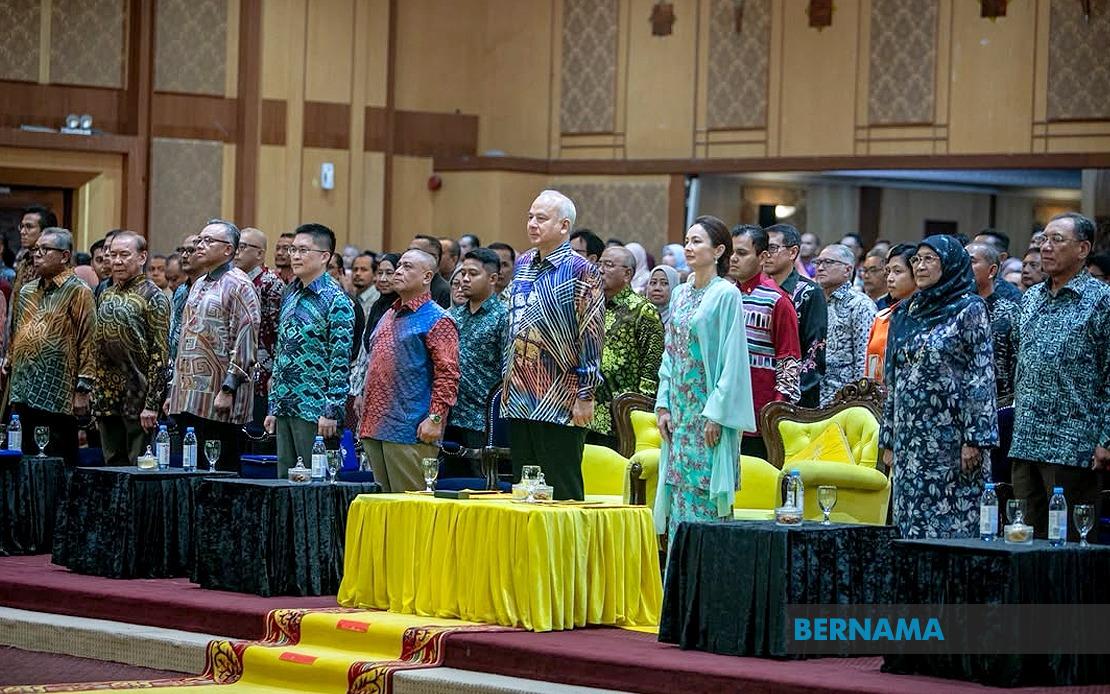
Sultan Nazrin Shah, the Sultan of Perak, presided over the opening of the state-level Merdeka Month celebration in Ipoh on Thursday evening, underscoring the royal family's commitment to fostering patriotism and national consciousness among younger generations. The event at Bangunan Perak Darul Ridzuan brought together education officials, government representatives, and hundreds of students in a showcase of cultural and academic competitions that exemplified the state's approach to instilling loyalty and civic pride. Joining the Sultan were Raja Permaisuri Tuanku Zara Salim, Menteri Besar Datuk Seri Saarani Mohamad, and Deputy Education Minister Wong Kah Woh, reflecting the significance placed on the occasion by both state and federal authorities.
The scale of participation in this year's Merdeka Month activities demonstrates substantial momentum in Perak's educational engagement initiatives. The programme drew 214,095 entries from students across primary and secondary institutions, representing an impressive 83.6 per cent of the student population in the state. This level of involvement represents not merely a numerical achievement but signals a broader willingness among schools and families to embrace organised national observances. The competitions encompassed diverse disciplines, ranging from language-based competitions to visual arts, creative writing, and musical performances, allowing students from varying backgrounds and abilities to participate meaningfully.
Particularly noteworthy is the 15 per cent increase in participation compared with the previous year, a trajectory that education officials attribute to growing awareness of the programme's value as a talent-discovery and confidence-building platform. According to Perak Education Department director Zulkafli Mohamed Mokhtar, the expanding uptake reflects the programme's increasing relevance within schools and communities across the state. This growth trajectory carries implications beyond mere statistics; it suggests that state-level educational initiatives, when properly resourced and supported by school leadership, can achieve genuine traction and become embedded within institutional culture.
The philosophical underpinning of the Merdeka Month initiative extends well beyond ceremonial patriotism. State education officials explicitly frame the programme as aligned with the Malaysia Education Plan 2026-2035, a comprehensive national strategy that prioritises not only academic excellence but also moral development, critical thinking, historical consciousness, and leadership capabilities. This alignment indicates a deliberate effort to embed national observances within broader pedagogical frameworks rather than treating them as isolated cultural events. For Malaysian policymakers, the integration of patriotic education with substantive competency development represents an attempt to address criticisms that national celebrations can sometimes appear disconnected from practical educational outcomes.
The Sultan's involvement in presenting awards to winning students across multiple categories served to elevate the status of the competitions and reinforce the connection between individual achievement and national purpose. Ifwat Arrafi Mohd Amin of SMK Tun Abd Razak in Bagan Datuk claimed the upper secondary Malay Language Public Speaking award, while E Johnnes Abysia from SMK Sungai Pari secured victory in the English public speaking category. These recognition ceremonies, conducted under royal patronage, communicate to student participants that their intellectual and creative pursuits carry significance beyond classroom assessment and contribute to the nation's cultural fabric.
The distribution of institutional awards further emphasises the programme's system-wide focus. The Kinta Utara District Education Office received a special award for Best Achievement, along with RM20,000 in cash recognition, acknowledging the coordinating effort required to mobilise schools and students at the district level. Such incentive structures, when directed toward administrative units rather than solely individual performers, encourage institutional commitment to programme implementation and create accountability mechanisms within the education bureaucracy. For Malaysian school administrators, the availability of recognition and financial support potentially influences resource allocation decisions and staff prioritisation throughout the academic year.
The breadth of competition categories reflects conscious curriculum design aimed at identifying and nurturing talent across multiple domains. Competitions spanning choral speaking, choral recitation, choir performance, caricature drawing, essay writing, poetry composition, and poster design ensure that students with varying interests and aptitudes encounter appropriate avenues for participation. This multi-disciplinary approach contrasts with educational models that concentrate prestige and resources narrowly on academic subjects, instead positioning arts, oratory, and creative expression as integral to holistic student development. For Southeast Asian education systems grappling with questions about how to balance academic rigour with broader skill development, Perak's model offers practical demonstration of inclusive programming.
The involvement of both the Sultan and Raja Permaisuri in awarding prizes across different categories carried symbolic weight regarding gender representation and the royal family's interest in diverse educational pursuits. Tuanku Zara Salim's participation in presenting awards for essay, poetry, and poster competitions, distinct from Sultan Nazrin's focus on public speaking and artwork prizes, demonstrated shared commitment to the entire range of student achievements rather than hierarchical differentiation of disciplines. This approach, while seemingly procedural, communicates subtle messaging about the equal value assigned to different forms of intellectual and creative expression.
The exhibition component of the event, featuring drawing and caricature works from participating students, provided a gallery-style space for the royal family to engage directly with student creativity and observe the visual outputs of the programme. Such interactive elements transform what might otherwise remain an awards ceremony into a genuine showcase of student work, allowing decision-makers to assess quality, observe artistic development across age groups, and witness the programme's tangible outcomes. For education practitioners seeking to enhance the legitimacy and impact of youth competitions, the integration of exhibition spaces alongside awards distribution creates opportunities for deeper stakeholder engagement.
From a broader Malaysian and Southeast Asian perspective, Perak's Merdeka Month programme represents one approach among several strategies for channelling patriotic sentiment into constructive educational activity. The emphasis on student agency through competition and public recognition contrasts with more didactic models of civic education that rely primarily on curriculum content delivery. By positioning students as active creators and performers rather than passive recipients of patriotic messaging, the programme attempts to generate intrinsic motivation toward national pride and cultural appreciation. This pedagogical choice carries implications for how other Malaysian states and neighbouring Southeast Asian countries design their own citizenship and national observance programmes.
The programme's scale and growth trajectory indicate sustained institutional commitment and adequate resource allocation from Perak's education sector. The participation of senior state officials and royal patronage suggests that competing priorities have not displaced this initiative from the education calendar and budgetary considerations. For Malaysian states evaluating their own implementation of national programmes, the Perak experience demonstrates that consistent support over time, combined with structural features designed to encourage school participation and recognise achievement, can produce measurable increases in engagement. The model's sustainability will depend on whether the enthusiasm evident in participation statistics translates into perceived value among school administrators and whether the RM20,000 awarded to the top-performing district office proves sufficient incentive to justify the administrative burden on district education organisations.

