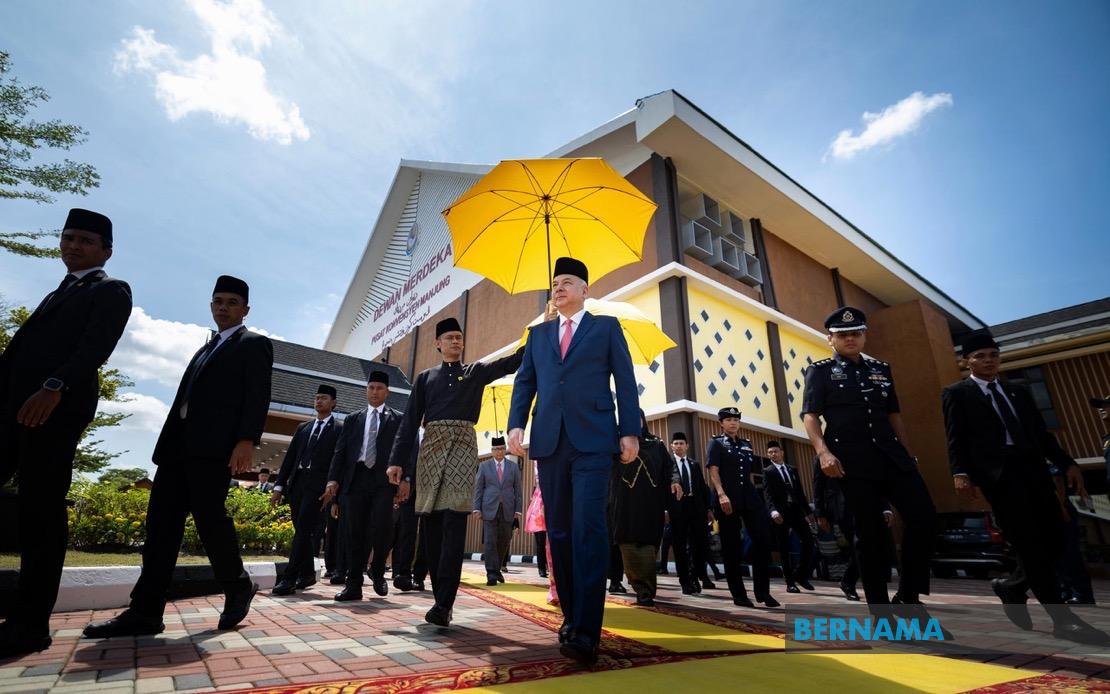
Sultan Nazrin Shah, the Sultan of Perak, has officially inaugurated the Merdeka Hall of the Manjung Municipal Council in Lumut, bringing to completion a project that has taken nearly a decade to realise. The significant infrastructure development, which cost RM12.7 million and can accommodate 2,500 people, represents a major addition to the district's civic facilities and reflects the state's commitment to modernising public infrastructure in its secondary centres. The ceremony was attended by Tuanku Zara Salim, the Raja Permaisuri of Perak, as well as Raja Iskandar Dzurkarnain Sultan Idris Shah, the Raja Di Hilir of Perak, underscoring the importance of the occasion within Perak's governance circles.
The opening ceremony drew together state and federal leadership, with Datuk Seri Saarani Mohamad, the Perak Menteri Besar, and Datuk Seri Dr Zambry Abd Kadir, the Higher Education Minister, both present to witness the milestone. Their attendance highlighted the cross-party nature of the project and the collaboration between different levels of government in advancing Perak's development agenda. The presence of these senior figures also demonstrated the state's intention to position Manjung as a priority area for investment and growth.
Peeling back the timeline of the project reveals a narrative of persistence within the state's bureaucratic machinery. The vision for a rebuilt Merdeka Hall originated in 2016, when the then-Menteri Besar championed the initiative despite competing fiscal demands. The subsequent Federal Government allocation, following years of advocacy and planning, eventually translated into the groundbreaking ceremony and now the opening itself. This extended development cycle, while lengthy, illustrates the complexities of securing funding and managing large construction projects in Malaysia's tiered governance structure.
The timing of the inauguration was deliberately synchronised with the Manjung Municipal Council's 25th anniversary celebrations, creating a symbolic convergence of milestones. The council was originally established as a district council on January 1, 1980, before being elevated to municipal status on August 1, 2001. This quarter-century of administrative evolution reflects the district's growing economic and social significance, with the new hall serving as a physical manifestation of institutional maturation. The dual celebration underlined the council's trajectory from a smaller administrative unit to a more empowered local government body.
In his keynote address, Saarani articulated an ambitious vision for Manjung's future, framing the hall's opening as the first of three interconnected developments. Beyond the immediate achievement of completing the 2016 initiative and marking the council's anniversary, he positioned the hall as essential infrastructure for a broader transformation. By 2030, Perak aims to establish Manjung as a Tourism and Maritime City, a designation that would fundamentally reshape the district's economic profile and attract investment in hospitality, maritime industries, and related services. The Merdeka Hall, in this strategic context, becomes more than a conference venue; it is a foundational element of urban branding and economic repositioning.
The scale and capability of the facility underscore this strategic thinking. With capacity for 2,500 attendees, the hall is designed to accommodate major conferences, trade exhibitions, cultural events, and conventions that would previously have required delegates to travel to larger urban centres. Such infrastructure gaps have historically disadvantaged secondary cities in Malaysia's competition for events and business tourism. By closing this gap, Manjung positions itself as a viable host for regional gatherings, potentially injecting direct and indirect economic benefits into the local economy through accommodation, dining, and transportation services.
Saarani's remarks on governance continuity carry particular weight in a state known for fractious politics. His emphasis on the project's progression across different administrations, from initiation through Federal approval to completion, signals a commitment to depoliticising developmental projects. In the Malaysian context, where local government and state dynamics can be turbulent, the stability demonstrated by seeing a multi-year project through to completion offers reassurance to potential investors and residents about the reliability of public institutions. This message of continuity resonates strongly in a political environment where policy reversals and administrative disruptions are not uncommon.
The naming of the facility as Merdeka Hall carries symbolic weight beyond mere nomenclature. In Saarani's interpretation, the hall's title serves as a reminder that national independence represents an ongoing trust requiring constant vigilance and renewal. This framing situates a municipal infrastructure project within the broader narrative of national sovereignty and responsibility, elevating the facility's significance beyond its immediate utilitarian functions. The invocation of merdeka values suggests an intention for the hall to become a space where civic engagement, informed deliberation, and community consensus-building can flourish.
For Malaysian and Southeast Asian observers, the Manjung project illustrates broader patterns in regional development strategy. As major metropolitan centres become increasingly congested and expensive, secondary cities are attracting renewed attention from both government planners and private investors. The strategic development of Manjung as a tourism and maritime hub reflects a recognition that sustainable economic growth requires distribution beyond primary cities. This approach mirrors initiatives elsewhere in Southeast Asia, where countries are systematically upgrading provincial infrastructure to facilitate more balanced development.
The convergence of maritime and tourism objectives in Manjung's 2030 vision also reflects regional economic trends. With global supply chains increasingly scrutinised and diversified, ports throughout Southeast Asia are modernising to capture transshipment opportunities. Simultaneously, cruise tourism and maritime heritage attractions are growing segments of the region's tourism economy. Manjung, positioned on the Perak coast with established port infrastructure, is well-placed to capitalise on both trends. The Merdeka Hall, as a gathering place for industry forums and stakeholder engagement, becomes an instrumental asset in advancing these complementary agendas.
Looking forward, the hall's success will depend on its actual utilisation and the quality of programming and management that future operators deliver. The gap between infrastructure provision and effective utilisation is well-documented in developing economies, where impressive facilities sometimes underperform due to inadequate marketing, operational challenges, or insufficient demand. The Manjung Municipal Council and Perak state government will need to actively cultivate usage among corporate clients, tourism operators, and community organisations to ensure the facility becomes a genuine economic and social catalyst rather than an underutilised monument.
The project also raises questions about resource allocation within Perak's governance structures. While the hall represents an important investment in Manjung, the decision to invest RM12.7 million in a single facility invites scrutiny about competing priorities. Roads, healthcare facilities, education infrastructure, and other public goods also compete for limited development budgets. The state government's confidence in the tourism and maritime city strategy suggests they believe this particular investment will generate sufficient returns—through economic activity, employment, and tax revenue—to justify its opportunity costs relative to other potential uses of the funds.
Ultimately, Sultan Nazrin's inauguration of the Merdeka Hall marks a tangible step in Perak's deliberate repositioning as a state with ambitions beyond its traditional economic base. The facility embodies not merely bricks and mortar but a declaration of intent regarding Manjung's future trajectory. Whether the hall fulfils its potential as a catalyst for broader development and whether Manjung successfully transitions to tourism and maritime prominence will become clear only with time and demonstrated economic outcomes. For now, the opening represents a moment of institutional optimism and a commitment to infrastructure that, properly deployed, could indeed contribute meaningfully to the district's transformation.

