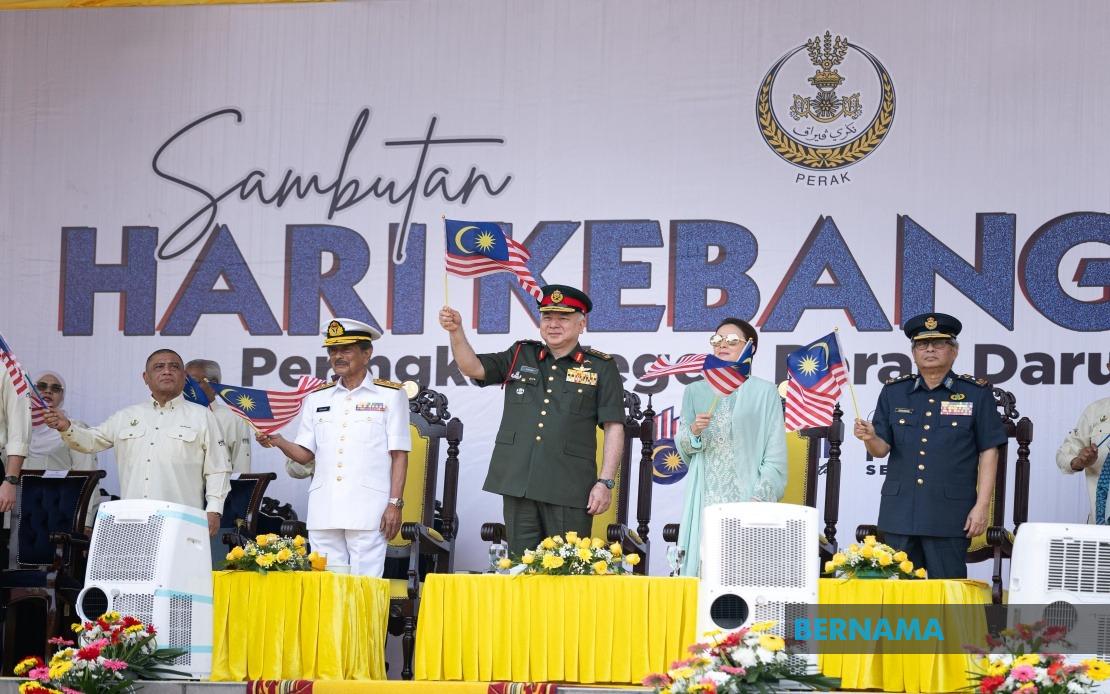
Sultan Nazrin Shah, the Sultan of Perak, together with Raja Permaisuri Tuanku Zara Salim, presided over the state-level National Day 2026 Awards Presentation Ceremony at Dewan Bandaran Ipoh on August 31. The dignified occasion brought together the state's senior leadership, including Menteri Besar Datuk Seri Saarani Mohamad and members of the State Executive Council, to recognise individuals who have demonstrated exceptional dedication to safeguarding Malaysia's territorial integrity and national security. The presence of Raja Muda Raja Jaafar Raja Muda Musa and Raja DiHilir Raja Iskandar Dzurkarnain Sultan Idris Shah underscored the ceremonial significance of honouring those who have sacrificed for the nation.
Eleven personnel spanning Malaysia's defence and law enforcement agencies received formal recognition and financial awards from the Sultan. The recipients comprised six members of the Malaysian Armed Forces, two from the Royal Malaysia Police, and three from the Royal Malaysian Navy. Each honouree received RM1,000 in cash accompanied by a certificate of appreciation, a modest but meaningful acknowledgement of their contributions during critical operations spanning decades of Malaysia's security history.
Among the most poignant recipient stories was Warrant Officer 2 Mohamad Razali Din, whose operational commitment during Operation Naga in Banding came at devastating personal cost. His encounter with a landmine resulted in the permanent loss of his left leg below the knee, a sacrifice that represents the physical toll exacted on personnel engaged in counter-insurgency and security operations. Such injuries remain lifelong reminders of the dangers faced by those deployed in complex operational environments, particularly during Malaysia's historical struggle against communist insurgency.
Warrant Officer 2 Megat Abdullah Megat Othman represented a different dimension of combat capability and effectiveness. His operational success during Operation Batu Kawah in Sri Aman, where he successfully neutralised three communist terrorists, exemplified the professional military competence required in high-risk engagements. The commando knife and certificate presented to him symbolised both his tactical achievement and the specialised skills demanded of personnel operating in counter-terrorism roles during that period of Malaysia's security operations.
The broader cohort of Malaysian Armed Forces recipients—Staff Sergeant Idris Ismail, Corporal Mokhtar Sulaiman, Lance Corporal Khairul Anuar Abdul Hamid, and Lance Corporal Alias Abd Wahab—represented the operational backbone of Malaysia's defence establishment. These mid-ranking and junior enlisted personnel form the foundation upon which operational effectiveness depends, often performing duties that involve direct exposure to hostile environments and substantial personal risk.
The Royal Malaysia Police contingent comprised retired Sub-Inspector Omar Jayus and retired Sergeant Major Abdul Malek Nordin, acknowledging the contributions of law enforcement personnel to internal security and public safety. Meanwhile, the Royal Malaysian Navy representatives—retired First Admiral Mohamad Imran Abd Hamid, retired Commander Mohd Akhbar Mohd Yusof, and retired Warrant Officer 2 Ahmad Safwi Shaari—recognised naval personnel's role in maritime security and territorial defence, an increasingly important responsibility as Malaysia seeks to protect its extensive exclusive economic zones and maritime interests in the region.
Beyond the individual recognition, the ceremony formed part of broader National Day 2026 celebrations, during which Sultan Nazrin also presented prizes recognising excellence in the National Month parade and beautification competitions. These parallel acknowledgements reflected the holistic nature of National Day observance, which encompasses both the solemn recognition of sacrifice and the collective participation of communities in celebrating national identity and cohesion.
Menteri Besar Saarani's address during the ceremony struck deeper philosophical notes about Malaysia's foundational character and contemporary challenges. He emphasised that Malaysia's strength fundamentally derives not from homogeneity but from conscious collective choice by diverse communities to coexist as a unified nation. This framing holds particular relevance in contemporary Malaysia, where questions of national identity and social cohesion periodically surface in public discourse.
Saarani articulated the institutional and constitutional scaffolding that binds Malaysian society: the shared national flag, the common Constitution, the unifying role of Malay as the national language, and the stabilising institution of the Malay Rulers. These elements represent the formal architecture of Malaysian national identity and cohesion, structures that require active maintenance and recognition rather than passive acceptance.
The Menteri Besar's warning about erosion of national togetherness reflected contemporary anxieties about social polarisation. His observation that unity becomes threatened when differences overshadow individual personhood—when people are perceived primarily through lenses of race, religion, or factional identity rather than as individuals worthy of respect—articulated a genuine challenge facing Malaysian society. This concern resonates particularly in an era of digital communication and ideological fragmentation, where communities can increasingly retreat into homogeneous information environments.
Saarani's imagery of widening distance gradually obscuring shared bonds captured the gradual, almost imperceptible process through which national cohesion can unravel. His warning that taken-for-granted unity requires active maintenance and conscious choice resonated with Malaysia's experience as a multicommunal state navigating ongoing questions about integration, representation, and the distribution of resources and opportunities among diverse populations.
The Perak National Day ceremony thus functioned simultaneously on multiple levels: as formal recognition of individual sacrifice and service, as celebration of Malaysia's defence and security institutions, as affirmation of state-level observance of national occasions, and as platform for addressing enduring questions about the nature of Malaysian national identity and the conditions necessary for maintaining social cohesion. For Perak specifically, such ceremonies reinforce the role of the institution of the Sultan as custodian of values transcending partisan or factional divisions.

