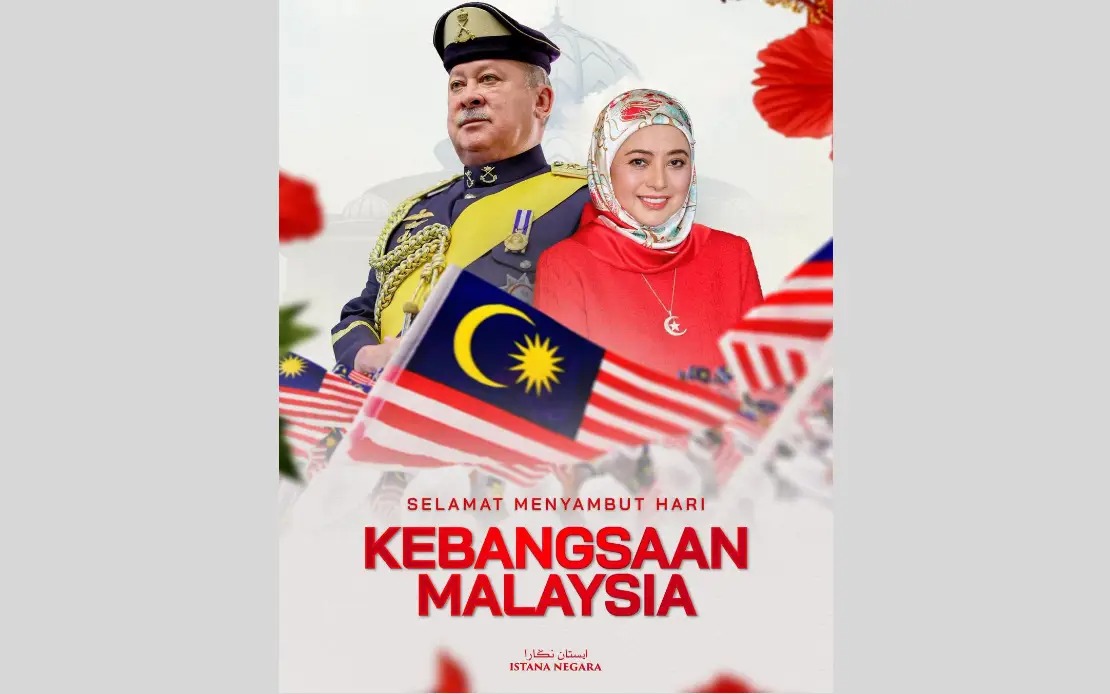
Malaysia's monarchs, Sultan Ibrahim Sultan Iskandar and Raja Zarith Sofiah, marked the nation's 69th National Day on August 31st by conveying heartfelt greetings to all Malaysians through an official royal message posted on the King's Facebook page. The gesture underscores the enduring significance of Merdeka Day in the national calendar, a time when Malaysia reflects on its journey since independence in 1957 and reaffirms its commitment to national unity and progress.
The official state celebration took place in Putrajaya, where Their Majesties arrived at 8 am to witness the formal proceedings. They were received by Prime Minister Datuk Seri Anwar Ibrahim and his wife Datuk Seri Dr. Wan Azizah Wan Ismail, alongside Communications Minister Datuk Seri Fahmi Fadzil, who chairs the organising committee overseeing both the 2026 National Day and Malaysia Day festivities. This convergence of Malaysia's political and constitutional leadership demonstrated the significance accorded to the nation's founding moment.
The festivities operated under the unifying banner of "Malaysia MADANI: Kesejahteraan Dinikmati," a theme that emphasises shared prosperity and national wellbeing as central pillars of contemporary Malaysian governance. This conceptual framework reflects the government's broader vision of inclusive development, where economic growth and social welfare are deliberately woven into policy objectives. The MADANI philosophy, adopted as a guiding principle by the current administration, seeks to position Malaysia as a nation where advancement benefits all communities equitably.
The celebration commenced with traditional military pageantry, establishing the ceremonial tone for the occasion. This was followed by an array of stage performances showcasing Malaysia's cultural diversity and artistic heritage. The structured progression from formal military protocols to entertainment offerings created a comprehensive expression of national identity, blending respect for institutional traditions with celebration of creative expression. Such ceremonial architecture serves important functions in reinforcing national cohesion and collective memory.
The centrepiece of the festivities was an elaborate parade and march-past that drew together an unprecedented scale of participation. Approximately 10,819 participants marched across 76 contingents, representing various government agencies, community organisations, and civilian groups. The procession included 22 brass bands providing musical accompaniment, 11 decorated vehicles conveying thematic messages, 328 assets encompassing land, sea, and air components demonstrating national defence capabilities, and 112 service animals including mounted police units. Additionally, 22 electric vehicles were incorporated, reflecting Malaysia's growing commitment to sustainable transportation and environmental consciousness.
The parade's composition revealed deliberate efforts to showcase Malaysia's multifaceted identity and technological aspirations. The inclusion of maritime and air assets highlighted the nation's strategic position as a regional maritime power, while the emphasis on electric vehicles signalled alignment with global decarbonisation trends. For Malaysian observers and regional onlookers, such displays communicate both continuity with national traditions and forward-looking modernisation.
A particularly distinctive element was the human graphic display arranged on terraces surrounding the venue, featuring 26 separate formations that collectively created a visual narrative of Malaysia's multicultural mosaic. This performative approach to celebrating diversity transcends conventional speech-making, instead allowing thousands of participants to physically embody the nation's pluralistic character. The formations required extensive coordination and rehearsal, reflecting significant institutional investment in communicating national values through collective visual symbolism.
For Malaysians and regional observers, the 69th National Day observance represents more than ceremonial commemoration. It provides an opportunity to assess how the nation is navigating contemporary challenges including economic restructuring, climate adaptation, and social cohesion. The MADANI framework and the scale of participation demonstrated in Putrajaya suggest institutional commitment to projecting national stability and unity at a time when regional geopolitics remain fluid and domestic priorities demand sustained attention.
The royal participation and formal government presence at Putrajaya underscored constitutional continuity and the enduring role of Malaysia's monarchy as symbolic custodian of national unity. In the Malaysian political system, the King's public engagement with major national occasions carries constitutional and cultural significance beyond ceremonial courtesy, reinforcing institutional legitimacy and the shared national project that transcends partisan politics.
As Malaysia approaches the 2026 National Day and Malaysia Day celebrations—both of which will be jointly observed—the scale and ambition demonstrated in the 69th anniversary observance suggests the government intends these forthcoming commemorations to be particularly elaborate. This forward-looking perspective indicates that national leadership views these occasions as platforms for articulating long-term vision and reinforcing social cohesion, particularly as Malaysia navigates complex transitions in economic structure and regional positioning.

