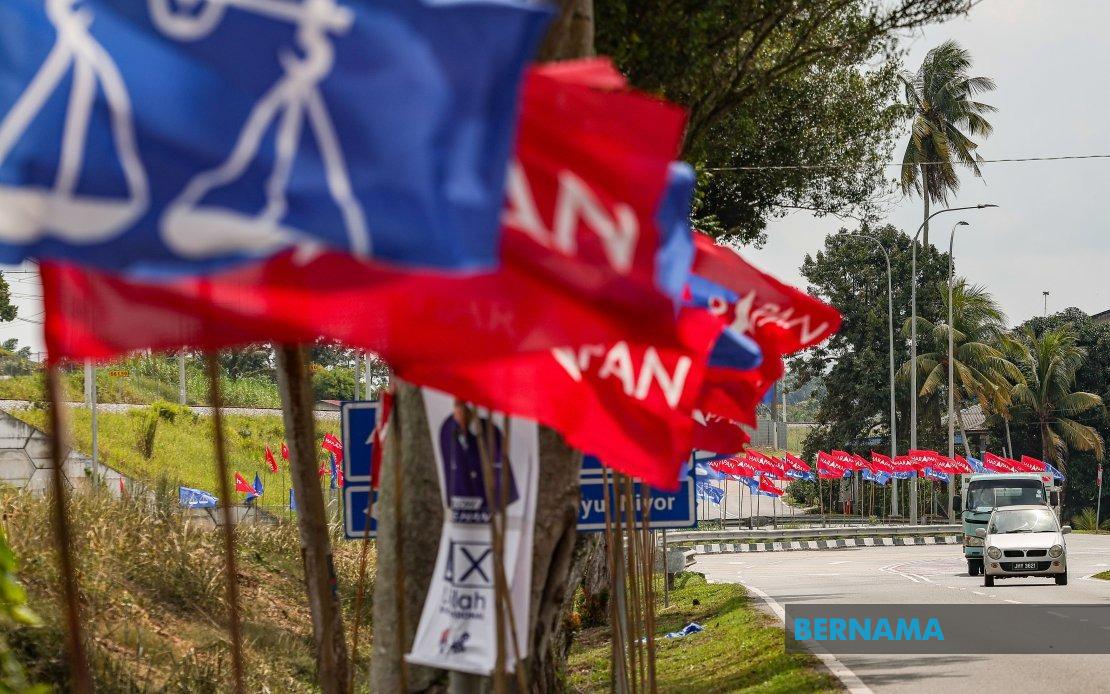
Pakatan Harapan's candidate for the Larkin state seat, Suhaizan Kaiat, expressed confidence on June 30 that his coalition can wrest back the constituency from Barisan Nasional during the 16th Johor state election, provided that voter participation reaches levels comparable to federal polling. His optimism rests on historical voting data rather than recent state-level results, marking a strategic pivot that reflects PH's broader challenge in recovering ground lost during the 2022 Johor poll.
Suhaizan grounded his assessment in the 14th General Election pattern, when BN's control of Larkin proved vulnerable under conditions of elevated turnout. The distinction between state and federal voting behaviour in the constituency offers PH a potentially viable pathway, though it requires mobilising voters who have shown inconsistent engagement at the state level. He engaged with constituents in Larkin while articulating this analysis, seeking to translate historical precedent into contemporary momentum.
The 2022 Johor state election result presents a cautionary reference point for PH strategists. Turnout that year reached only 51 per cent, constrained by pandemic-related factors that depressed participation across the state. This suppressed engagement appears to have benefited the incumbent BN, whose organisational machinery and rural networks remain stronger in low-turnout scenarios. For Suhaizan, the 51 per cent figure represents an anomaly rather than an accurate benchmark of constituency preferences.
As Pulai Member of Parliament, Suhaizan occupies a federal platform that potentially amplifies his local reach, though his parliamentary seat does not overlap with the state constituency he seeks to represent. This dual role underscores PH's strategy of deploying its strongest federal representatives to secure state gains, recognising that federal legitimacy can translate into state-level support when voters perceive connections between national and regional governance.
A secondary element of PH's Larkin strategy centres on capturing disaffected Bersatu supporters. Recent strains in the relationship between Bersatu and PAS create potential openings for parties seeking to attract voters unhappy with the coalition dynamics shaping state politics. Suhaizan noted that previous collaboration between PH and Bersatu in earlier configurations might encourage party members to view PH favourably, particularly given that Bersatu has declined to contest Larkin this election cycle. This calculation reflects sophisticated coalition arithmetic rather than mere optimism.
The seat's recent electoral history illustrates these shifting alignments. Datuk Mohd Izhar Ahmad captured Larkin in GE14 under the PH-Bersatu banner, demonstrating that the constituency could support PH-aligned candidates when conditions aligned. However, Mohd Hairi Mad Shah's successful BN challenge in 2022 reversed this result, claiming victory with a majority of 6,178 votes—a substantial but not insurmountable gap given the constituency's apparent sensitivity to turnout variations.
For this election, Larkin presents a three-way contest that complicates traditional two-party dynamics. Beyond Suhaizan and incumbent Mohd Hairi, the field includes Norsinah Abu representing Bersama. The three-cornered race introduces variables that historical precedent cannot fully explain, potentially rewarding the candidate with strongest ground organisation rather than the most favourable electoral winds. PH's victory would require not only recovering GE14 supporters but also consolidating support efficiently despite competition for opposition votes.
The broader Johor state election context—featuring 172 candidates across 56 seats with polling scheduled for July 11—demonstrates that Larkin represents one subplot within a more complex political drama. Early voting commences July 7, offering a preliminary gauge of turnout trends that could either validate or undermine Suhaizan's turnout-dependent strategy. The state-wide campaign dynamics may significantly influence Larkin's trajectory, particularly if national PH messaging resonates unevenly across constituencies.
Suhaizan's emphasis on voter turnout reflects PH's recognition that it performs better when the electorate demonstrates broader engagement. Higher turnout typically benefits parties with more diverse support bases and stronger suburban and urban networks, where PH maintains competitive advantages. Conversely, low-turnout elections tend to favour BN's consolidated rural machinery and established voter loyalty networks. This dynamic has proven consistent across multiple electoral cycles, giving the turnout question particular salience in strategic planning.
The Larkin contest carries implications extending beyond its immediate constituency boundaries. A PH victory would signal successful coalition recovery in Johor, traditionally BN's stronghold, while a BN retention would reinforce perceptions of incumbent strength. For Bersatu, the configuration of contested seats and alliance choices reflects its evolving positioning within Malaysia's fractured political landscape, where the party navigates competing pressures from PAS relations and potential PH reconnection.
Suhaizan's confidence, while measured and conditional upon turnout improvements, positions PH as viewing Larkin not as permanently lost but as recoverable terrain. This framing maintains party morale while establishing a threshold—voter participation—that operationalises hope into measurable targets. Whether constituent engagement during the campaign period produces the turnout elevation Suhaizan anticipates will ultimately determine whether historical GE14 patterns predict July 11 outcomes or whether the 2022 result establishes the new normal for this constituency.

