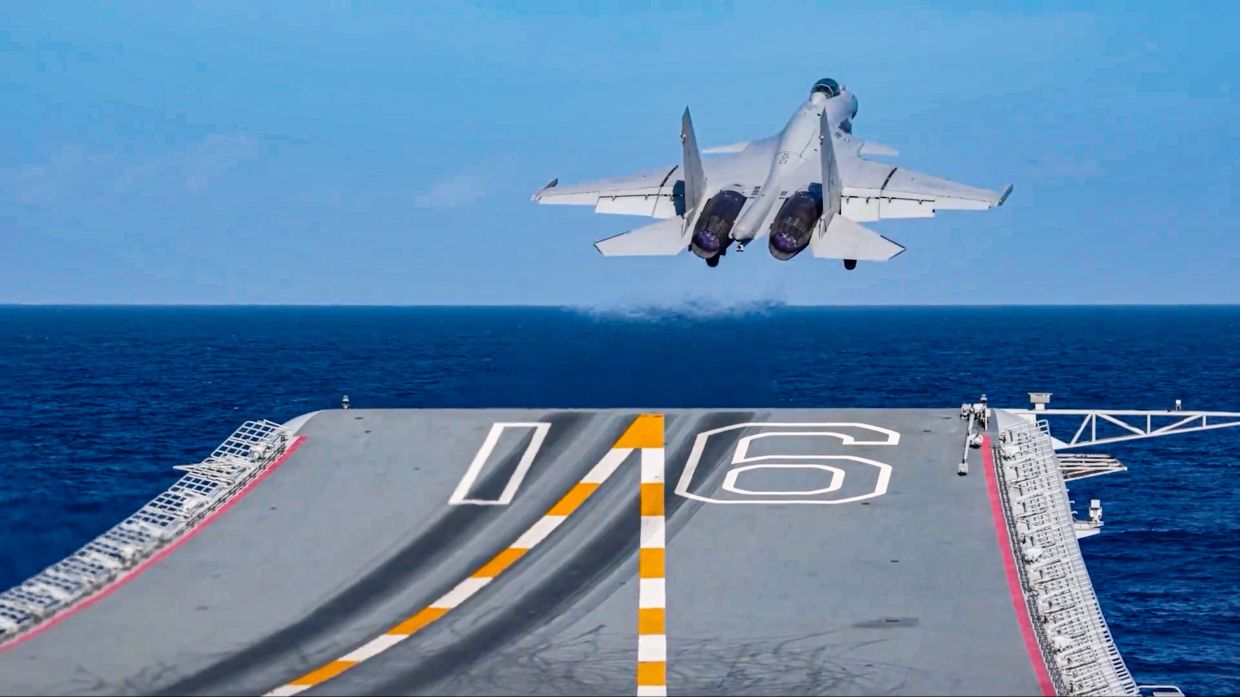
China's ambitious plan to expand its aircraft carrier fleet into a world-class naval force confronts a critical vulnerability in the depths of the sea. Defence analysts increasingly argue that submarine warfare represents the most consequential threat to Beijing's carrier ambitions, a gap that could undermine the strategic value of these expensive vessels in any future conflict. The Centre for Strategic and International Studies in Washington recently outlined how the United States and its regional allies could employ a comprehensive "cost-imposition" strategy against Chinese carrier groups, with submarine ambushes emerging as the fifth and potentially most damaging pillar of this approach.
The theoretical threat matrix extends across multiple domains. Land-based strike networks, satellite-guided air operations, cyber and electromagnetic warfare, and drone swarms all feature in the strategic playbook targeting Chinese carriers. Yet among these varied threat vectors, undersea operations stand apart in their lethality and difficulty to counter. The report identified American attack submarines prowling the western Pacific as perhaps the single most potent weapon against Chinese carrier groups, particularly because the People's Liberation Army Navy (PLAN) has struggled to develop adequate capabilities for detecting and tracking submarines at depth—a technological challenge that leaves high-value surface vessels dangerously exposed in contested waters.
Geography compounds this vulnerability. The western Pacific and approaches to the Taiwan Strait funnel Chinese naval operations through narrow maritime chokepoints where defending forces concentrate, creating ideal ambush conditions. Strategic waterways such as the Luzon Strait, Balinese Straits, and passages through the first island chain offer limited escape routes for lumbering carrier groups. Rather than requiring widespread naval superiority, an adversary could concentrate submarine assets at these narrow passages to threaten carriers as they transit toward operational areas. Meanwhile, carrier-based aircraft conducting long-range strikes would depend on satellite surveillance and communications networks vulnerable to cyber attack and electromagnetic disruption, compounding the operational risks.
Christopher Sharman, director of the China Maritime Studies Institute at the US Naval War College, acknowledges that Chinese undersea vulnerability "remains significant today," though he cautions it is "not a static weakness." The PLAN has invested substantially in recent years to enhance its capacity to understand and operate effectively in the undersea environment. Yet despite these efforts, meaningful gaps persist. Chinese naval researchers themselves have publicly acknowledged that Beijing's meteorological and oceanographic capabilities continue to lag substantially behind those of the United States Navy. This comparative disadvantage becomes especially acute beyond the first island chain, where the PLAN must operate in increasingly distant waters with less detailed knowledge of ocean conditions that affect sonar performance and submarine detection.
Beijing has launched major programmes to close this intelligence gap. The Transparent Ocean initiative, conceived over a decade ago, envisions a vast network integrating satellites, research vessels, buoys, autonomous underwater gliders, and seabed sensors to collect oceanographic data across strategically sensitive regions including the western Pacific, South China Sea, and Indian Ocean. The Ocean University of China, which originally proposed the concept, has installed hundreds of deep-sea observation systems and steadily expanded monitoring networks from the South China Sea into the open Pacific. Chinese authorities have explicitly linked these oceanographic efforts to national security imperatives, recognising that understanding ocean physics directly translates to improved submarine operations and anti-submarine warfare effectiveness.
Simultaneously, the PLAN has expanded its anti-submarine capabilities. New fixed-wing maritime patrol aircraft, Type 927 ocean-surveillance vessels equipped with towed-array sonar, and upgraded helicopter platforms designed to hunt submarines now form an emerging undersea defence architecture. The PLAN has also enhanced sensors fitted to its patrol aircraft and anti-submarine helicopters, steadily improving its ability to detect and track submerged vessels. These investments represent genuine technological progress, yet many analysts argue they remain insufficient to counter the quietest and most advanced US attack submarines operating in the region.
The submarine challenge extends beyond protecting carriers alone. Undersea warfare sits at the core of PLA naval strategy, particularly regarding the control of sea lanes within the first island chain. For Chinese strategists, effective submarine operations represent essential elements in any scenario involving Taiwan, where undersea forces could contest US naval superiority and complicate potential intervention by regional allies. The PLAN views submarine capabilities as critical to achieving sea control in wartime and as a means to offset American naval advantages, especially in scenarios where third parties might contemplate military involvement. Chinese military-affiliated analysts have sometimes described the waters near China's coast as a "wide-open door," lamenting Beijing's inability to monitor and control these depths sufficiently to deny access to potential adversaries.
The technical sophistication gap compounds these strategic challenges. According to Timothy Heath, head of defence research firm Perceptum, US submarines represent among the quietest vessels in the world, making them exceptionally difficult for Chinese anti-submarine forces to detect and engage. This acoustic advantage, accumulated over decades of technological investment, remains nearly impossible for China to overcome in the near term. Japanese naval capabilities would further complicate any scenario involving Taiwan, as Tokyo might attempt to target and destroy Chinese warships operating adjacent to Japanese territorial waters, adding another dimension to the undersea warfare challenge.
Some analysts question whether China should deploy its valuable carriers at extreme distances from the homeland. Heath suggests that "it would be foolish for China to deploy the carriers that far out," given the multiplicity of ways advanced navies could target them. He argues that land-based intermediate-range ballistic missiles remain China's most effective tool for threatening US warships operating toward the second island chain, offering greater range and survivability than carrier aircraft while avoiding the risk of losing expensive and politically significant capital ships. The strategic logic increasingly points toward a role for Chinese carriers limited to operations closer to the mainland, where air cover from land-based aircraft and missiles could provide protective cover.
The implications for regional stability merit serious consideration. Should China perceive undersea warfare capabilities as inadequate to protect carrier operations, Beijing might compensate through other military investments or strategic doctrinal shifts. The CSIS report's authors contend that American procurement priorities should reflect the challenges China faces in projecting power through carrier operations at extended distances. They specifically call for expanded US investment in torpedoes, undersea drones, and expanded missile production coordinated with regional allies including Japan and Australia. Such recommendations suggest that the submarine vulnerability China faces could shape not only Chinese strategic choices but also the defense commitments of the United States and its regional partners for years to come.

