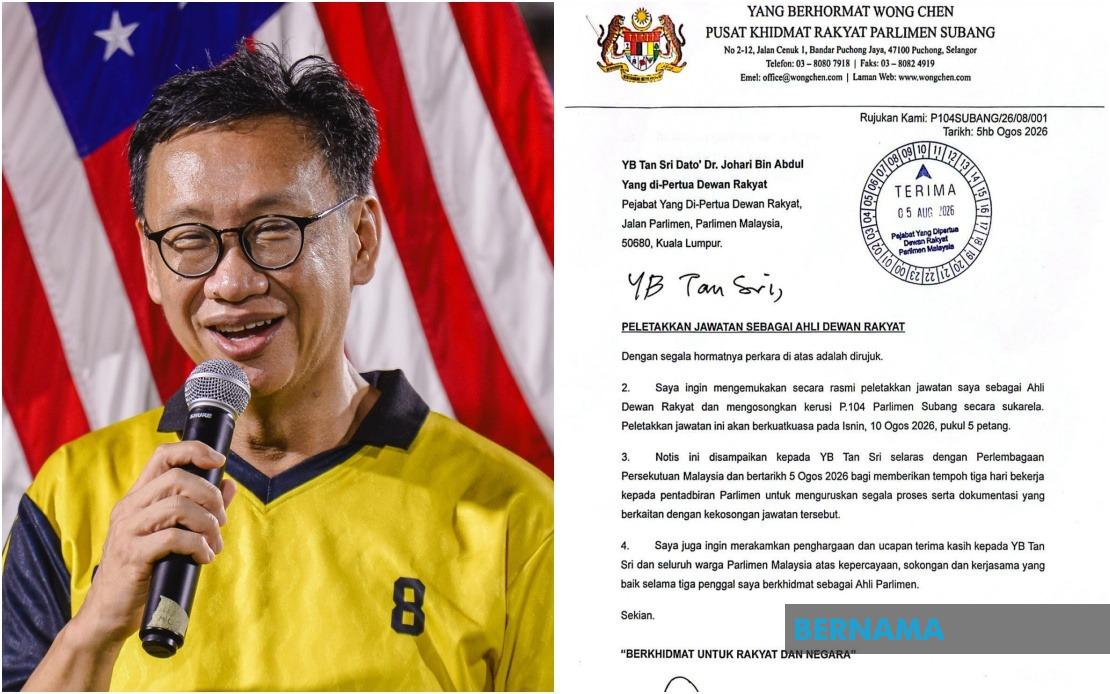
Wong Chen, the Member of Parliament for Subang, has brought his three-term tenure in the Dewan Rakyat to a formal close, with his resignation taking effect at 5:00 pm today. The decision marks the end of an extended period of parliamentary service in one of the Klang Valley's most politically significant constituencies. Wong's resignation letter, dated August 5, 2026, was submitted to Dewan Rakyat Speaker Tan Sri Johari Abdul, providing the Parliament administration with advance notice to manage the procedural and administrative requirements that accompany a mid-term vacancy.
The timing of Wong's notification reflects a deliberate approach to his departure. By providing a five-day advance notice before his resignation took formal effect, he has enabled the parliamentary authorities to prepare adequately for the transition. This courtesy notice period demonstrates awareness of the operational demands placed on Parliament's administrative machinery when managing sudden vacancies. The legislative framework governing such resignations falls squarely within the provisions of the Federal Constitution, ensuring the legitimacy and constitutional propriety of the move.
In communicating his decision through a Facebook post, Wong acknowledged the institutional relationships that have characterised his parliamentary journey. His formal letter to Speaker Tan Sri Johari expressed appreciation for the trust and cooperation extended by the Parliament leadership and supporting staff across his three consecutive terms. The tenor of his remarks suggests an amicable conclusion to his legislative career rather than a departure marked by controversy or discord. The explicit mention of gratitude towards the Speaker and parliamentary administration indicates an intent to leave office with institutional goodwill intact.
The Subang parliamentary seat, representing a diverse urban constituency that encompasses both established residential areas and emerging commercial zones, will now become subject to the constitutional processes governing parliamentary vacancies. The vacancy will trigger electoral procedures for the appointment of a successor, whether through a by-election or through other constitutional mechanisms available to the ruling coalition. For Subang voters, this represents a significant political transition, as Wong's replacement will inherit a seat that has served as a platform for engagement with urban middle-class constituencies and professional communities within the Klang Valley region.
Wong Chen has scheduled a press conference for 11:00 am tomorrow to provide a comprehensive explanation of his resignation decision and presumably to address any questions from the media and public regarding his future plans and reasons for stepping down. This dedicated media session suggests that his departure carries substantive implications worth elaborating upon beyond the basic constitutional facts of resignation. The conference will likely provide greater insight into whether Wong intends to pursue alternate career pathways, pursue opportunities outside Parliament, or transition to different forms of public service.
Among the practical adjustments accompanying his departure is the removal of the honorific title "Yang Berhormat" from all official documentation and signage associated with his parliamentary office. Beginning next month, billboards, office signboards, and official correspondence bearing his name will be updated to reflect his status as a private citizen rather than as a member of the legislative chamber. This administrative change symbolises the formal separation between Wong's former parliamentary standing and his civilian identity, completing the bureaucratic architecture of his transition from elected office.
The Subang constituency has long occupied a significant position within Malaysian politics due to its substantial electorate, demographic diversity, and strategic location within Selangor state's political landscape. The seat's voters encompass professionals, business owners, and families from varied socioeconomic backgrounds, making representation there an influential platform for engaging with urban Malaysian opinion. Wong's three-term tenure means he has navigated multiple electoral cycles and shifting political landscapes, suggesting his departure may reflect shifting personal priorities or changing assessments of his long-term career direction.
The constitutional framework enabling Wong's resignation underscores the flexibility embedded within Malaysia's parliamentary system. Members of Parliament retain the right to voluntarily relinquish their seats, a provision that acknowledges the principle that legislative representation should ideally rest upon willing, active participation rather than obligation or compulsion. Wong's use of the voluntary resignation mechanism reflects his prerogative as an elected representative to make autonomous career decisions aligned with his personal circumstances and future aspirations.
For the broader Malaysian political context, Wong's departure marks another incremental shift in the composition of the Dewan Rakyat's membership. While individual resignations are not uncommon in parliamentary democracies, they nevertheless contribute to the continuous evolution of legislative representation and the circulation of personnel through different phases of political participation. The succession process in Subang will likely generate considerable political attention, particularly among parties seeking to consolidate or strengthen their positions within the Klang Valley's highly competitive electoral environment. Regional political analysts will monitor which faction ultimately succeeds to the seat and how this transition reshapes the representation of this crucial urban constituency.

