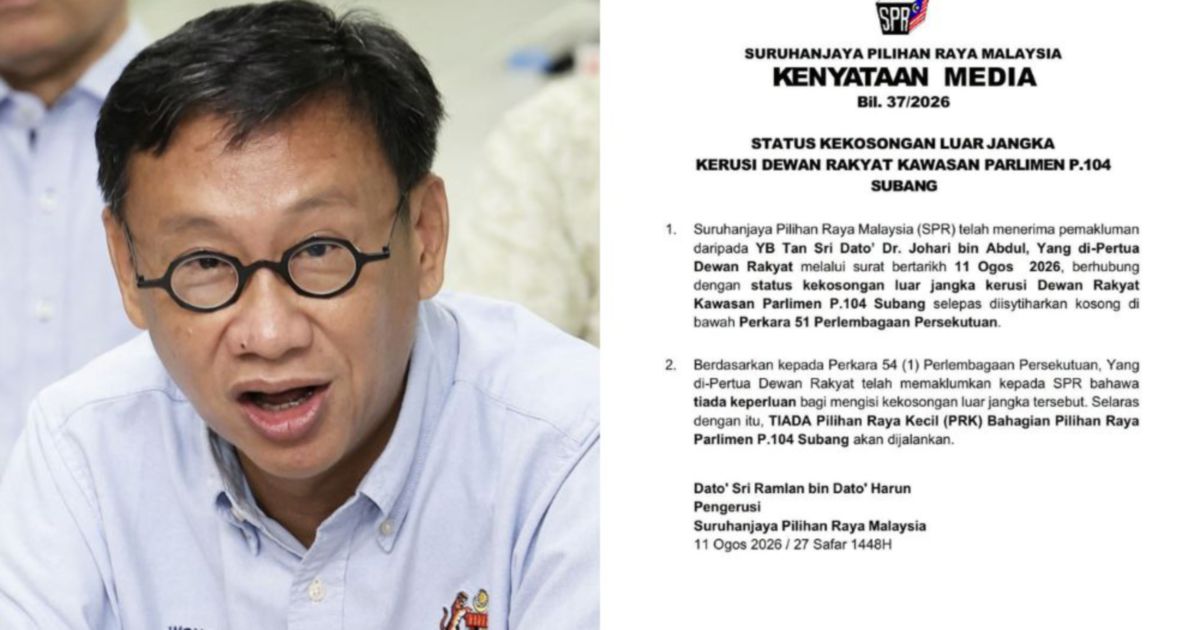
The Election Commission has confirmed that no by-election will be triggered by Wong Chen's departure from the Subang parliamentary seat, bringing clarity to the succession process in this strategically important central Selangor constituency. Wong Chen's resignation as the PKR member of parliament has concluded speculation about whether Malaysian voters would return to the ballot box for a special electoral contest to fill the vacancy he leaves behind in the Dewan Rakyat.
The decision by the election management authority represents a significant procedural outcome that will affect how Subang's estimated 600,000 residents and registered voters approach their political representation over the coming parliamentary term. Subang, located within the Petaling Jaya administrative division in Selangor's western corridor, is a mixed urban-suburban constituency with substantial middle-class populations, young professionals, and established residential communities that have long served as a political bellwether for national voting trends.
Wong Chen's resignation occurred within the constitutional window that permits MPs to vacate their seats without automatically triggering the by-election mechanism that would ordinarily apply to deaths, disqualifications, or forced removals from office. The politician, who has represented the area since 2018, maintained a notably active profile within parliament and beyond, frequently engaging on matters affecting urban constituencies and digital governance issues relevant to his technology-oriented voter base.
The absence of a by-election indicates that Subang will continue functioning without a directly elected representative in the Dewan Rakyat until the next general election cycle arrives, a prospect unlikely before mid-2026 unless parliament is dissolved earlier under emergency constitutional provisions. This arrangement, while administratively efficient, creates a representational gap that will require careful management of constituent concerns through alternative institutional channels and PKR's party structures.
For PKR, the party decision-making process will focus on determining whether to field a replacement candidate during the next general election or allow the seat to remain effectively uncontested in terms of parliamentary representation. The party, which governs Selangor in coalition and holds significant representation across peninsular constituencies, must balance internal political considerations with broader coalition commitments under the current Pakatan Harapan arrangement governing federal-level politics.
Subang has demonstrated itself as a swing constituency capable of responding to national political movements and performance evaluations of sitting MPs. The demographic composition—featuring substantial numbers of tertiary-educated voters, younger professional workers, and households with diverse ethnic and religious backgrounds—has made it reflective of broader urban sentiment across Malaysia's metropolitan areas. Wong Chen's 2018 victory margin and subsequent electoral performance have reflected both the locality's specific concerns and its resonance with national political themes affecting the middle-income urban electorate.
The Election Commission's determination follows standard constitutional interpretations regarding parliamentary vacancies and by-election triggers. Malaysian electoral law distinguishes between different circumstances creating vacancies, with certain categories automatically invoking by-election requirements while others permit the continuation of vacancies without electoral intervention. The legal framework governing Wong Chen's departure has been assessed to fall within provisions allowing vacancy continuation without mandatory electoral process.
From a broader Malaysian political perspective, the absence of a Subang by-election preserves government resources and avoids the considerable expense associated with organizing, administering, and securing a special electoral exercise. By-elections, while democratically significant, impose substantial fiscal burdens on the state and create temporary political intensity that can divert attention from broader governance priorities. The avoidance of electoral spending in Subang during this period aligns with fiscal consciousness, particularly relevant given economic pressures and post-pandemic budgetary constraints affecting state capacity.
The constituency will function under the representation framework already established through its state assemblyperson, who manages day-to-day constituent services and local matters through the Selangor state assembly. However, the absence of a Dewan Rakyat MP represents a material gap in federal parliamentary advocacy and access to national-level policy processes affecting the area's interests in infrastructure, education, healthcare, and economic development programming.
For PKR members and supporters within Subang, the development creates strategic uncertainty regarding the party's commitment to retaining what represents a valuable urban parliamentary seat in its coalition portfolio. The timing and nature of any succession or replacement strategy will signal broader party priorities and coalition negotiations as Malaysia approaches its next electoral cycle. The decision also affects federal government representation calculations, as the ruling coalition's parliamentary arithmetic depends upon maintaining control of marginal constituencies where vacancies could shift balance-of-power considerations.
Stakeholders across Subang's diverse communities—including business associations, resident groups, educational institutions, and civil society organizations—will need to adjust their engagement strategies to work directly with state-level representatives and seek federal advocacy through alternative channels. Community concerns regarding local infrastructure improvements, traffic management, environmental protection, and development control will require navigation through PKR's party structures and Selangor state government rather than through direct parliamentary constituency relationships.
The Election Commission's ruling provides definitional certainty about the procedural and legal status of the Subang seat through the remainder of the current parliamentary term, allowing political stakeholders to plan their strategies accordingly without uncertainty regarding potential by-election timing. As Malaysian politics continues evolving through coalition adjustments, generational changes in political leadership, and shifting voter preferences in urban constituencies, the Subang situation will serve as a reference point for how political resignations are managed within the broader framework of parliamentary governance and electoral administration in contemporary Malaysia.

