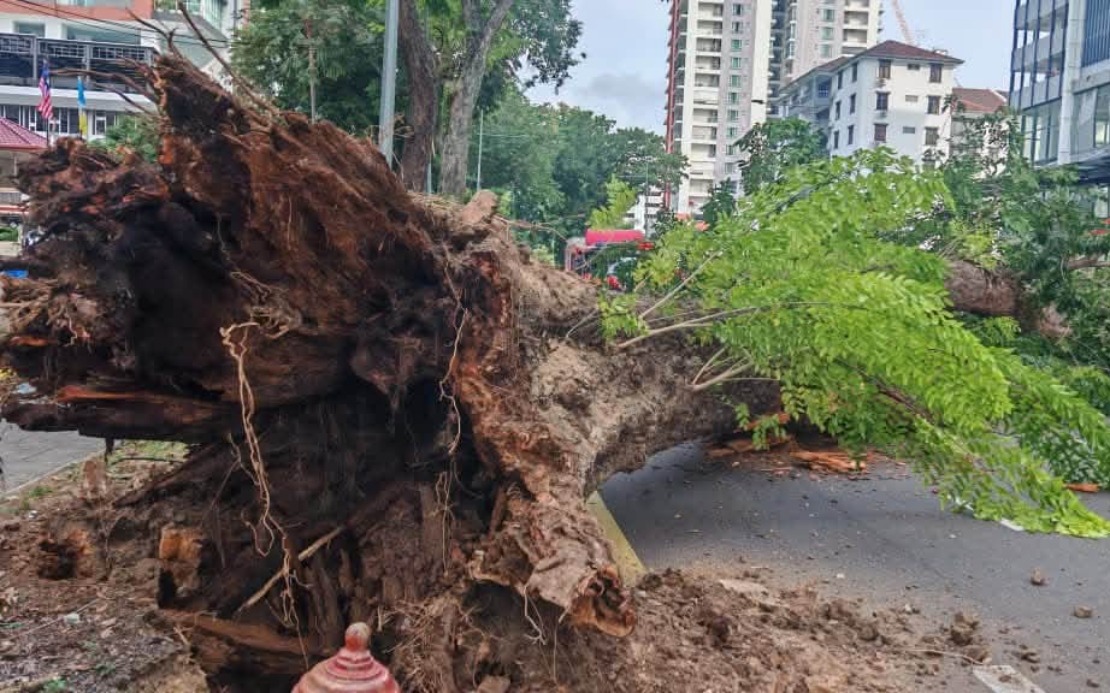
A 90-year-old Pterocarpus indicus, or Angsana tree, collapsed along Jalan Macalister in George Town on Friday morning, crushing a vehicle and injuring three occupants. The 28-metre-tall tree gave way at approximately 9 am, striking a Perodua Ativa SUV carrying an elderly couple and their grandchild. The incident highlighted growing urban challenges in managing mature urban forests in Malaysia's historic city centres, where heritage greenery competes with infrastructure demands and environmental pressures.
George Town Municipal Council Mayor Datuk A. Rajendran attributed the structural failure to multiple interrelated factors rather than a single cause. The tree exhibited approximately 30 per cent root rot throughout its root system, while cavity decay had compromised roughly 40 per cent of its base trunk. These internal degradation processes had substantially weakened the tree's load-bearing capacity and ability to anchor itself firmly in the ground. The combination proved catastrophic, especially given the tree's considerable height and weight.
Beyond the immediate pathological issues, urban environmental pressures significantly contributed to the collapse risk. Chronic soil compaction—a common problem in busy city streets where constant vehicular and foot traffic compresses the earth—restricted the tree's rooting space and ability to absorb moisture and nutrients. Infrastructure upgrading works in the vicinity had further constrained root development and structural support. These cumulative pressures placed extraordinary strain on an aging specimen that had likely stood for a century without major structural intervention.
Interestingly, weather conditions did not precipitate the failure. Mayor Rajendran confirmed that no heavy rainfall or strong winds occurred at or immediately before the collapse. This absence of triggering meteorological factors suggests the tree's structural integrity had been critically compromised for some time, reaching a point where gravity alone proved sufficient to topple it. The incident underscores how seemingly stable urban trees can pose hidden dangers despite appearing superficially sound to casual observation.
The George Town Municipal Council's response was relatively swift. Clearance operations commenced at 9.41 am and continued for over five hours, with the road reopened by 2.20 pm. However, this reactive approach reveals an underlying tension in urban forest management across Malaysia. Despite a remote sensing study conducted in 2023 indicating that trees along Jalan Macalister remained in good condition with no warning indicators, the eventual discovery of severe internal decay suggests limitations in existing assessment methodologies. Routine maintenance performed as recently as January 2024 apparently failed to detect the critical structural compromise.
Municipal authorities have now intensified their approach to mature tree management along the affected corridor. The 2024 assessment of aged specimens on Jalan Macalister identified 13 trees requiring removal, all of which have since been felled. This proactive stance reflects lessons learned, though it raises questions about whether such comprehensive removal represents the most appropriate balance between urban greenery preservation and public safety. The density of heritage trees in George Town represents both an asset and a management liability.
The broader tree management statistics reveal the scale of challenges facing Malaysian municipalities. George Town approved 179 high-risk trees for felling this year, with 148 already removed as of the incident date. The first three quarters of the year saw 247 trees felled across the municipality. These removals addressed diverse issues including obstruction of drainage systems, dead or leaning specimens, development pressures, road and river widening initiatives, and encroachment on water supply infrastructure owned by Penang Water Supply Corporation. The diversity of removal reasons reflects the complex intersection of municipal development, environmental management, and public safety considerations.
A comprehensive 2023 assessment identified 2,535 trees requiring categorisation across George Town. Of these, 45 cases involved drainage obstruction, 138 were classified as dead or dying, 2,242 fell under risk assessment or miscellaneous categories, and 110 related to development or infrastructure requirements. This inventory suggests that while many trees remain viable, a substantial proportion face challenges that threaten either their health or their compatibility with urban infrastructure and development patterns. Such data is increasingly valuable as Malaysian cities grapple with balancing heritage preservation against modernisation.
In response to the Jalan Macalister incident, municipal authorities have instructed the appointed contractor to accelerate works involving height reduction and removal of trees deemed susceptible to collapse. Certified arborists have been tasked with conducting fresh assessments to identify specimens presenting unacceptable risk. This represents a shift toward more intensive professional scrutiny, though it remains to be seen whether such measures will become standard across other Malaysian municipal areas or remain reactive to specific incidents.
The collapse raises important questions for urban planners and environmental managers across Malaysia. Many historic commercial and residential districts feature mature trees planted decades or even a century ago, when soil compaction, infrastructure density, and urban heat stress were less pronounced. As these venerable specimens age, the combination of their advancing years with intensifying urban pressures creates hazard scenarios that may not be adequately captured by existing assessment protocols. Malaysian municipalities must invest in more sophisticated monitoring technologies and arborist expertise to identify internal decay before catastrophic failure occurs.
Furthermore, this incident exemplifies the tension between heritage preservation and modernisation in Malaysian cities. George Town, a UNESCO World Heritage site, derives character partly from its mature urban forest. Yet that same forest represents an ongoing management challenge. Future urban planning must incorporate tree health monitoring and strategic replanting of younger specimens to create a more stable age-mixed population. Without such forward planning, future incidents remain probable, particularly as climate variability and urban intensification accelerate environmental stresses on Malaysia's aging urban trees.

