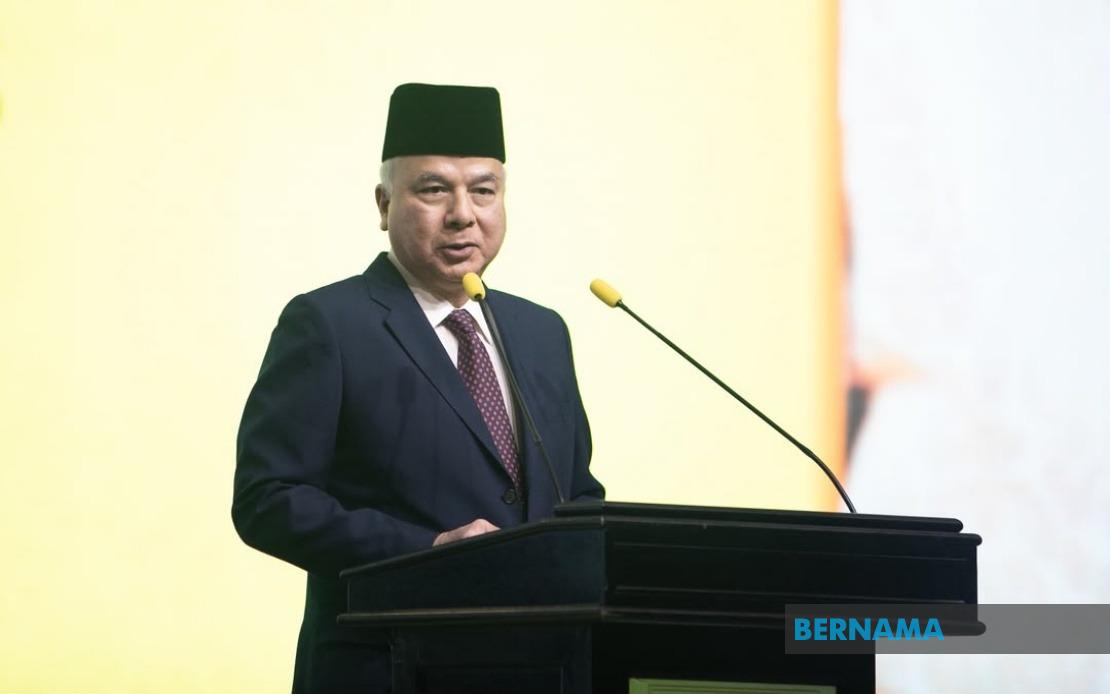
Sultan Nazrin Shah, the Sultan of Perak, delivered a sobering assessment of national development at the 8th World Conference on Islamic Thought and Civilisation in Ipoh on July 21, arguing that material abundance and human talent mean little without the institutional foundations that sustain them. His Royal Highness contended that even countries blessed with natural wealth and a gifted population can disappoint their people if governance structures prove inadequate, leaders lack accountability, or politicians prioritize personal advancement over public duty. The remarks, made before an audience that included Deputy Prime Minister Datuk Seri Fadillah Yusof, Perak Menteri Besar Datuk Seri Saarani Mohamad, and Higher Education Minister Datuk Seri Dr Zambry Abd Kadir, underscored a regional concern relevant to Southeast Asian governments grappling with development challenges.
Effective governance in practical application requires the coordinated functioning of multiple institutional pillars, Sultan Nazrin explained, each robust enough to endure leadership transitions and individual administrations. This structural resilience forms the bedrock upon which citizen confidence rests. Without it, even well-intentioned policies falter as populations lose faith in the systems meant to serve them. The Sultan articulated three critical dimensions of functional governance. First, transparency in the collection and deployment of public funds creates assurance among citizens that their tax contributions and other revenues genuinely serve collective interests rather than enriching the privileged few. Second, impartial application of the law ensures that accountability applies uniformly across society, regardless of wealth or status—no individual, however influential, escapes scrutiny, and no person, however powerless, loses legal protection. Third, a political culture grounded in civilized disagreement, where opposition functions as legitimate oversight rather than mortal threat, allows power to transfer through ballots rather than conflict.
The distinction between stability and the mere absence of debate proved crucial to Sultan Nazrin's analysis. He observed that many of the world's most stable democracies simultaneously host vigorous and contentious political discourse. Their stability derives not from suppressed disagreement but from channelling disputes through established institutions—legislatures, courts, electoral bodies—rather than through street violence or extrajudicial means. Political instability emerges instead when the institutional scaffolding corrodes, when citizens cease believing in the fairness of elections, the independence of courts, or the integrity of public office. This erosion of institutional trust strikes hardest at society's most vulnerable members: the poor, the marginalized, those without voice or influence in decision-making corridors. Their welfare deteriorates as governance breakdown removes the protections and provisions that institutions once guaranteed.
The budgetary process exemplifies how governance translates into tangible outcomes affecting ordinary lives. Sultan Nazrin characterized government budgets as moral documents as much as financial instruments, as they explicitly reveal which constituencies and which needs receive priority in resource allocation. Decisions embedded in budget lines determine whether funds flow toward education in rural areas, healthcare in urban slums, infrastructure in underdeveloped regions, or projects benefiting concentrated interests. By examining budget composition, citizens glimpse their government's actual values, stripped of rhetorical flourish. A civil service functioning truly on behalf of all citizens—without discrimination based on ethnicity, religious affiliation, or partisan loyalty—embodies national unity in its most concrete and operational form. Leaders who govern with humility, who listen before legislating, and who recognize their authority as temporary stewardship rather than personal possession, cultivate genuine loyalty and pride among their populations more effectively than any propaganda campaign.
Development itself cannot proceed in isolation, Sultan Nazrin cautioned, addressing a concern particularly resonant in Malaysia's regional context. No nation, regardless of talent or resource endowment, achieves prosperity by withdrawing from global engagement. Trade, foreign investment, technological transfer, and knowledge exchange function as currents propelling modern economies forward. Sustainable growth requires cooperation spanning multiple dimensions: between nations through trade and diplomatic frameworks, between government and private enterprise through enabling policy environments, and between state institutions and civil society organizations that mobilize citizens and distribute benefits. Evidence from across the global economy demonstrates that countries embracing open trade while simultaneously building resilient, diversified domestic industries outperform those retreating into protectionism or dependent upon single sectors or commodities.
Yet cooperation between nations demands careful calibration, Sultan Nazrin emphasized, rejecting false choices between openness and autonomy. International engagement need not become dependency, nor should welcoming foreign capital and expertise compromise a nation's capacity for independent decision-making and strategic direction. This balance represents perhaps the central challenge confronting Southeast Asian economies seeking to leverage globalization while maintaining policy sovereignty. Malaysia, positioned as a global Islamic finance hub through decades of deliberate institutional development, exemplifies how nations can combine international participation with distinctive competitive advantage. From sukuk issuance to takaful insurance to Syariah-compliant asset management, Malaysia has constructed specialized financial infrastructure attracting international capital while retaining local control.
Islamic finance itself remains massively underutilized as a tool for cross-border economic cooperation and development finance, Sultan Nazrin argued, despite its theoretical potential and Malaysia's demonstrated capacity. Beyond mere compliance with religious prohibitions against riba, authentic Islamic finance embodies a fundamentally different economic philosophy emphasizing risk-sharing, asset-backing, and equitable participation in economic returns. If this underlying philosophy received serious implementation rather than superficial adaptation, Islamic finance could catalyze major infrastructure investment across Organisation of Islamic Cooperation member states, facilitate small and medium enterprise financing networks, and channel patient capital toward long-term development challenges including clean water provision and renewable energy transition. Such a reorientation would leverage Islamic finance's distinctive characteristics—patient capital, asset-based structure, stakeholder equity—toward addressing precisely those development bottlenecks that traditional finance neglects because they promise limited short-term returns.
The implications for Malaysia and the broader Southeast Asian region extend beyond financial architecture. Sultan Nazrin's emphasis on institutional strength, accountable governance, and transparent resource management resonates with persistent regional challenges: corruption limiting development effectiveness, weak judicial independence constraining rule of law, and political systems where access determines outcomes more than merit or demonstrated need. His framing of budgets as moral documents particularly challenges governments across Southeast Asia to examine whether fiscal priorities genuinely reflect stated development commitments or merely entrench existing privilege structures. The integration of Islamic finance principles with development priorities offers Malaysia distinctive advantage if executed rigorously, potentially positioning the country as leader in mobilizing patient capital for infrastructure and inclusive growth across the Islamic world.
Ultimately, Sultan Nazrin's address articulates a vision of development rooted in institutional integrity rather than personality-driven leadership or resource-based advantage. This perspective counters prevailing narratives in some Southeast Asian political cultures that position strong individual leaders as solutions to governance challenges. Instead, Sultan Nazrin suggests that durable prosperity emerges from systems transcending individual leaders, from transparent processes constraining arbitrary power, and from political cultures treating disagreement as legitimate rather than seditious. For Malaysia specifically, managing the transition from resource-dependent growth to innovation-based prosperity while maintaining social cohesion across diverse communities requires precisely this institutional strength and accountable governance framework. The Sultan's remarks provide intellectual scaffolding for examining whether current governance trajectories in Malaysia and the region sufficiently emphasize institutional development, transparency, and the distribution of benefits toward vulnerable populations who ultimately determine whether development translates into shared national success or merely concentrated gain.

