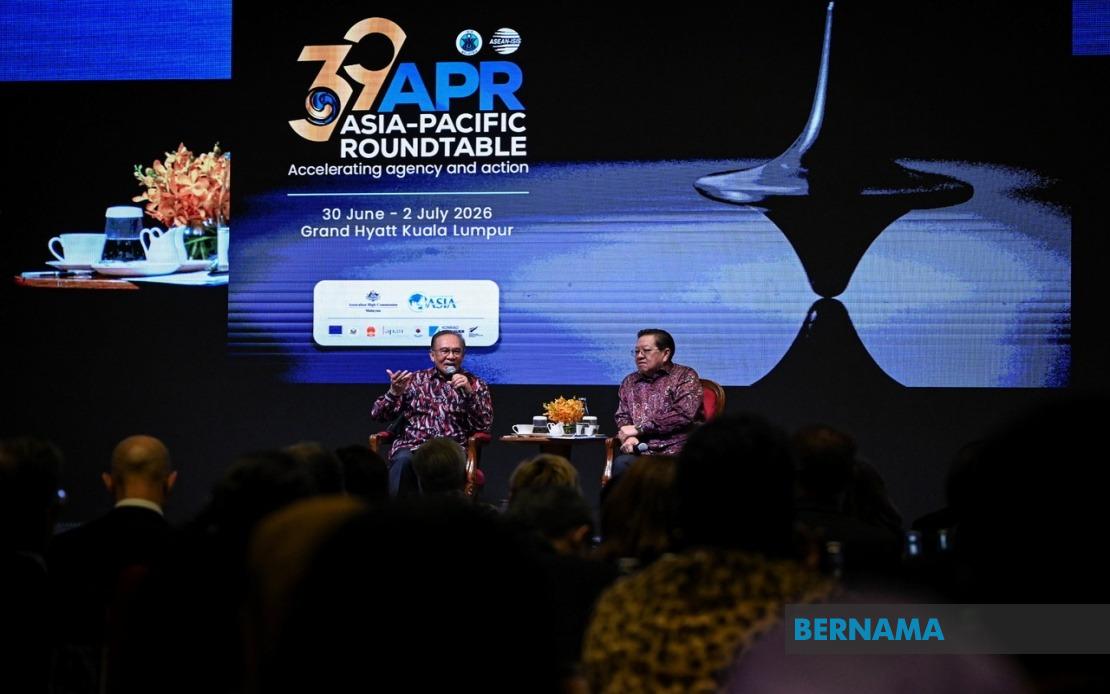
Prime Minister Datuk Seri Anwar Ibrahim has positioned governance strengthening as Malaysia's paramount responsibility, asserting during the 39th Asia-Pacific Roundtable in Kuala Lumpur that meaningful global participation must be anchored in solid domestic foundations. Speaking at a question-and-answer session on July 2, Anwar underscored the sequential nature of national development, where internal institutional reform provides the necessary platform for credible international engagement. This framing reflects a deliberate strategic choice to redirect focus inward at a moment when regional and global tensions continue to compete for policymakers' attention across Southeast Asia.
The Prime Minister outlined a four-pillar domestic agenda that encompasses institutional improvement, anti-corruption measures, socioeconomic levelling, and universal access to essential services. Anwar specified that his administration's immediate focus encompasses eradicating corruption, narrowing inequality gaps, and guaranteeing that all citizens benefit from quality education and healthcare infrastructure. This articulation moves beyond rhetorical commitment by identifying concrete governance challenges that resonate with ordinary Malaysians navigating daily systemic inefficiencies. For observers across the region grappling with similar institutional deficits, the emphasis carries particular weight as Malaysia positions itself as a model for governance reform within Muslim-majority democracies.
Central to Anwar's positioning is the assertion that Malaysia can advance principled international stances without sacrificing domestic priorities. Rather than framing the choice as binary, he suggested that a well-governed nation possesses greater moral authority and practical capacity to contribute meaningfully to regional and global discourse. This approach carries implications for ASEAN coherence and Malaysia's influence within regional architecture, particularly as geopolitical tensions in the Indo-Pacific intensify. A government perceived as managing domestic affairs competently gains credibility when advocating for multilateral solutions or mediating disputes among neighbouring states.
The Prime Minister challenged prevailing frameworks that interpret international conflicts through civilisational lenses, arguing instead that many tensions originate from inadequate understanding rather than fundamentally incompatible values. By invoking the late Palestinian-American scholar Edward Said's concept of a "clash of ignorance" rather than civilisations, Anwar repositioned the discourse away from essentialist categories that suggest permanent antagonism between cultural or religious groups. This intervention carries significance for how Malaysia, as a multicultural nation, engages with narratives of global polarisation that threaten to replicate internal divisions on the international stage.
The MADANI framework emerged prominently in Anwar's remarks as the governing philosophy integrating technological progress with human-centred values. This dual emphasis addresses a common governance challenge across the region, where nations risk pursuing digital transformation while neglecting social cohesion and equitable opportunity distribution. By explicitly linking technological advancement to human values, Malaysia signals awareness that development divorced from ethical considerations generates its own instability. The framework's articulation suggests recognition that Southeast Asian societies require growth models addressing both material aspirations and cultural continuities.
Anwar referenced the Quranic concept of "li ta'arafu," translating it as an injunction for societies to move beyond mere tolerance toward genuine comprehension and appreciation of differences. This theological grounding provides a values-based justification for pluralistic governance, particularly relevant for a multiethnic, multireligious nation where institutional arrangements must reflect rather than suppress diversity. The invocation demonstrates how religious and secular governance discourses can intersect productively, potentially offering insights for other Muslim-majority democracies navigating similar institutional questions. For Malaysia specifically, elevating this concept signals commitment to substantive inclusion beyond surface-level acknowledgment of diversity.
The emphasis on demonstrating that a Muslim-majority nation can sustain democratic values and moderation addresses both international perceptions and domestic legitimacy concerns. Anwar's formulation suggests awareness that Malaysia's governance trajectory carries implications extending beyond national borders, influencing how Muslim-majority democracies navigate the intersection of religious identity and democratic institutions. This positioning carries stakes for regional influence, particularly if Malaysia's governance experiment succeeds or falters visibly. Neighbouring countries observing Malaysia's institutional evolution draw lessons about whether religious majorities can effectively govern pluralistic societies through democratic mechanisms.
The Prime Minister's framing prioritises institutional and systemic reform over geopolitical posturing, a choice reflecting pragmatic recognition that governing capacity determines influence more reliably than rhetorical assertion. In an environment where regional powers compete for advantage across multiple domains, Anwar's emphasis on consolidating domestic governance foundations suggests strategic patience regarding Malaysia's international positioning. This approach potentially strengthens ASEAN by directing member states toward stabilising internal arrangements rather than exacerbating regional tensions through external adventurism.
The articulation of this governance agenda occurs within a specific political context where concerns about institutional legitimacy, corruption management, and equitable service delivery persist in Malaysian public discourse. By centering these concerns at a high-level international forum, Anwar signalled that addressing them constitutes not parochial preoccupation but fundamental national business. This messaging carries domestic political resonance while also communicating to international observers the seriousness with which the government treats governance imperatives. The positioning potentially reshapes expectations regarding Malaysia's international engagement, suggesting measured participation responsive to domestic consolidation rather than expansive external activism.

