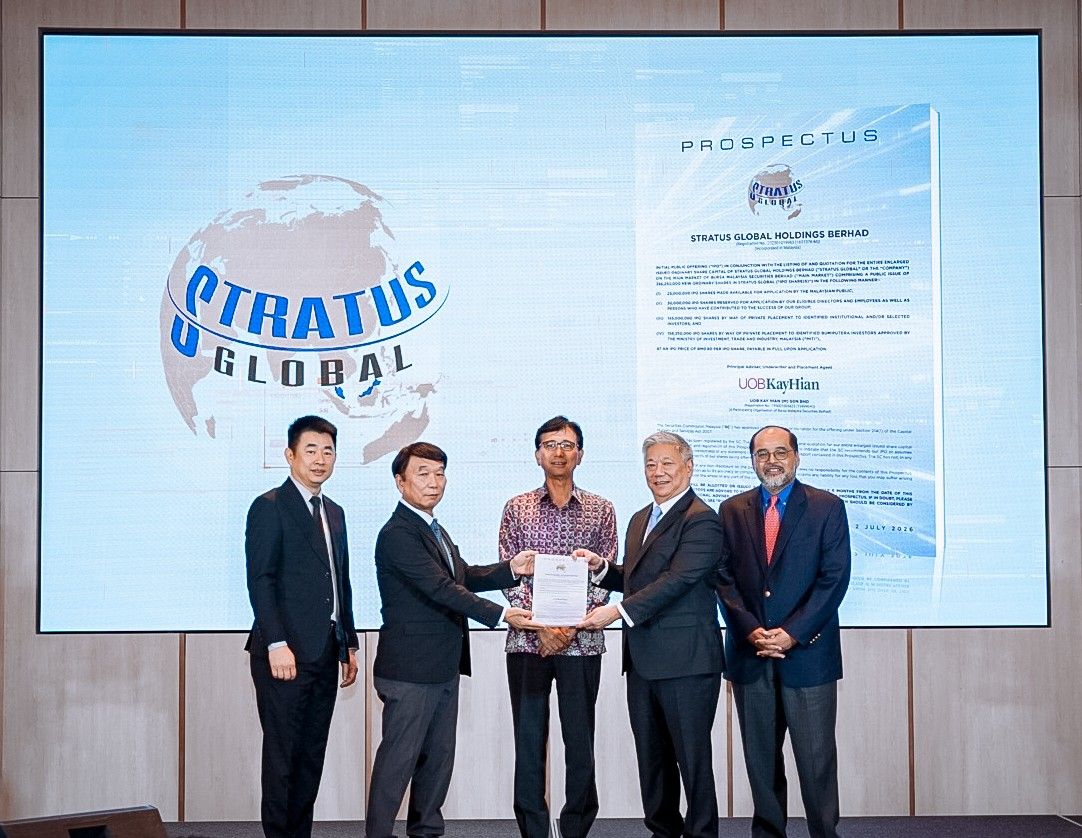
Stratus Global Holdings Bhd, a specialized provider of automated material handling system (AMHS) solutions for the semiconductor industry, has moved forward with its Initial Public Offering on Bursa Malaysia's Main Market, seeking to raise RM285 million. The company has opened applications for the listing, which is scheduled to be completed by July 21, marking a significant expansion moment for one of Malaysia's homegrown technology solution providers serving the region's critical semiconductor ecosystem.
The IPO structure involves the issuance of 356.25 million new shares priced at 80 sen per share, which positions Stratus Global with an anticipated market capitalisation of RM1 billion upon completion of the enlarged share capital base of 1.25 billion shares. Notably, the offering comprises only newly created shares, with no secondary offering of existing shares being made available for sale by current shareholders, indicating a growth-focused capital raising approach rather than a partial exit by founders or early investors.
The deployment of capital reveals Stratus Global's strategic priorities moving forward. The largest allocation of RM122.6 million is earmarked for constructing a new manufacturing plant in Penang, positioning the company to deepen its footprint in Malaysia's semiconductor manufacturing corridor. Research and development receives RM45 million in funding, reflecting the company's commitment to innovation in an increasingly complex and technologically demanding sector. Working capital allocation of RM82.4 million will support operational scaling, while RM20 million targets international business expansion into key overseas markets where semiconductor manufacturing hubs continue to grow. Listing-related expenses account for RM15 million of the proceeds.
Founded in 1998, Stratus Global operates at a critical juncture of the semiconductor manufacturing supply chain, providing comprehensive end-to-end AMHS solutions encompassing system design, fabrication, installation and commissioning services. The company's technology directly supports the efficiency and precision demands of semiconductor production facilities, where automated material handling has become essential to meeting increasingly tight tolerances and production volumes. This positioning gives Stratus Global exposure to both the cyclical dynamics and structural growth drivers of the global semiconductor industry.
The company's customer portfolio spans multinational semiconductor manufacturers operating across Malaysia and international markets in Asia, Europe and North America, providing geographic and customer diversification that insulates the company somewhat from concentrated dependency on any single region or client. This global reach is particularly significant given Malaysia's role as a major semiconductor manufacturing hub in Southeast Asia, complemented by growing presence in other established and emerging semiconductor markets.
Ryo Narisawa, executive director and chief executive officer, framed the IPO as a transformational event for the company's development trajectory. His remarks emphasised that the capital raising provides the financial capacity to significantly expand manufacturing capabilities—essential for meeting growing demand from customers—whilst simultaneously investing in innovation pipelines through enhanced research and development activities. The expansion strategy also targets strengthening Stratus Global's international presence, recognising that semiconductor manufacturing capital flows and market share opportunities increasingly transcend individual countries or regions.
For Malaysian investors and the broader market, Stratus Global's listing represents exposure to a company supplying critical infrastructure for semiconductor manufacturing at a time when regional production capacity remains a geopolitical and economic priority. Semiconductor manufacturing equipment and solutions providers have attracted growing investment attention as countries globally seek to secure and expand domestic chip production capabilities. The timing coincides with sustained interest from major semiconductor manufacturers in developing manufacturing capacity across Southeast Asia, including Malaysia.
The IPO timeline reflects conventional market procedures, with applications opening immediately and closing on July 10, allowing a ten-day subscription window before listing on July 21. UOB Kay Hian (M) Sdn Bhd serves as principal adviser, underwriter and placement agent, bringing institutional investor networks and market credibility to the offering process. The choice of lead advisor suggests access to both domestic and potentially international investor bases interested in semiconductor supply chain exposure.
The Main Market listing designation indicates that Stratus Global has met Bursa Malaysia's more stringent listing requirements compared to the Alternative Market, reflecting the company's scale, governance standards, and track record. This positioning may facilitate future capital raising, debt financing and institutional investor participation. For technology-focused investors seeking exposure to semiconductor manufacturing infrastructure providers with established customer relationships and geographic diversification, Stratus Global's entry represents a new domestic option with clear growth trajectories tied to structural semiconductor industry expansion.
The company's expansion plans, particularly the Penang manufacturing facility, reinforce Malaysia's continued importance as a semiconductor manufacturing and solutions hub within the broader Asian manufacturing landscape. As global semiconductor supply chains continue rebalancing and companies invest in geographic redundancy and capacity diversification, Malaysian-based suppliers like Stratus Global stand to benefit from proximity to major manufacturing customers and established operational ecosystems. The investment in research and development signals ambitions to move further up the technology value chain, potentially developing proprietary solutions rather than remaining dependent on incremental service delivery improvements.

