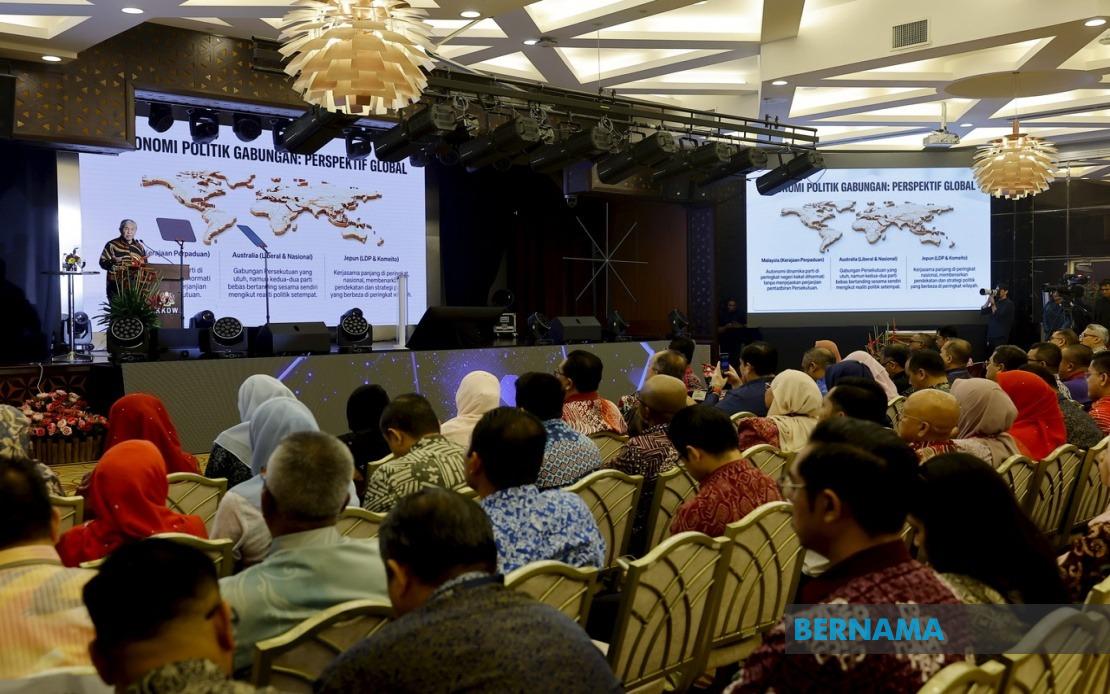
Deputy Prime Minister Datuk Seri Dr Ahmad Zahid Hamidi has moved to reassure Malaysians that the Unity Government's federal stability remains intact despite intensifying political competition at the state level, particularly following recent elections in Johor and Negeri Sembilan. Speaking at the Rural and Regional Development Ministry's monthly assembly in Putrajaya, Ahmad Zahid, who also chairs Barisan Nasional, sought to address concerns that diverging state-level interests could fracture the broader coalition underpinning the MADANI Government.
The Deputy Prime Minister's remarks underscore a delicate balancing act facing Malaysia's ruling coalition. The Unity Government was forged on the foundation of a formal understanding and written agreement between its constituent parties, a covenant Ahmad Zahid emphasised would endure until Parliament is dissolved. This distinction is crucial: it suggests that state-level political manoeuvres, where coalition partners may compete directly against one another in pursuit of regional power, operate within a separate and parallel framework that does not automatically trigger broader federal realignments.
Ahmad Zahid articulated a framework for understanding how the coalition functions amid such tensions. He characterised the arrangement as operating under the principle of political autonomy within a coalition structure, whereby individual parties retain the latitude to pursue their own political strategies and advance their respective identities without compromising the overarching federal agreement. This concept, though straightforward in theory, reflects the pragmatic compromises necessary to maintain a multi-party government in Malaysia's competitive political landscape.
The Deputy Prime Minister offered concrete assurances regarding the continuity of government operations. As long as Parliament remains in session and has not been dissolved, he stated, the federal machinery will persist in executing its functions, the administrative apparatus will proceed uninterrupted, and every obligation the government has undertaken to the electorate will be honoured according to schedule. This assertion carries particular weight given Malaysia's history of political instability, when shifts in coalition dynamics have previously precipitated governmental crises and policy paralysis.
The recent state elections in Johor and Negeri Sembilan have indeed intensified intra-coalition competition, particularly between Umno-led Barisan Nasional and its federal coalition partners. In Johor, Barisan Nasional secured a commanding victory, while the results elsewhere have reshuffled regional power dynamics. These outcomes naturally invite speculation about whether state-level momentum might translate into federal pressure for portfolio reallocations or shifts in policy direction. Ahmad Zahid's intervention appears designed to forestall such speculation by reiterating that state and federal spheres operate according to distinct competitive logics.
Crucially, Ahmad Zahid emphasised that the coalition government does not demand that its constituent parties abandon their distinctive political identities or core principles. This point resonates widely across Malaysia's fractionalised political ecosystem, where coalition partners often harbour competing ideologies and represent divergent electoral constituencies. The Umno-led Barisan Nasional, the Islamic Pas, the Chinese-majority DAP, and other coalition members each bring distinct constituencies and policy priorities to the federal arrangement. Allowing each to maintain electoral separation at the state level while preserving federal unity represents a pragmatic accommodation of these differences.
The political developments Ahmad Zahid referenced will neither alter the policy direction of the MADANI Government nor disrupt its implementation roadmap, he declared. This includes planned government initiatives, legislative programmes, and infrastructure projects that constitute the administration's core agenda. The statement implicitly acknowledges that coalition governments face constant pressure to adjust priorities or shuffle resources in response to electoral outcomes. By setting this boundary, Ahmad Zahid signals that the federal government will resist such pressures, at least in the medium term.
For Malaysian observers, Ahmad Zahid's remarks offer both reassurance and a glimpse into the coalition's internal dynamics. The need for such clarification itself reveals the fragility inherent in multi-party governing coalitions, particularly in a political system where state and federal contests routinely occur asynchronously, allowing coalition partners to compete fiercely in some elections while cooperating in others. The Unity Government represents an unprecedented arrangement in Malaysian politics, bringing together ideologically diverse parties under a shared commitment to institutional stability and reform.
The broader Southeast Asian context adds another dimension to this domestic political choreography. Malaysia's neighbours in Singapore and Thailand have experienced instability arising from coalition fragmentation and shifting political allegiances. By explicitly reinforcing that state-level competition will not cascade into federal disruption, Ahmad Zahid positions Malaysia as maintaining governmental continuity and policy predictability, factors that international investors and regional partners closely monitor. Economic stability and investor confidence depend partly on political predictability, making such public reassurances economically significant beyond their immediate political messaging.
The Deputy Prime Minister's framework suggests that the Unity Government operates as two parallel structures: a state-level arena where electoral competition proceeds without constraint, and a federal sphere governed by agreed protocols that transcend state-level outcomes. This dual-track approach allows coalition members to satisfy their grassroots political bases and pursue state-level ambitions while maintaining the minimum cooperation necessary for federal governance. Whether this arrangement can sustain itself through multiple election cycles, however, remains uncertain. Political dynamics in Peninsular Malaysia have historically demonstrated that state-level victories breed confidence and emboldened claims for federal recognition, potentially testing the boundaries Ahmad Zahid has outlined.
The coming months will test whether Ahmad Zahid's assurances prove durable or merely rhetorical. Coalition discipline often frays once electoral momentum begins accumulating behind particular partners, and pressure for federal cabinet adjustments or policy shifts typically follows state-level victories. Yet for now, the Deputy Prime Minister has attempted to establish a clear rule: competitive politics at the state level should not be mistaken for federal instability. Whether his coalition partners accept this framing will ultimately determine the government's resilience.

