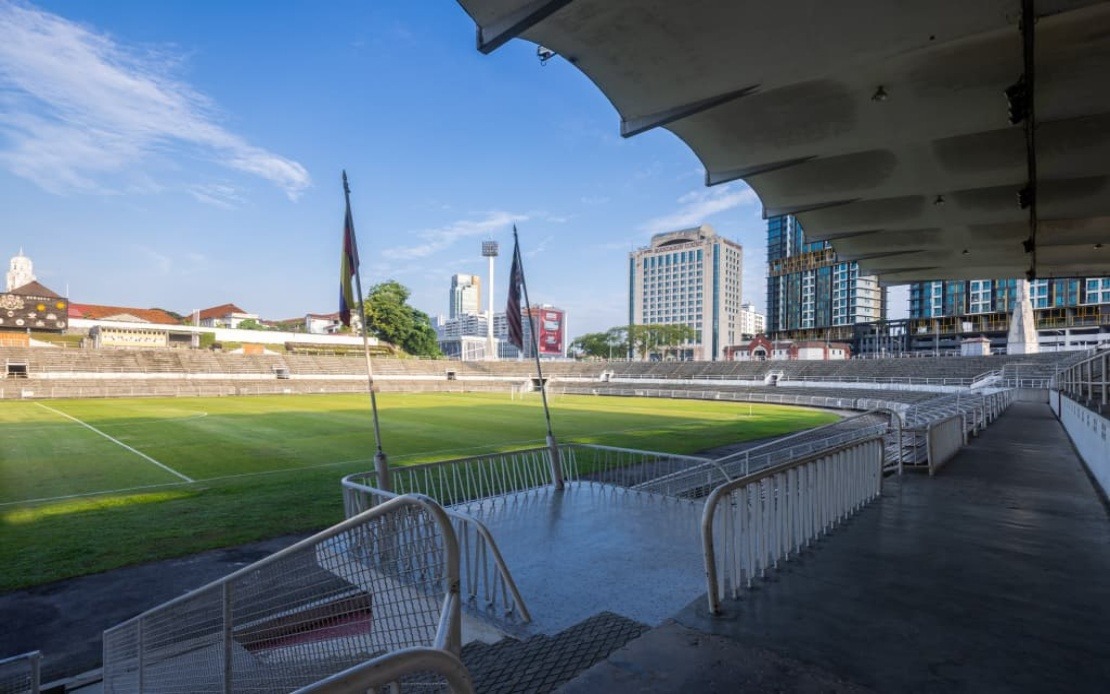
Standing in the shadow of Merdeka 118, Stadium Merdeka remains one of the nation's most potent historical anchors. Nearly seven decades have passed since Tunku Abdul Rahman Putra Al-Haj delivered the proclamation of independence within its walls on August 31, 1957, yet the venue continues to function as far more than a sports facility. It has evolved into a custodian of national memory, a physical space where Malaysians of all generations can touch and experience the moment their country was born.
The stadium's creation itself speaks to the ambition and urgency of the independence movement. Constructed in just twelve months at a cost of approximately RM2.3 million, it was purpose-built to serve as the stage for Malaya's defining moment. When Tunku Abdul Rahman issued his seven resounding cries of "Merdeka!", the venue transformed into hallowed ground, marking not merely the end of British colonial administration but the beginning of an autonomous nation's story. This single event in 1957 established the stadium's place in Malaysian consciousness, an achievement no amount of subsequent sports championships or cultural events could entirely overshadow.
Professor Dr Sarjit Singh Gill from Universiti Putra Malaysia's social anthropology department underscores the stadium's significance beyond its physical structure. As Chairman of the National Council of Professors' National Unity Cluster, Gill emphasises that Stadium Merdeka transcends its function as a sports venue to embody the nation's identity, dignity and cultural inheritance. The proclamation of independence represented not merely a change in political administration but the crystallisation of a people's aspirations and determination. The stadium, therefore, operates as a tangible reminder of these intangible qualities that define the Malaysian nation.
The venue's historical resonance continued to reverberate in the years following 1957. In 1963, Stadium Merdeka again served as the ceremonial stage when Malaysia was formally constituted as a federation, bringing Sabah and Sarawak into the political union and effectively terminating British colonial authority across the entire region. Though Singapore would later chart its own path, the proclamation ceremony within those walls represented the completion of a decolonisation process that transformed Southeast Asia's political landscape. This dual historical significance—hosting both the birth of Malaya and the birth of Malaysia—distinguishes Stadium Merdeka from countless other national monuments.
The venue's continued existence was far from guaranteed. During the late 1990s, developers and urban planners viewed the aging stadium as an obstacle to Kuala Lumpur's modernisation. The site faced genuine redevelopment threats that could have erased it from the landscape entirely. However, public opposition and government intervention prevented demolition, recognising that certain spaces possess value transcending commercial calculation. In 2000, Permodalan Nasional Berhad (PNB) assumed custodianship of the heritage site, undertaking the complex task of preservation while making the venue accessible and relevant to contemporary Malaysians.
Under PNB's stewardship through PNB Merdeka Ventures Sdn Bhd, the stadium has undergone meticulous restoration guided by original Public Works Department construction drawings. Rather than creating an artificial museum piece, the organisation has sought to authentically restore the venue to its original condition whilst enabling active use. Upper seating tiers added over the decades were removed to restore the original 20,000-seat capacity, and iconic features including the scoreboard, washroom facilities, decorative mosaic tiles and distinctive cantilevered roof were painstakingly restored to their original specifications. Chief Executive Officer Datuk Dr Izwan Ibrahim articulates the philosophy underlying this approach: authenticity matters because it maintains the stadium's integrity as a historical document and ensures that its stories remain genuinely accessible to Malaysians seeking connection to their national narrative.
Recognition of Stadium Merdeka's significance extends beyond Malaysia's borders. The venue received a UNESCO Asia-Pacific Heritage Award in 2008, validating its historical importance within a regional and global context. Domestically, its designation as a National Heritage site in 2009 provided institutional protection and acknowledgment of its irreplaceable value. These formal recognitions reinforce what Malaysians intuitively understand: that certain places possess spiritual and cultural weight that supersedes their material components.
The stadium's transformation from a venue hosting official ceremonies into a living community space represents a deliberate curatorial choice. Today it welcomes schools, universities and the general public, offering refurbished facilities for community athletics and hosting cultural events like the Bazram Merdeka bazaar during Ramadan, which attracted over 250,000 visitors earlier this year. This programming strategy intentionally demystifies the venue, positioning it not as a sealed historical artifact but as a living space where Malaysians actively create memories and understanding. For younger generations who never learned about 1957 except through textbooks, experiencing Stadium Merdeka firsthand transforms abstract historical knowledge into embodied understanding.
Much of the stadium's preservation reflects the dedication of individuals who have devoted their careers to the venue's maintenance. Alias Daud, who spent the final decade of his 35-year career with PNB specifically caring for Stadium Merdeka, articulates the emotional dimensions of heritage preservation work. For Daud, walking through the stadium's gates evokes simultaneous feelings of pride, gratitude and nostalgia, stemming from witnessing countless visitors from diverse backgrounds discovering and connecting with the site. He has observed how visitors—particularly younger ones—experience revelation when learning that this venue hosted independence's proclamation, often spending time reading plaques, photographing significant locations and absorbing the historical narrative embedded in its architecture and layout.
The stadium's role as an educational and commemorative space intensifies during the national month preceding August 31. Government agencies, schools and universities descend upon the venue to engage with its history firsthand, creating content and facilitating learning experiences that connect younger Malaysians to their national story. These annual rituals reinforce the stadium's function as a repository of collective memory, a space where the abstract concept of "nation" becomes concrete through physical presence and shared experience. Young people standing where Tunku Abdul Rahman proclaimed independence forge a different kind of understanding than those encountering the historical narrative solely through textbooks.
The architectural preservation of Stadium Merdeka must be understood within the context of Malaysia's rapid urban transformation. As modern skyscrapers including the towering Merdeka 118 rise around it, the stadium's modest structure maintains its presence through historical rather than physical prominence. This juxtaposition creates an unintended symbolism: the nation's commercial future rises around its historical foundation. The stadium's continued standing amidst contemporary development serves as a deliberate statement that certain things remain more valuable than optimal land use or maximum economic extraction. By preserving Stadium Merdeka, Malaysia affirms that some spaces transcend market logic.
The preservation and activation of Stadium Merdeka reflects broader questions about how nations maintain connection to foundational moments while simultaneously racing toward future aspirations. For Malaysia, the challenge involves ensuring that subsequent generations, increasingly distanced temporally from 1957, understand what independence meant and why it matters. Stadium Merdeka functions as the answer to this challenge—not through lectures or official pronouncements, but through the quiet power of place, through allowing Malaysians to literally stand where their nation began. As the country navigates complex contemporary challenges, the venue reminds citizens of what Malaysians have already achieved together and what determination and unity can accomplish.
The stadium's future preservation remains crucial precisely because historical memory requires active tending. Without deliberate effort, places lose their power to communicate and connect. Through its careful stewardship, PNB has demonstrated that heritage conservation is not about creating static museums but about enabling living engagement with history. Stadium Merdeka endures not because Malaysians worship the past, but because understanding how the nation emerged from colonialism remains essential to navigating its present and imagining its future.

