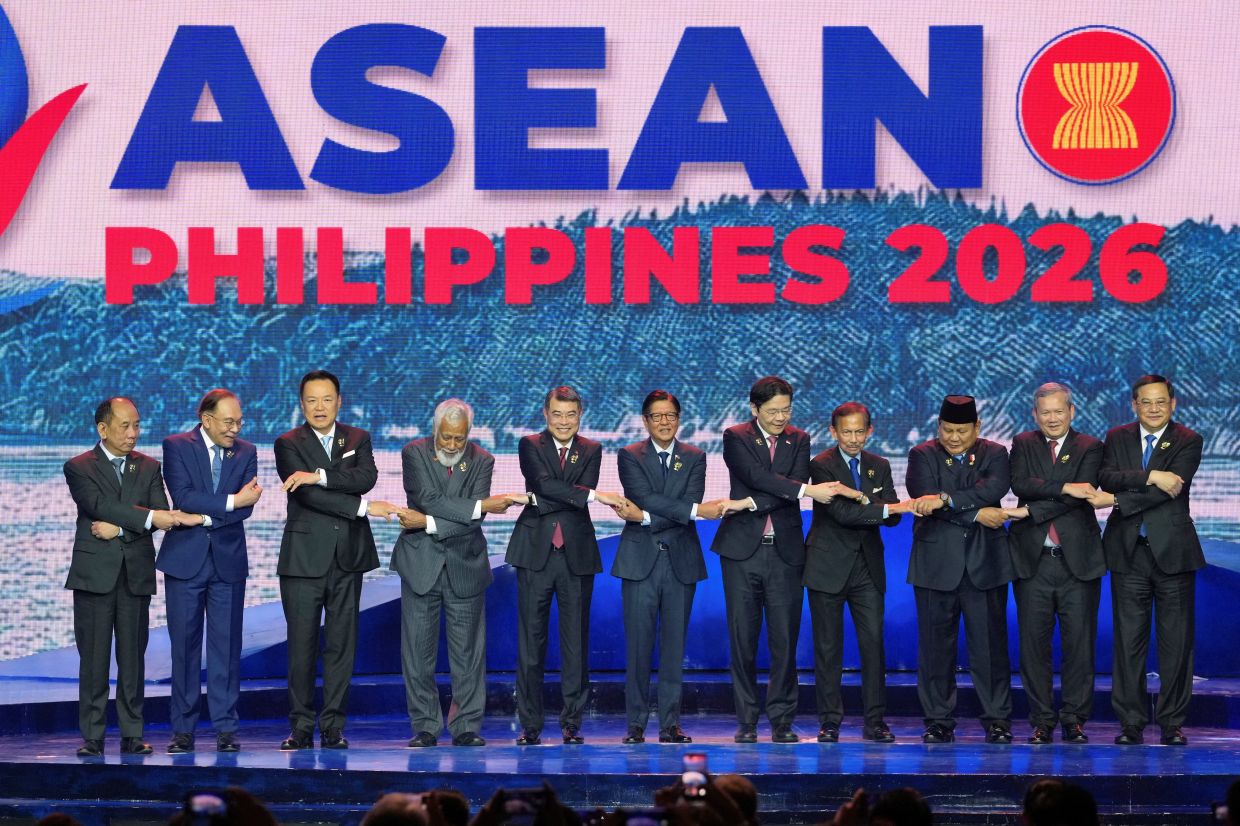
Southeast Asia's diplomatic establishment will assemble in the Philippine capital this week for a consequential gathering that underscores the region's precarious position between competing global powers and unresolved regional crises. The three-day meeting, led by ASEAN foreign ministers under the Philippines' current chairmanship of the 11-nation bloc, will draw heavyweight participants including U.S. Secretary of State Marco Rubio, Chinese Foreign Minister Wang Yi, Russian Foreign Minister Sergey Lavrov, and representatives from the European Union. The timing reflects mounting concerns about both external conflicts threatening the region's prosperity and internal strife that has stymied ASEAN's efforts at crisis management within its own borders.
At the forefront of discussions will be the escalating military confrontation between the United States and Iran, which has reverberated far beyond the Middle East to affect one of the world's most economically vital waterways. The Strait of Hormuz, through which roughly one-fifth of global petroleum supplies transit annually, has become a flashpoint once again as hostilities intensify. For a resource-scarce region like Southeast Asia, this development carries acute implications. The bloc's 680 million inhabitants depend substantially on Middle Eastern petroleum and natural gas imports, making any disruption to energy supplies a matter of immediate national security. The Philippines experienced this vulnerability firsthand when President Ferdinand Marcos Jr. declared a national energy emergency in March, a precautionary measure designed to safeguard fuel availability and prevent panic-driven hoarding that could destabilise prices for essential commodities.
Southeast Asian foreign ministers plan to issue a joint diplomatic statement expressing serious concern over the Middle East situation and calling for both American and Iranian leadership to pursue negotiated solutions rather than escalatory military actions. This represents a delicate balancing act for the region, which seeks to maintain constructive relationships with both Washington and Tehran while protecting its own economic interests. However, the crisis also highlights a deeper anxiety among Southeast Asian capitals: the possibility that Washington's military commitments and strategic focus may be diverted from the Indo-Pacific, potentially leaving regional powers including China with greater latitude to pursue their territorial ambitions without adequate American counter-balancing.
Rubio's attendance in Manila carries symbolic weight precisely because it aims to reassure Southeast Asian partners that the Trump administration remains committed to Asia-Pacific security despite Middle Eastern preoccupations. The U.S. State Department has characterised the visit as advancing Washington's priority of maintaining "a free and open Indo-Pacific," a formulation that carries obvious implications for Chinese actions in disputed waters and Beijing's posture toward Taiwan. Rubio has indicated openness to meeting with Wang Yi, though logistics remain unconfirmed, signalling that despite recent tensions between Washington and Beijing, both capitals recognise the importance of maintaining diplomatic channels. The secretary of state has acknowledged that friction between major powers is inevitable, but has emphasised that dialogue and sustained engagement remain essential.
The question of whether Rubio will raise allegations about Chinese interference in the 2020 U.S. presidential election remains unresolved, and his position that Chinese leader Xi Jinping may visit America in September suggests that bilateral relations, while strained, have not completely derailed diplomatic progress. On the sidelines of the Manila talks, Rubio is expected to convene with fellow members of the Quad alliance—comprising the United States, India, Japan and Australia—a grouping explicitly designed to counterbalance Beijing's rising influence and repeatedly criticised by China as a containment mechanism. The Quad's prominence in American strategic planning underscores Washington's determination to maintain Asian partnership networks even as it manages Middle Eastern crises.
Within the ASEAN framework itself, however, the bloc faces considerable pressure to demonstrate progress on regional conflicts that have proven remarkably resistant to diplomatic resolution. Myanmar remains the most pressing example of ASEAN's limited capacity to enforce its own collective decisions. Since the military coup in February 2021 that ousted Aung San Suu Kyi's democratically elected government, more than 8,100 people have lost their lives in the ensuing armed conflict, with nearly 22,500 individuals languishing in detention according to the Assistance Association for Political Prisoners, a respected human rights monitoring organisation. A five-point peace framework that ASEAN leaders promulgated in 2021 has essentially stalled, undermined primarily by the Myanmar junta's systematic non-compliance and apparent indifference to international pressure.
Frustrated by this impasse, ASEAN initially imposed symbolic penalties, including banning Myanmar's military leaders from attendance at the bloc's most senior-level forums. Yet this resolve has begun to fracture, most evidently when Philippine Foreign Secretary Theresa Lazaro—serving as ASEAN's special envoy on Myanmar—met with Myanmar Foreign Minister Tin Maung Swe in Bangkok this month, marking the first such engagement in five years. Lazaro and Thai Foreign Minister Sihasak Phuangketkeow subsequently consulted with representatives of ethnic armed groups in the Thai resort city of Pattaya, attempting to revitalise dialogue among competing factions within Myanmar's fractured polity. Lazaro has defended these moves as consistent with the five-point consensus and necessary for diplomacy to advance, arguing that meaningful progress toward peace requires engagement with all parties including the military-dominated government.
Human rights advocates and pro-democracy groups have sharply contested this interpretation, viewing the decision to meet Myanmar's senior officials as a pragmatic capitulation that effectively nullifies ASEAN's earlier sanctions without extracting any substantive concessions from the junta regarding violence reduction or political transition. This criticism highlights a fundamental structural weakness in ASEAN decision-making: the bloc's consensus-based approach and commitment to non-interference in member states' internal affairs provide cover for autocratic governments to ignore collective pressure. The Myanmar situation exemplifies how ASEAN's institutional constraints can reduce its effectiveness as a conflict-resolution mechanism, particularly when one member state is determined to resist external pressure and when no ASEAN member possesses sufficient leverage to enforce compliance unilaterally.
Equally contentious is the protracted dispute over the South China Sea, which will feature prominently during Rubio's discussions with Wang and the broader ASEAN ministerial agenda. The territorial disagreements involve China, Taiwan, and several ASEAN members—specifically Brunei, Malaysia, the Philippines, and Vietnam—each asserting overlapping maritime claims in waters of extraordinary strategic and economic significance. The Philippines and China have experienced particularly acute friction, with multiple confrontations between coast guard vessels and naval assets occurring in recent years, raising the risk of accidental escalation into armed conflict. The two countries have clashed repeatedly over features including Scarborough Shoal and Second Thomas Shoal, incidents that have occasionally resulted in damaged vessels and injured personnel, though fortunately not yet in outright warfare.
An ASEAN-China "code of conduct" has been under negotiation for years, ostensibly designed to establish rules of engagement that would reduce the possibility of miscalculation and provide mechanisms for peaceful dispute resolution. Progress has been glacial, however, as competing interpretations of international law, different assessments of maritime boundary entitlements, and broader geopolitical rivalries have repeatedly stalled negotiations. The Foreign Minister Wang will participate in discussions about this code of conduct during the Manila meetings, yet expectations for breakthrough outcomes remain subdued. China's construction of artificial islands, deployment of military infrastructure in disputed areas, and increasingly assertive coast guard operations suggest that Beijing views the status quo as advantageous and may lack incentive to accept constraints that would reduce its operational flexibility or validate competing claimants' territorial assertions.
For Malaysia and other Southeast Asian nations heavily dependent on South China Sea trade routes and fisheries resources, the absence of an effective code of conduct represents a chronic vulnerability. An estimated one-third of global maritime commerce transits these waters, and disruption resulting from military escalation would carry catastrophic implications for supply chains and economies throughout the region. The concurrent crises in Myanmar and the Middle East illustrate how external and internal shocks can compound one another, straining ASEAN's institutional capacity and limiting member states' ability to coordinate responses. The Manila ministerial therefore represents both an opportunity for the bloc to demonstrate renewed commitment to managing regional tensions and a test of whether ASEAN's traditional diplomatic tools remain sufficient for addressing twenty-first century security challenges.

