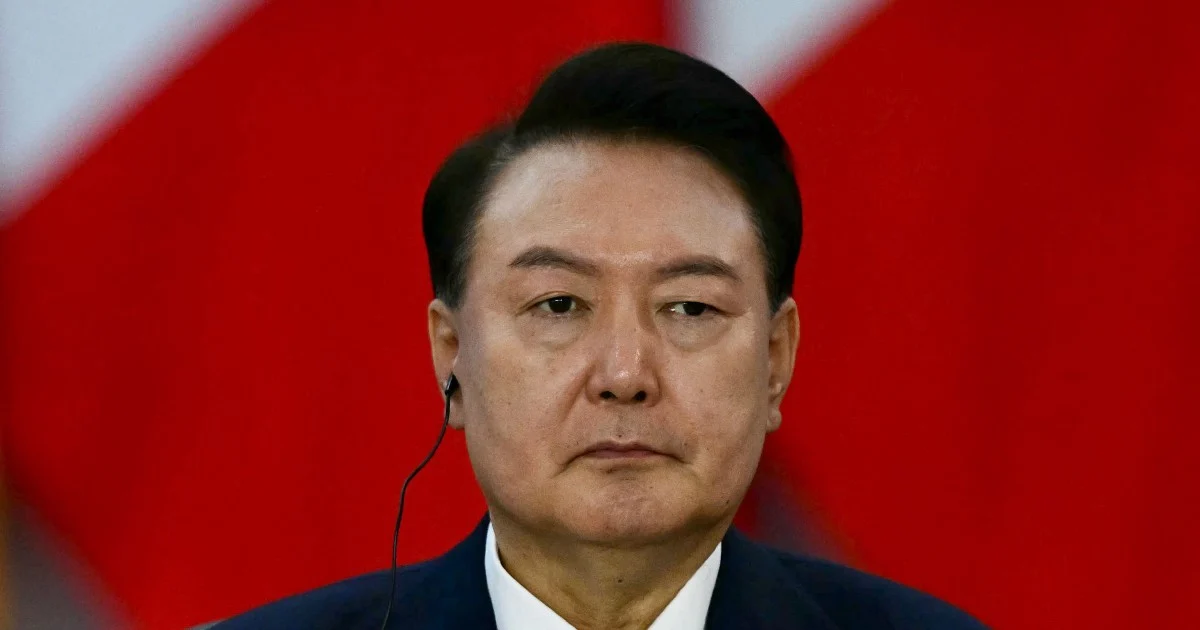
South Korea's Constitutional Court is preparing to deliver a critical verdict on Thursday concerning former president Yoon Suk Yeol's sweeping martial law declaration, marking a watershed moment for the nation's legal system and democratic institutions. The case against Yoon centres on his decision to impose martial law in December 2024, an extraordinary measure that triggered widespread chaos and constitutional upheaval before being swiftly overturned by lawmakers. The forthcoming judgment will determine whether Yoon faces impeachment and potential removal from office, fundamentally shaping South Korea's political trajectory in the months ahead.
Yoon's martial law declaration represents one of the most dramatic political crises in South Korea's recent democratic history. The measure, announced in a televised address late at night, shocked the nation and drew immediate backlash from opposition parties, civil society, and international observers who viewed it as a threat to constitutional governance. Within hours, parliament convened to vote down the declaration, demonstrating the resilience of South Korea's institutional checks and balances despite the executive's unilateral action. However, the rapid mobilization to reverse the decree masked deeper questions about Yoon's motivations, the circumstances leading to his decision, and his accountability for the disruption caused.
The charges against Yoon encompass multiple alleged violations stemming from the martial law episode and its disorderly resolution. Prosecutors have accused him of overstepping his constitutional authority by declaring martial law without sufficient justification, acting in a manner that threatened the nation's democratic order. Beyond the declaration itself, investigators have scrutinized Yoon's conduct during the chaotic aftermath, including allegations related to military movements and potential obstruction during the legislative response. These compound charges suggest prosecutors view the incident as more than a momentary lapse in judgment, but rather as a deliberate and calculated act with serious implications for presidential power.
The Constitutional Court's deliberation has attracted enormous public attention and international scrutiny. For Malaysian and Southeast Asian observers, the proceedings offer insights into how established democracies manage executive overreach and protect constitutional safeguards when leaders challenge institutional norms. South Korea's institutional response—through parliamentary action, judicial review, and public accountability mechanisms—contrasts sharply with scenarios in neighbouring regions where similar power grabs might encounter weaker resistance. The court's ruling will test whether constitutional democracies can effectively constrain executive authority when a sitting or recently departed leader attempts to consolidate power through emergency measures.
Yoon's political standing has deteriorated significantly since December 2024. His approval ratings have plummeted amid public anger over the instability his actions precipitated. The martial law declaration exacerbated existing tensions between Yoon's administration and the opposition-controlled parliament, creating a gridlock that has hampered routine governance. Economic concerns, combined with the constitutional crisis, have shifted South Korea's political atmosphere substantially. Citizens across the political spectrum have grappled with questions about legitimate authority, the bounds of presidential power, and whether the constitutional framework adequately protects democratic norms.
The case reflects broader tensions within South Korean society regarding governance and leadership. Yoon's supporters contend that the martial law declaration, though misguided, represented an attempt to bypass parliamentary obstruction and address governance challenges. Critics argue that regardless of Yoon's intentions, circumventing democratic procedures through emergency declarations sets a dangerous precedent that undermines constitutional rule. The Constitutional Court must navigate this ideological divide while interpreting the constitution's provisions on emergency powers and presidential authority.
For the broader Asia-Pacific region, South Korea's handling of this crisis carries instructive significance. The case demonstrates how institutional checks, media freedoms, and an independent judiciary can restrain executive power even when leaders possess substantial formal authority. Unlike some neighbouring democracies where such declarations might persist unchallenged, South Korea's parliament, courts, and public mobilized quickly to contain the threat. However, the very occurrence of the martial law attempt also reveals vulnerabilities in how constitutions can be tested by determined leaders.
The Constitutional Court's verdict will carry profound implications for South Korea's political culture and institutional development. A ruling against Yoon would affirm the judiciary's role as guarantor of constitutional limits and demonstrate that even high-ranking officials face accountability. Conversely, any perceived leniency could embolden future challenges to democratic norms. The court's reasoning will likewise influence how other democracies interpret emergency powers and presidential authority in their own constitutional frameworks.
Beyond immediate political consequences, this case will shape South Korea's approach to presidential accountability, separation of powers, and the protection of democratic institutions. The verdict will establish important precedent regarding what constitutes impermissible executive action and how courts should respond when leaders attempt to invoke emergency powers to overcome parliamentary opposition. For a nation that transitioned from authoritarianism to democracy only decades ago, the court's judgment affirms that institutional safeguards and rule of law remain central to national governance and that no individual, regardless of rank, stands above constitutional constraints.

