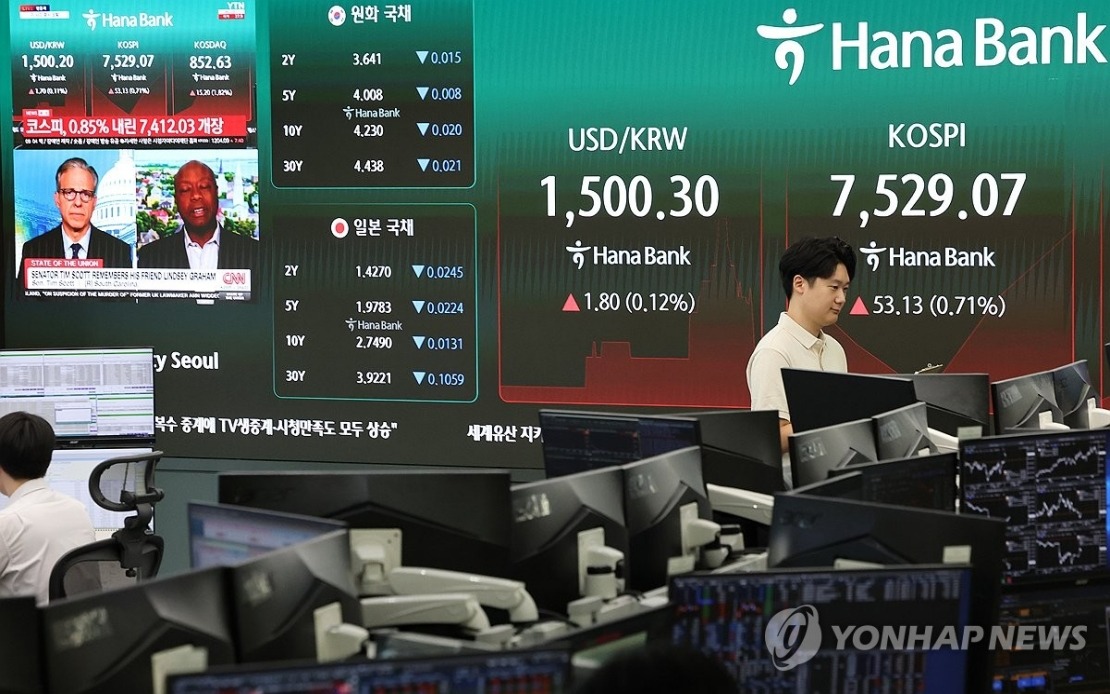
South Korea's stock market experienced significant turbulence on Monday when the Korea Exchange activated an emergency circuit breaker mechanism, bringing trading to a temporary standstill as the benchmark Korea Composite Stock Price Index tumbled in response to renewed geopolitical tensions in the Middle East. The trading halt lasted 20 minutes, providing a pause for market participants to reassess their positions amid the volatile conditions affecting sentiment across the broader region.
The circuit breaker was triggered at approximately 1:28 p.m. local time after the KOSPI fell more than 8 percent from the previous trading session's closing level. This automatic suspension mechanism serves as a critical safeguard designed to prevent panic selling and allow investors time to process significant price movements before resuming normal market operations. The activation underscores how quickly external shocks can reverberate through financial markets, even those geographically distant from the source of conflict.
The underlying cause of the market's sharp decline centred on fresh military confrontations between the United States and Iran, with disputes centring on control and freedom of navigation through the strategically vital Strait of Hormuz. This waterway represents one of the world's most critical energy chokepoints, through which approximately one-third of global seaborne oil passes daily. Any disruption to shipping through these waters carries immediate implications for energy prices and broader economic stability throughout Asia, where nations including South Korea depend heavily on Middle Eastern oil imports.
Investor caution intensified as fears mounted regarding potential supply chain disruptions and oil price volatility. South Korea, as the world's fifth-largest petroleum importer and a major petrochemical producer, faces particular exposure to energy price fluctuations originating from Middle Eastern supply shocks. The Korean manufacturing sector, which remains the backbone of the nation's export economy, stands vulnerable to sudden increases in input costs, making geopolitical developments in West Asia directly consequential for local business confidence.
The frequency of circuit breaker activations in recent months provides telling evidence of elevated market fragility and investor anxiety. The Monday occurrence marked the seventh instance this year that the KRX has been compelled to implement the protective mechanism. This repetition suggests that South Korean equities have experienced persistent bouts of acute selling pressure throughout 2024, driven by various macroeconomic concerns ranging from interest rate expectations to global trade tensions and now geopolitical escalation in strategically sensitive regions.
For Malaysian observers and investors, the KOSPI's volatility carries material significance. The Malaysian stock exchange maintains substantial exposure to South Korean companies through cross-regional investment flows, and broader Asian equity indices move in tandem during periods of systemic risk. The circuit breaker activation in Seoul serves as an early warning indicator that regional risk appetite may deteriorate further, potentially affecting pricing across Southeast Asian bourses. Malaysian export-oriented companies dependent on regional supply chains also face indirect consequences if South Korean manufacturing activity contracts amid market instability.
The psychological impact of market halts extends beyond the immediate trading suspension. Circuit breakers, while intended to restore order, can intensify investor anxiety by visibly confirming that price movements have exceeded normal parameters. This visibility may amplify rather than dampen selling pressure once trading resumes, particularly when underlying concerns—such as geopolitical hostilities—remain unresolved. The prolonged uncertainty surrounding US-Iran relations means that Korean investors lack reassurance that conditions will stabilise shortly, potentially encouraging them to maintain defensive positioning.
The resilience of South Korea's financial markets will depend partly on whether the geopolitical situation stabilises and partly on broader macroeconomic conditions. The nation's central bank faces a delicate balancing act between managing inflation expectations and providing support to equities through accommodative monetary policy. Any perception that interest rates will remain elevated to combat inflation could sustain downward pressure on equity valuations, particularly among growth-sensitive stocks that dominate the KOSPI composition.
Regional policymakers across Southeast Asia are likely monitoring developments in Korea closely, recognising that contagion effects from major Asian economies can rapidly transmit to smaller neighbours. Malaysia's Bursa Malaysia, while generally resilient, could experience knock-on volatility if broader regional risk sentiment deteriorates further. Institutional investors managing cross-border portfolios typically adjust allocations across Asia as a single region, meaning distress in Seoul may prompt reallocation away from other emerging Asian markets including Malaysia.
The incident underscores the complex interconnections characterising modern financial markets, where geopolitical events thousands of kilometres away can trigger automatic trading halts and portfolio rebalancing across the region within hours. For Malaysian investors and policymakers, the message is clear: regional stability remains intimately linked to developments in distant theatres, and energy security concerns in the Middle East translate directly into financial market consequences affecting household savings and corporate investment decisions across Southeast Asia. Vigilance regarding evolving Middle Eastern dynamics remains essential for understanding near-term equity market trajectories throughout the region.

