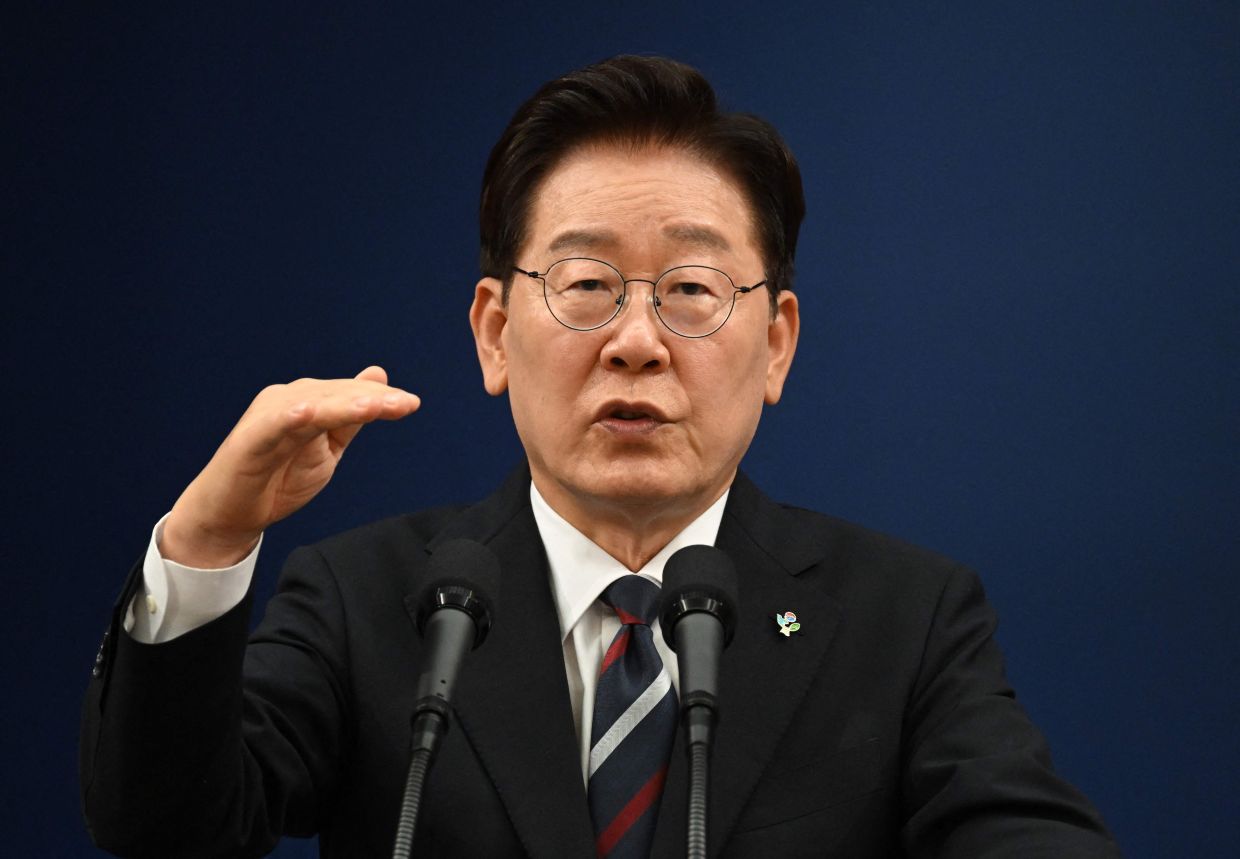
South Korean President Lee Jae Myung is confronting an unprecedented political challenge after his approval rating collapsed to 46.7 per cent in a poll released on June 22, marking the first occasion since his inauguration on June 4, 2025, that negative evaluations have surpassed his supporters. The Realmeter survey reveals that disapproval now stands at 49.7 per cent, a striking reversal that underscores deepening public discontent with his leadership during the critical early months of his presidency.
The deterioration in presidential support has been relentless and unambiguous. Over a five-week span, Lee's approval rating plummeted by more than thirteen percentage points, tumbling from 60.5 per cent in mid-May to its current nadir. The weekly descent—tracking through 59.3 per cent, 59.1 per cent, and 55.2 per cent—demonstrates consistent erosion rather than fluctuation, suggesting fundamental shifts in public sentiment rather than temporary reactions to isolated events. The trajectory is particularly damaging because it began immediately after his European diplomatic tour, which analysts had expected to bolster his standing through positive international engagement.
Two major domestic crises have catalysed this collapse in confidence. The ballot shortage that plagued South Korea's June 3 local elections triggered widespread public anger and demands for accountability, with ongoing debates centring on whether a complete rerun should occur and whether early voting should be abolished. Simultaneously, the ruling Democratic Party of Korea is fractured over its leadership succession, with an internal power struggle intensifying ahead of the August 17 convention to elect a new party chair. This combination of electoral mismanagement and partisan infighting has created a toxic political environment that extends beyond the President himself, undermining public trust in governmental competence and institutional integrity.
When contextualised against recent South Korean presidential history, Lee's decline appears startlingly swift. His predecessor Yoon Suk Yeol did not experience disapproval exceeding approval until June 2022, six weeks into his term—a timeline matching Lee's predicament. However, previous presidents deteriorated more gradually: former President Park Geun-hye required approximately sixteen months to reach this threshold in June 2014, while former President Moon Jae-in took roughly nineteen months to face equivalent disapproval in December 2018. Lee's rapid descent therefore represents a distinctive pattern, suggesting either heightened public expectations for presidential performance or deeper structural dissatisfaction with governance.
The geographic distribution of Lee's approval collapse reveals substantial regional variation that carries implications for his political coalition. His rating fell most steeply in the conservative strongholds of Daegu and North Gyeongsang Province, plummeting 9.9 percentage points to merely 34.6 per cent—a troubling development for a conservative president in traditionally supportive territories. Greater Seoul, encompassing Seoul itself, Incheon, and Gyeonggi Province, also witnessed sharp declines, with ratings dropping 7.6 percentage points in both Incheon and Gyeonggi Province to 44.8 per cent, and in Seoul to 39.8 per cent. This erosion among metropolitan moderate and conservative voters suggests that Lee's coalition is fragmenting across multiple constituencies simultaneously.
Demographic analysis of ideological support patterns reinforces this picture of broad-based deterioration. Moderate voters, typically a pivotal swing constituency, experienced a 4.9 percentage point decline in approval to 47.5 per cent—a significant movement given their traditional role as kingmakers in South Korean elections. Even among liberals, where Lee maintains his strongest support at 80.4 per cent, backing slipped 3.2 percentage points, indicating that his natural base is not immune to erosion. Conservatives, who have shown the most resistance to abandoning him, lost only 0.7 percentage point, settling at 19.8 per cent, but this modest decline masks the severity of the drop in conservative regions, suggesting that Lee's remaining conservative support is geographically concentrated and potentially fragile.
The presidential office responded with studied humility, acknowledging the results without explicitly accepting responsibility. In a statement from Cheong Wa Dae, officials framed the approval fluctuations as reflections of public assessment of both economic conditions and governance broadly, pledging to listen more carefully to public concerns and expectations. This carefully calibrated response avoided defensiveness while signalling openness to course correction, a tactical choice that may be designed to buy time while the administration recalibrates its political strategy and awaits developments in the ongoing electoral administration investigation.
Beyond presidential approval, the Realmeter survey identified shifting party support dynamics that suggest a complex realignment. The ruling Democratic Party of Korea gained 2.1 percentage points to reach 40.1 per cent support, while the main opposition People Power Party declined 2 percentage points to 42.3 per cent. Notably, the Democratic Party's recovery occurred despite internal factional tensions, apparently benefiting from public perception that the party was managing the electoral crisis responsibly through a bipartisan agreement to investigate the ballot shortage. This counterintuitive finding—that a ruling party facing governance failures could improve its standing—indicates that South Korean voters may be rewarding cross-party cooperation and accountability measures over partisan blame-shifting.
The People Power Party's position, however, proves more precarious than aggregate numbers suggest. The conservative opposition faces mounting internal pressures from disputes over leadership resignation alongside persistent controversies surrounding the election administration fiasco. Among younger voters, the party experienced catastrophic declines: support among those in their twenties fell 10.5 percentage points to 48.6 per cent, while support among those in their thirties dropped 5.1 percentage points to 47.4 per cent. This exodus of young voters from the conservative camp represents a long-term threat to the party's demographic viability and suggests that the election mismanagement has permanently damaged the ruling coalition's appeal to generationally important constituencies.
For Southeast Asian observers, Lee's predicament illuminates broader patterns in democratic governance. The rapidity with which public confidence can evaporate when institutional failures occur—particularly in electoral administration, which sits at democracy's foundation—demonstrates the fragility of presidential legitimacy even in established democracies with sophisticated institutional frameworks. Lee's case further underscores how administrative crises can exploit and exacerbate existing partisan divisions, creating compounding legitimacy challenges that extend beyond any single policy domain. The convergence of electoral mismanagement and party succession battles has created a perfect storm that his administration appears poorly equipped to weather.
The polling data also reflects a concerning trend regarding asset market inequality. Realmeter identified widening disparities in the asset market as eroding support among moderate voters and Greater Seoul residents, even as the Kospi index achieved the positive milestone of breaching the 9,000-point mark. This disconnect between headline economic indicators and household perceptions of economic fairness suggests that headline growth metrics no longer sufficiently reassure voters about their economic prospects or social mobility. For a newly inaugurated president, this represents a substantial challenge, as economic management typically forms a crucial foundation for presidential legitimacy during early tenure.
As Lee navigates this unprecedented approval crisis, the political calendar offers little respite. The Democratic Party's August 17 leadership convention will occur while his approval remains underwater, potentially intensifying factional conflicts or alternatively producing leadership changes that could reshape the political landscape. Meanwhile, the National Assembly investigation into election administration failures will continue generating negative headlines and demands for accountability. The President's capacity to stabilise his approval rating will likely depend on whether his administration can demonstrate rapid, effective responses to public concerns while the party manages its succession struggle without additional internal explosions that deepen public cynicism about governmental competence.