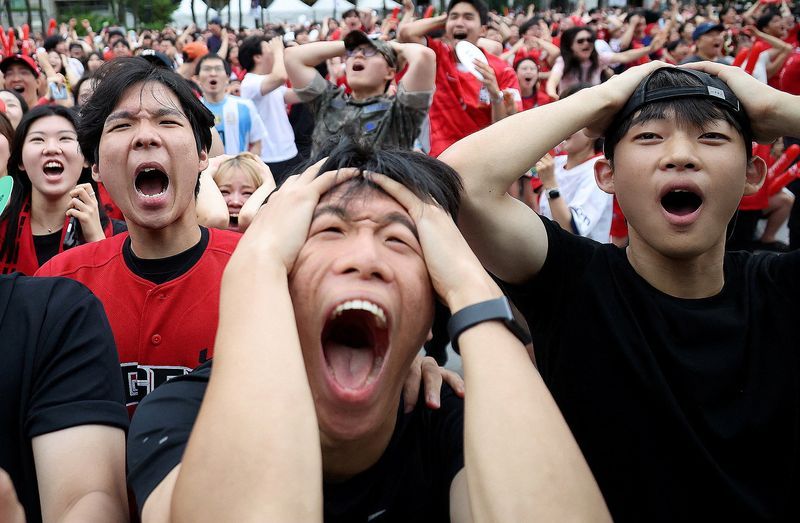
South Korean President Lee Jae Myung has launched an extraordinary political assault on his country's football establishment following the national team's shock early elimination from the World Cup, demanding a formal investigation by the Ministry of Culture, Sports and Tourism into what he characterised as systemic failures in personnel management. The president's pointed criticism, delivered via social media on Sunday, represents an unusually direct intervention by a sitting head of state into sporting affairs and signals growing public anger over a result that has left the nation bewildered.
The scale of South Korea's disappointment cannot be overstated in a country where football occupies an outsized cultural and emotional significance. The team's failure to progress from Group A, despite being widely positioned as strong contenders to advance from what many considered a relatively manageable pool of opponents, defied expert predictions and public expectations. Successive defeats to Mexico and South Africa relegated the Koreans to third place in their group, leaving them outside the cluster of eight best-performing third-placed teams eligible for the knockout stage—a mathematically cruel elimination that only compounded the sting of the underperformance.
President Lee's intervention zeroed in on national team coach Hong Myung-bo, framing the manager's reappointment in 2024 as emblematic of broader governance failures that prioritise factional loyalty over demonstrated capability. The president articulated a sweeping critique of what he termed the prevalence of "us versus them" thinking in institutional decision-making, arguing that when organisational appointments become vehicles for rewarding preferred groups rather than selecting the most competent individuals, the consequences become inevitable and predictable. This framing moves beyond mere sports commentary to touch on what Lee portrayed as a fundamental rot in how Korean institutions function.
The controversy surrounding Hong's hiring had already generated substantial scepticism within Korean media circles and among sports observers, with critical reporting suggesting the appointment process lacked transparency and potentially reflected factional considerations rather than objective assessment of managerial credentials. Hong has consistently denied allegations of impropriety, yet the appointment continues to attract scrutiny from segments of Korean civil society. The accumulation of these criticisms, combined with the team's catastrophic on-field performance, has created a perfect storm of political and sporting discontent.
The public response has evolved beyond typical post-tournament recriminations. A petition circulating through South Korea's national assembly website demanding Hong's dismissal rapidly accumulated sufficient signatures to trigger an initial formal review process, indicating that the calls for accountability resonate across significant portions of the electorate. More colourfully, social media has been saturated with images of South Korean shopkeepers displaying notices explicitly banning the coach from their establishments—a form of grassroots shaming that, while humorous in presentation, reflects genuine public frustration.
President Lee's statement went beyond personalised attacks on Hong to articulate a systemic indictment of how decision-making authority operates in Korean institutions when oversight mechanisms prove inadequate. The president observed that such "botched appointments" become possible precisely because monitoring and accountability structures remain weak or ineffective, allowing those with hiring power to act without sufficient scrutiny. This analysis suggests that for Lee, the football team's failure represents a visible symptom of deeper institutional pathologies that extend well beyond sport into how Korean governance functions more broadly.
The demand for a ministry-led investigation signals that the administration intends to move beyond rhetorical criticism toward formal institutional action. Such an investigation would presumably examine the procedures surrounding Hong's appointment, evaluate the selection criteria against actual qualifications, and attempt to establish whether the hiring process deviated from established norms. The investigation also provides political cover for potential subsequent actions, whether those involve management changes, procedural reforms, or broader accountability measures.
For Malaysian and regional observers, this episode illuminates the high stakes surrounding national football performance in East Asian societies and the intersection between sporting outcomes and political legitimacy. While Malaysia has experienced its own cycles of football success and disappointment, the intensity of South Korea's governmental response reflects how deeply football penetrates the national consciousness in that country. The case also demonstrates how sports failures can become focal points for broader critiques of institutional competence and governance standards.
The episode underscores another significant dynamic: the vulnerability of technical specialists and administrators to political pressure when on-field results disappoint. Coach Hong, regardless of the actual merits of his appointment or his tactical decisions, now operates in an environment where his professional viability has been publicly questioned by the nation's highest elected official. This creates obvious pressures that extend beyond normal coaching challenges and suggests the path forward remains fraught with political as well as sporting complications.

