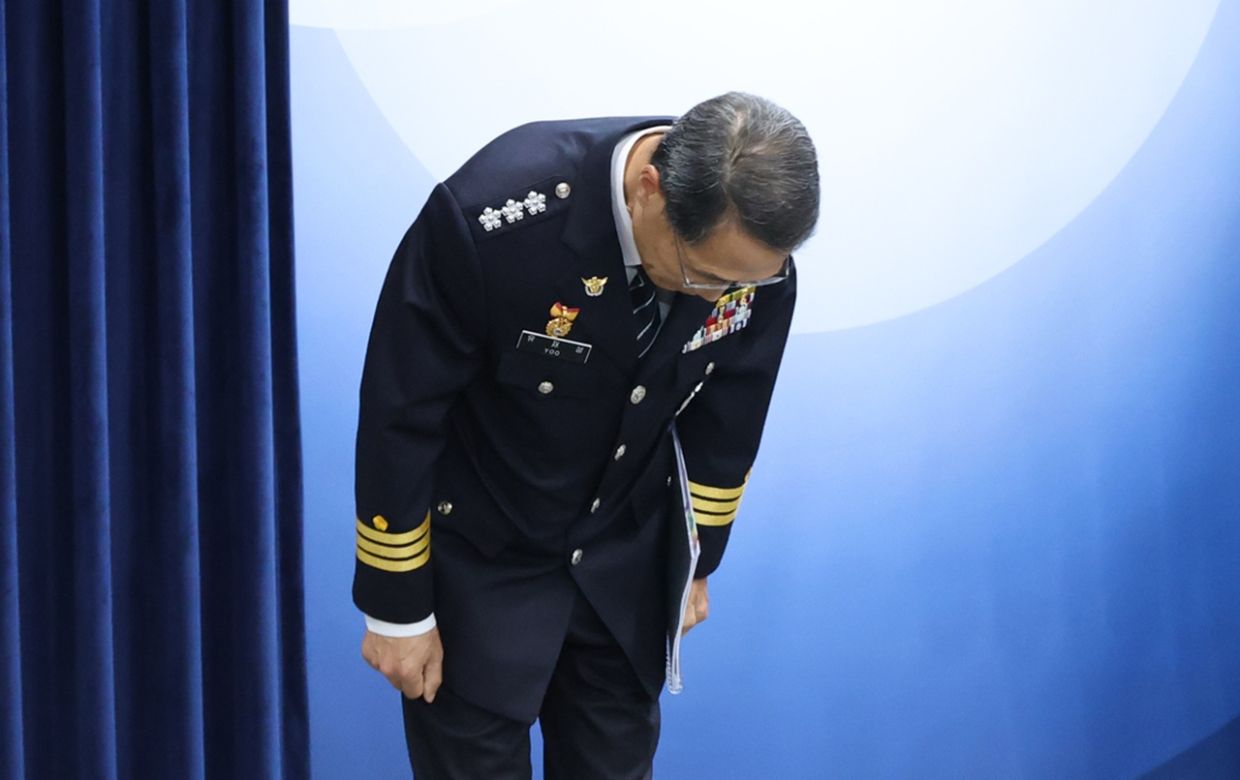
South Korea's police force faces a critical reckoning as its acting leadership moves to contain a deepening collusion scandal. During a press briefing at the Government Complex Seoul on Monday, Acting National Police Agency Commissioner General Yoo Jae-sung outlined an ambitious reform agenda designed to address widespread public anger over allegations that officers leaked investigation details and destroyed evidence in a high-profile murder case. The announcement comes as pressure mounts for senior officials to accept responsibility for institutional failures that have severely damaged public confidence in law enforcement.
The scandal centres on the investigation into Jang Yoon-gi, a suspect arrested for allegedly murdering a teenage girl in Gwangju in May. Investigators stand accused of providing confidential information to Jang's father, a serving police officer, while simultaneously failing to preserve crucial evidence. These allegations suggest a troubling pattern of preferential treatment and internal loyalty superseding investigative integrity—revelations that have triggered intense criticism of how the National Police Agency conducts sensitive investigations and manages conflicts of interest within its ranks.
Yoo pledged to transform how the police conduct investigations, framing the scandal as a catalyst for meaningful institutional change rather than merely a public relations exercise. In his statement, he committed the agency to regaining public trust through systematic overhaul of investigative practices and acknowledged the urgency of the moment. When pressed on whether he would resign amid calls for senior officials to step down, Yoo indicated he would remain focused on his duties without being driven by self-preservation—a measured response that suggested the government intends to demonstrate reform through action rather than symbolic gestures alone.
The reform programme includes establishing an investigative task force by the end of July, comprising seven to ten members with external experts forming the majority. This body will examine personnel policies designed to sever inappropriate relationships between officers and their communities, alongside procedural improvements for cases involving vulnerable populations. The emphasis on outside experts reflects recognition that internal-only reform efforts lack credibility and that independent oversight is essential to rebuilding institutional legitimacy.
Beyond the task force, the police are creating a dedicated internal affairs investigation unit under the National Office of Investigation. This unit represents a structural attempt to address systemic accountability gaps by investigating serious duty-related crimes committed by police personnel regardless of rank. The proposed measure signals an intention to move beyond the historical practice where senior officers received preferential treatment or avoided scrutiny—a shift that could fundamentally alter how the force polices itself.
Yoo also outlined plans for a new oversight body operating under the Korean National Police Commission, comprised of approximately one hundred civilian investigators tasked with examining alleged human rights violations and misconduct within police operations. Establishing this body requires amendments to the Police Act, with relevant legislation already submitted to the National Assembly. This dimension of the reform reveals Seoul's willingness to subject police conduct to civilian scrutiny—a governance approach that acknowledges the limits of self-regulation and the necessity of external democratic accountability.
For observers across Southeast Asia, particularly in Malaysia where public trust in law enforcement remains a sensitive issue, South Korea's response offers both lessons and cautionary insights. The Korean approach emphasizes institutional restructuring, external oversight, and procedural transparency as mechanisms for restoring confidence. However, the willingness of political leadership to impose significant constraints on police autonomy also reflects the severity of public backlash and the recognition that maintaining institutional legitimacy sometimes requires ceding operational authority to civilian bodies.
Another significant element of the reform package addresses the police rotation system, which currently applies to superintendent-level officers and some senior inspectors. The Interior Ministry has proposed expanding this rotation requirement across all ranks to prevent entrenched relationships between officers and local communities. However, Yoo cautioned that universal rotation presents practical challenges, including questions of fairness regarding housing allowances and the logistical costs of relocating lower-ranking personnel. This tension between reform ambition and operational feasibility suggests that even well-intentioned institutional changes must navigate real constraints.
The police commissioner indicated that rather than imposing sweeping rotation mandates immediately, the agency would gather input from rank-and-file officers before finalizing any expansion of the system. Support measures would accompany any rotation policy to mitigate hardship on officers and their families. This consultative approach recognizes that reform initiatives lacking frontline acceptance may generate internal resistance, potentially undermining their effectiveness. For a police force already facing public criticism, deteriorating morale among officers could complicate efforts to rebuild institutional performance and public trust simultaneously.
Regarding Jang's father, whose position as a serving officer created obvious conflicts of interest, Yoo stated that the police would await findings from the special investigation team before concluding their internal inspection and determining follow-up actions. This decision to defer final judgment pending independent investigation suggests the leadership is attempting to demonstrate impartiality and avoid appearance of internal favoritism—a strategic choice that acknowledges how specific personnel decisions would be interpreted in the context of broader collusion allegations.
The comprehensiveness of South Korea's announced reforms indicates official recognition that public confidence cannot be restored through superficial measures or isolated personnel changes. By proposing structural reforms that include civilian oversight, external expert involvement, and independent investigation of police misconduct, Seoul's leadership is signalling that institutional legitimacy requires genuine power-sharing with democratic oversight bodies. Whether these reforms succeed in fundamentally transforming police culture and practices will depend on rigorous implementation, sustained political support for measures that constrain police autonomy, and genuine acceptance by rank-and-file officers of new accountability frameworks.
For Malaysia and other regional democracies where questions about police integrity periodically surface, South Korea's experience underscores how collusion scandals can precipitate comprehensive institutional reform. The Korean case demonstrates that restoring public confidence typically requires not merely punishing individual wrongdoers but restructuring the systems and incentive structures that enabled misconduct in the first place. Whether Seoul's ambitious reform agenda ultimately succeeds will provide valuable evidence about the conditions necessary for police forces to rebuild institutional legitimacy in contemporary democracies.

